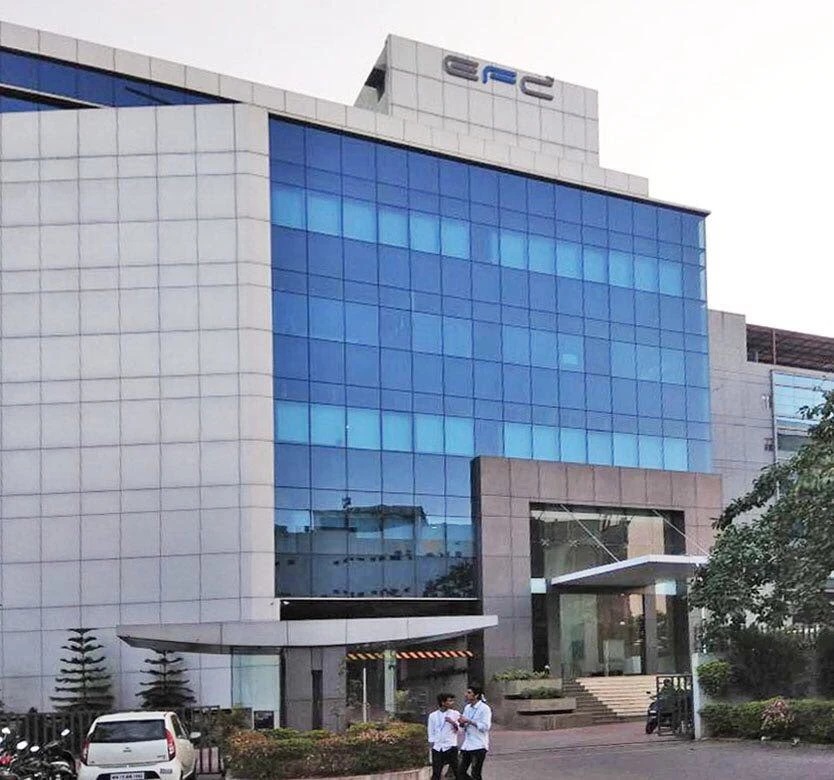
EFC (I) Ltd, FY26: Three Engines Firing, Working Capital Tightening
General information and entertainment, not investment advice. The author is not a SEBI-registered adviser or research analyst. No recommendation, no promised returns. Markets carry risk including loss of capital. Figures may not be current. Consult a registered adviser before acting.
FY26 was a 58% top-line sprint: ₹1,037 Cr in revenue against ₹657 Cr the year prior. The PAT jumped 67%—to ₹235 Cr from ₹141 Cr—which outpaced sales growth, a sign that the leasing base (higher margin, recurring) is carrying more weight while design & build and furniture scale up.
But here’s the tension. The company is burning cash on working capital: receivables spiked to ₹245 Cr (86 days) from ₹98 Cr, and inventory swelled to ₹37.5 Cr. Management flagged this explicitly—FY27 collections are the make-or-break. The cash position thinned to ₹88 Cr from ₹141 Cr; operating cash flow sat at just ₹56 Cr, down from ₹134 Cr the prior year.
Borrowings jumped to ₹1,406 Cr, up 60% YoY. The equity base strengthened (a rights issue of ₹160 Cr at ₹150/share was allotted in May 2026), but so did leverage: D/E ratio climbed to 1.74x from 1.45x. ROCE held at a healthy 19.8%, but the working capital build is real and unignored by management.
Three vertical engines: Leasing (52% revenue) steady at ₹5,356 Cr and 44% YoY growth. Design & Build (41% revenue) roared at 66% YoY to ₹4,378 Cr. Furniture (6% revenue) came from nowhere—₹632 Cr, up 202% YoY, still early but margin-accretive. All three grew.
Does ₹88 Cr cash fix a working capital crisis, or just delay the uncomfortable conversation? Let’s dig.
2. Introduction
EFC (I) Limited is not a new company—it was incorporated in 1984 as Amani Trading and Exports. For most of its life it was sleepy. Then, around 2021–22, it pivoted hard into managed office spaces and integrated workplace solutions, branded as a “Real Estate as a Service” (REaaS) platform.
The play: leasing furnished office space to enterprises, startups, and mid-market firms, executing the fit-outs in-house (Design & Build), and manufacturing furniture to supply those fit-outs and external clients. Think of it as vertical integration in the workspace business.
The company’s footprint: 25 cities, 750+ clients, ~750 seats under management across 79 centers, with 25 cities covered. Enterprise clients contribute 61% of rental revenue. Promoters control 56% of the stock (though there was some volatility in shareholding around the May 2026 rights issue).
FY26 was a pivot point. The company added capacity aggressively, expanded into new verticals (Design & Build exploded after the Whitehills merger in late 2025; Furniture went live with a 1.25 lakh sq ft plant in Pune), and funded growth partly through the rights issue. Growth came. Profitability came. Cash came under pressure.
3. Business Model: WTF Do They Even Do?
Leasing (52% of FY26 revenue, ₹5,356 Cr): Managed office spaces. The company leases or owns building space, furnishes it, manages it, and rents desks/suites to enterprises, startups, and co-working communities. Average lease tenure is 51 months for enterprise clients, which is sticky. Occupancy is north of 90%; payback is 18–20 months per seat.
The brands here are EFC (enterprise focus) and Sprint (co-working/startup focus). Pricing per seat climbed from ₹7,000–₹7,250 a quarter ago to ₹7,250–₹7,500 now, driven by location, infrastructure, and customization.
The mix is 41% whole-building operations (recurring, cleaner economics) and ~50% AUM from full buildings. Owned vs. leased asset split is roughly 19:81, meaning the company leases most space and owns some strategic assets (which show up on the balance sheet).
Design & Build (41% of FY26 revenue, ₹4,378 Cr): The company—through a subsidiary or merged entity, Whitehills Interior Limited—designs and builds office fit-outs for clients: TCS, Flipkart, Meta, CarTrade, etc. End-to-end: concept → execution. Predominantly in-house execution with 80+ designers and engineers, 45+ clients, capacity to execute contracts up to ₹200 Cr.
The margin is fat—consolidated EBITDA margin was 45.2%, and management claims D&B is “equally or higher margin” than Leasing. Order book is described as “very healthy” (no exact number disclosed). The company bids for large-ticket projects (₹50–₹200 Cr) and positions itself in the top 3–5 competitors in this space. Growth was 66% YoY.
Furniture (6% of FY26 revenue, ₹632 Cr): Manufacturing and trading. A Pune facility, 1.25 lakh sq ft, makes workstations, executive desks, lounge seating, storage. 1,500+ SKUs, 60,000+ units delivered. Capacity is ₹200–₹275 Cr (value terms). Revenue grew 202% YoY.
Strategic rationale: not just external sales. It’s a “margin accretive backward integration engine” supporting Leasing + D&B, reducing vendor dependency and improving turnaround time. Management targets “anything around 25% EBITDA” for Furniture at scale. Most demand is from internal D&B and Leasing projects, but external sales are growing.
The platform posture: clients can outsource the entire workplace lifecycle—lease space, design fit-outs, furnish it—all from one company. Synergies claimed: faster turnaround, cost control, supply-chain advantage, capital efficiency, rent-free fit-outs during ramp-up. Whether these materialize depends on execution, not positioning.
4. Financials Overview
Figures are consolidated, in ₹ crore.
Metric
Latest (FY26)
Prior Year (FY25)
YoY Change
Revenue
1,037
657
+58%
EBITDA
468
328
+43%
PAT
235
141
+67%
EPS
15.66
10.51
+49%
FY26 Detail:
Revenue opened the year at ₹657 Cr (FY25) and closed at ₹1,037 Cr. Operating profit (EBITDA before other income, depreciation, interest) was ₹468 Cr, up 43%. Net profit was ₹235 Cr, up 67%.
Operating margin (EBITDA / Revenue) was 45.2%, healthy. PAT margin tightened to 22.6% (from 21.4%) on the back of lower tax rate (24% vs 30%) and higher interest expense (₹56 Cr vs ₹46 Cr), a result of the expanded debt base.
Q4 FY26 (Quarter ended March 31, 2026):
Metric
Q4 FY26
Q4 FY25
YoY
Revenue
293
211
+39%
Operating Profit
144
109
+32%
PAT
69
48
+45%
EPS
4.69
3.61
+30%
Q4 was 26% of FY26 revenue. Quarterly revenue came to ₹293 Cr, up 39% YoY. Operating profit was ₹144 Cr (49% OPM—strong). PAT was ₹69 Cr, up 45%. The company’s biggest quarter of the year, and it accelerated YoY.
From the Earnings Call (May 29, 2026):
Management explicitly stated FY26 consolidated EBITDA was ₹4,682 Mn (₹468 Cr) vs ₹3,277 Mn FY25, and PAT was ₹2,379 Mn (₹238 Cr, a small discrepancy from the data sheet’s ₹235 Cr—likely a rounding or timing difference in the announcement). These numbers broadly align.
Key call commentary: management reiterated the REaaS platform as three integrated engines. ROCE at 33% (vs 30% prior year). Leasing generates “more than around 45%” of revenue with annuity characteristics; D&B and Furniture contribute volatility but are “margin accretive.” No material near-term capex needs; growth is funded by working capital borrowing backed by equity proceeds from the rights issue.
5. Market Expectations & Historical Multiples
This section describes how the market is currently pricing the company and how that compares with its own history and peer group. It is descriptive, not predictive.
Current Valuation (as of June 10, 2026):
Current Price: ₹186 (per the Screener data provided; note that prices referenced are not live)
Market Cap: ₹2,735 Cr
EPS (TTM/FY26 annualized): ₹15.66
P/E Multiple (Current): 11.8x
Historical P/E Average (Screener, 5-year): 35.5x
Peer Median P/E (from the peer table): 17.4x
ROCE: 19.8% (current); 5-year average 28.1%
ROE: 34.3% (current); 3-year average 28.5%
Price-to-Book: 3.43
Metric
EFC (Current)
Historical Avg (5yr)
Peer Median
P/E
11.8x
35.5x
17.4x
ROCE
19.8%
28.1%
13.7%
ROE
34.3%
28.1%
12.9%
What the Market is Pricing In:
The market trades EFC at a 32% discount to its own 5-year average P/E and below peer median, despite ROE of 34% (well above peers’ median 12.9%). This suggests the market is pricing in caution: either execution risk (on Design & Build and Furniture), working capital strain, or temporary margin pressure as the company scales.
The ROCE at 19.8% has slipped from the 3-year average of 28.5%, a signal that incremental capital is earning lower returns—consistent with the working capital buildup and new Furniture facility ramp-up. Leasing, the core annuity engine, typically carries high ROCE; the overall decline reflects drag from scaling early-stage verticals.
The company’s balance sheet carries ₹1,406 Cr of debt against ₹807 Cr of equity (including reserves), a D/E of 1.74x. For an asset-backed, real-estate-heavy business with long-tenure