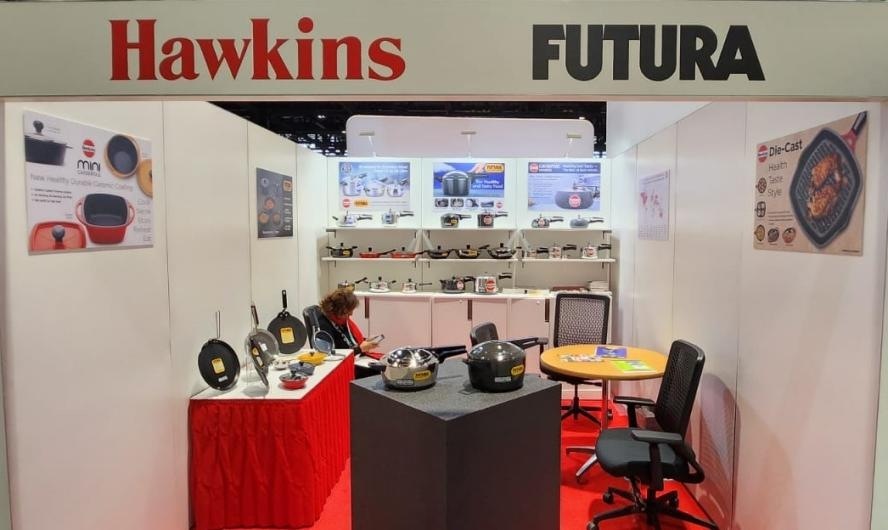
Hawkins Cookers FY26: Pressure Building Beneath a Pressure Cooker
General information and entertainment, not investment advice. The author is not a SEBI-registered adviser or research analyst. No recommendation, no promised returns. Markets carry risk including loss of capital. Figures may not be current. Consult a registered adviser before acting.
1. At a Glance
Hawkins posted FY26 revenue of ₹1,253 Cr, up 12.3%, while net profit climbed to ₹131 Cr from ₹115 Cr in FY25. The equity base grew by 16% to ₹445 Cr, and net cash hit ₹175 Cr—a 66-year-old pressure cooker maker is awash in cash but struggling to cash in on faster growth rates it hit years ago.
The company sells at 31.4x earnings (as of June 9, 2026, ₹7,742 per share) against a 10-year average of 36x, yet it has spent the same multiple band for years. ROCE stands at 41%, but the trajectory is flat—down from 45% in FY24. A fourth factory opened in Jaunpur in June 2025, yet to show in the numbers.
Why does a market-leading pressure cooker business with fortress balance sheet and double-digit margins trade like a value stock priced like a growth stock? The tension hums.
2. Introduction
Hawkins Cookers was incorporated in 1959 under Late H.D. Vasudeva and has operated under the Vasudeva and Khandelwal family stewardship ever since. Current Chairman Subhadip Dutta Choudhury took over in 2020 and brings three decades of tenure. The company is one of India’s few kitchenware manufacturers to build scale—300 cooker models across 13 types, with roughly a quarter of the Indian pressure cooker market and dominant shelf space in the organized retail tier.
The business sits at a crossroads. Domestic sales account for 93% of revenue; exports to 64 countries contribute 7%. Within India, the organized sector has claimed 60% of the kitchenware pie, yet the company’s penetration into modern retail and e-commerce remains under-leveraged relative to peers. A new product launch spree (58 new lines in FY25, capped by a smart electronic kettle) and a fourth manufacturing facility betray ambitions to scale beyond cookers and the wholesale channel.
3. Business Model: WTF Do They Even Do?
Hawkins manufactures and distributes pressure cookers and general cookware in aluminum, stainless steel, and hard-anodized finishes. The portfolio spans entry-level pans at ₹500–1,000 to premium tri-ply sets priced ₹4,000–7,500.
Pressure cookers drive the bulk—83% of revenue in FY26, with Hawkins holding about 25% of the organized market and claiming the #1 position. Cookware (pans, tava, bowls) picks up the rest, a distant second in market share but a stable floor. Three brands—Hawkins, Future, and Miss-Mary—each target different price points, a segmentation strategy bordering on self-cannibalization if execution stumbles.
The distribution network is the moat. As of FY25, the company boasted 9,588 dealers nationwide, a pan-India footprint built over decades of ground presence. E-commerce represented roughly 15% of the organized market as of the documents filed; Hawkins’ penetration here is opaque, a gap the new marketing push under Executive Director Neil Vasudeva aims to plug.
Manufacturing is vertically integrated: three factories (Thane, Hoshiarpur, Jaunpur) feed a relentless SKU machine. The company sources aluminum from Hindalco and stainless steel from compliant suppliers, investing in proprietary tooling rather than imported technology—141 patents and designs as of April 2025. A fourth factory in Jaunpur commenced operations in June 2025, a capex move with implications yet to surface in consolidated results.
The real question isn’t what they make—it’s how they move it. A 9,600-dealer network in a market shifting to online, a product portfolio exploding in options (300 SKUs), and margins compressing in the high single digits suggest the company is defending legacy terrain rather than conquering new ground.
4. Financials Overview
Figures are consolidated, in ₹ crore, quarterly and annual audited per Board outcome May 28, 2026.
FY26 (Year Ended Mar 31, 2026) — Latest Full Year
Metric
FY26
FY25
YoY Change
Revenue
1,252.93
1,115.76
+12.3%
EBITDA
186.22
126.16
+47.6%
PAT
131.19
114.69
+14.4%
EPS (₹)
248.10
216.90
+14.4%
Q4 FY26 (Jan-Mar 2026) — Latest Quarter, 3 months
Metric
Q4-FY26
Q4-FY25
QoQ
Revenue
365.43
306.66
+19.2%
PAT
39.78
34.36
+15.8%
EPS (₹)
75.22
64.97
+15.8%
The latest quarter benefited from base effects—Q4-FY25 was soft at ₹307 Cr. Full-year growth of 12.3% in revenue masks a softer H1 (H1 FY26 revenue was ₹545 Cr vs. ₹617 Cr in H1 FY25, a decline). Q4 FY26 bounced back to ₹365 Cr, suggesting seasonal or project-linked orders lifted the close. PAT margin at 10.5% remains steady, but EBITDA jumped 47.6% YoY—a function of lower raw material costs and operating leverage, not pricing power or volume miracles. Finance costs fell from ₹2.9 Cr to ₹3.5 Cr (near-negligible), a function of near-zero debt burden.
Wisdom line: A cooker maker is getting pricier aluminum and stainless steel, yet EBITDA margin expanded. Either pricing discipline kicked in, or the market softened so much that fixed cost absorption looked like margin magic.
5. Valuation Discussion: Fair Value Range (Educational Only)
What follows is a walkthrough of how three valuation methods work, using this company’s numbers as the example — not a target, not a forecast, not advice.
Method 1 (Price-to-Earnings):
Annualised EPS for FY26 is ₹248.10 (full fiscal-year reported, no multiplication). The peer band for consumer durables and houseware companies (Cello, Borosil, All