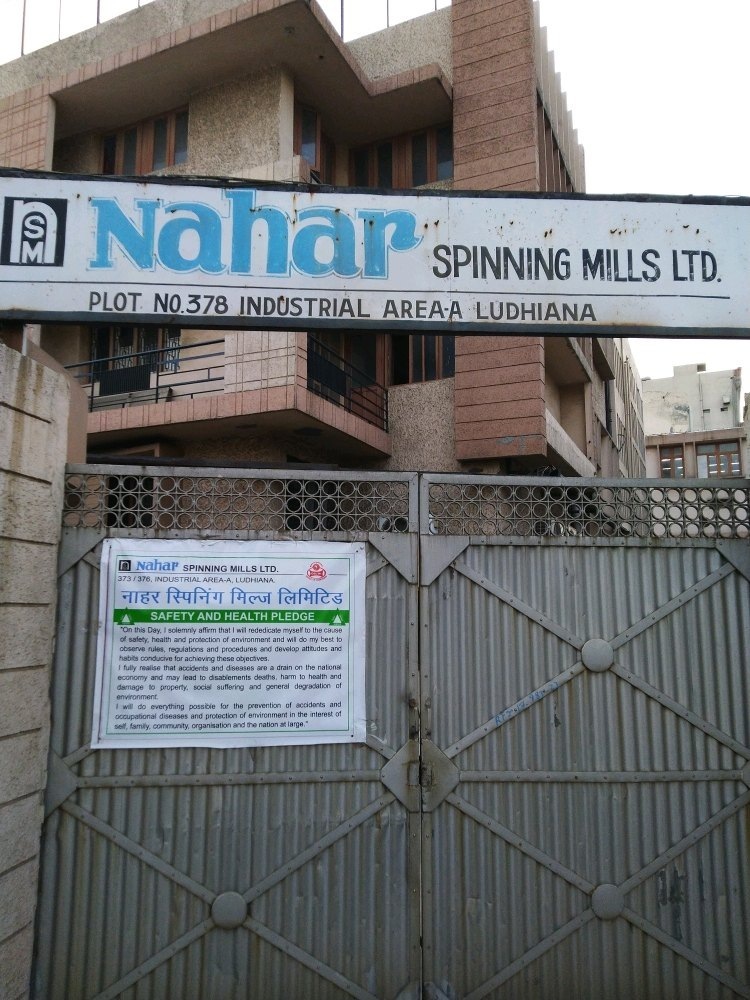
Nahar Spinning Mills FY26: A ₹984 Cr Mill Chasing Margins in a Commodity Grind
General information and entertainment, not investment advice. The author is not a SEBI-registered adviser or research analyst. No recommendation, no promised returns. Markets carry risk including loss of capital. Figures may not be current. Consult a registered adviser before acting.
1. At a Glance
The spinner has spun. Nahar clocked ₹3,218 Cr in FY26—a haircut from last year’s ₹3,285 Cr—while net profit came in at ₹21.82 Cr, a collapse of 43% against ₹38.40 Cr in FY25. Sales are down, profits are down, and the stock trades at 43.6x earnings while the sector median sits at 24.9x. That multiple gap whispers a question the results don’t answer: what exactly is the market paying for here?
Q4 delivered ₹917 Cr in sales and ₹23.42 Cr in profit, a relief bounce after three grim quarters. The company’s recent capex push—₹350 Cr for modernization plus solar—is live. Whether that relit the lamp or just replaced the bulb is the game to watch.
Operating margins compressed to 4.89% from 4.94%, a stutter, not a collapse. The true tension: the company expands capacity while commodities dictate its fate.
2. Introduction
Nahar Spinning Mills, incorporated in 1980, sits inside the Nahar Group, a Ludhiana-based textile dynasty. The company spins cotton yarn (blended too), exports hosiery knitwear, and runs manufacturing across Punjab and Madhya Pradesh—Ludhiana, Jitwal Kalan, Jodhan, Lalru, Raisen, Mandideep.
The export footprint spans Bangladesh, China, Egypt, Vietnam, plus long-standing retail doors in the US and Canada. Domestic-to-export splits run roughly even—47% home, 53% abroad—a mix that hedges India’s demand hiccups with global cotton cycles.
Two cogeneration plants (3.8 MW at Ludhiana, 4.8 MW at Lalru) and solar installations (announced: 11 MW by FY28) underscore a forward tilt toward cost absorption. The capacity expansion programme, completed in FY24 at ₹350 Cr outlay, lifted spindle capacity to 573,408 units—the company calls this a competitive moat. Time will verify that claim.
Promoter grip remains iron-fisted: Nahar Capital and Financial Services (47.01%), Nahar Poly Films (19.14%). Public holds 31.93%. No FIIs, DIIs traded away; October’s DII retreat (from 0.59% to 0.02%) was a whisper that the smart money had elsewhere to be.
3. Business Model: WTF Do They Even Do?
Cotton yarn: grade 20s, 30s, 40s to fancy counts—sold domestic and global. Hosiery knitwear: the garment-ready output, chasing quick fashion and athletic brands. Blended yarn: cotton-polyester mixes for end-use flexibility.
Revenue breakup FY24: Products (96%), export incentives (3%), services (1%). A commodity business pretending at brands but pricing on fibre, cost, and luck.
The model’s bone: yarn is fungible. Bangladesh spins it, Vietnam spins it, Pakistan spins it cheaper. Nahar’s edge, management claims, is scale, power self-supply (cogeneration + solar), and the “modernized spindle”—higher twist, finer counts, quicker changeovers. The balance sheet tells a different story: the company carries 573K spindles and earns ₹22.6 Cr on ₹984 Cr market cap. Return on tangible assets: negligible.
Hosiery and garmenting add margin (better than raw yarn) but scale is smaller—estimated 15-20% of volume. The factory footprint (six units) is a fixed-cost anchor; leverage cuts both ways: a 5% volume drop demands a margin squeeze that’s sharp and non-negotiable.
The distribution: agents in India, direct retail relationships abroad. No D2C, no brand. The business is infrastructure renting itself to commodity buyers on whatever price the fibre market sets.
4. Financials Overview
Figures are consolidated, in ₹ crore.
Metric
Latest FY (Mar 2026)
YoY
Prior FY (Mar 2025)
Revenue from Operations
3,217.92
-1.99%
3,284.56
EBITDA
309.27
-49.78%
616.33
Net Profit
21.82
-43.24%
38.40
EPS (₹)
6.04
-43.24%
10.62
FY25 was the outlier—a 115% profit bounce from FY24’s ₹12.35 Cr. FY26 erased most of that bounce. Quarterly decomposition reveals the churn: Q1 saw red (₹15.2 Cr loss), Q2 clawed back to ₹6.64 Cr, Q3 dipped again (₹4.64 Cr loss), Q4 surged to ₹23.42 Cr. That volatility is the signature of a business at the mercy of input prices and inventory marks.
Operating profit margin landed at 4.89%—flat versus FY25 (4.94%)—meaning the company protected operating leverage despite lower sales. That’s the good news. The bad news: it did so by cutting costs more aggressively than it cut prices, a margin-defense move that signals input-price volatility, not pricing power.
PAT margin contracted to 0.68% from 1.17%, a squeeze visible in the tax line: FY26’s tax rate ballooned to 16% (from 7% prior year), and interest costs remained high (₹54 Cr vs. ₹79 Cr YoY reduction). The company still financed its capex programme; debt inched down but was not a priority.
5. Valuation Discussion: Fair Value Range (Educational Only)
What follows is a walkthrough of how three valuation methods work, using this company’s numbers as the example — not a target, not a forecast, not advice.
Method 1 (Trailing P/E): Annualised EPS is ₹6.04 (FY26 full year, no adjustment). Peer band P/E ranges 8.54x (five-year median) to 43.57x (current).
At the peer five-year median (8.54x): ₹6.04 × 8.54 = ₹51.60. At the peer ten-year median (estimated ~10x): ₹6.04 × 10 = ₹60.40. At the current sector median (24.9x): ₹6.04 × 24.9 = ₹150.40.