B.L.Kashyap & Sons Ltd, Q4 FY26: A Builder in Rebuilding Mode
General information and entertainment, not investment advice. The author is not a SEBI-registered adviser or research analyst. No recommendation, no promised returns. Markets carry risk including loss of capital. Figures may not be current. Consult a registered adviser before acting.
1. At a Glance
The company reported revenue of ₹363.7 crore in Q4 FY26 — a 23.6% jump year-on-year — yet net profit swung to a ₹12.5 crore loss from a ₹3.2 crore profit in Q4 FY25.
The culprit: a ₹37.8 crore exceptional item (₹20 crore Right of Recompense to CDR lenders, ₹17.8 crore contract asset write-off from arbitration).
Strip that out, and the operating machine worked. EBITDA stood at ₹26.9 crore (7.4% margin), flat versus Q4 FY25’s ₹7.3 crore on its much smaller base.
Order book crossed ₹5,296 crore as of March 2026. Fund-based debt has fallen from ₹700 crore to ₹270 crore — a debt reset story in motion. But equity returns are broken: ROE at 2.59% over the trailing year tells you the capital is idling.
The story: a company that blew up in CDR (2014), is now executing on its way out.
Heading into this quarter: Can it make a return on its equity, or just a return of it?
2. Introduction
B.L.Kashyap & Sons is a civil EPC contractor — builder of malls, office parks, railways, and residential towers across India.
The company was founded in 1989 by three Kashyap brothers. For decades it thrived on DLF, Embassy, and private developers. Then the global meltdown of 2008–2010 crushed it. By 2014, leverage and losses forced the company into Corporate Debt Restructuring — a formal bank-supervised reset that locked it out of the market for years.
The reset worked. Between FY22 and FY26, the company paid down ₹400+ crore of debt, took only bank guarantees and working capital limits, and clawed back to profitability. Most of FY25 and FY26 was dominated by finishing old projects, managing arbitrations (hence the exceptional write-offs), and retooling the balance sheet.
In May 2026, CRISIL upgraded the company’s credit rating to BB-/Stable — proof that the reset was real, not cosmetic.
3. Business Model: WTF Do They Even Do?
B.L.Kashyap is a general contractor for large construction projects. It does two things: take a brief from a developer or government body, staff a site, manage subcontractors and material flows, and hand over a finished building.
The model has a crushing disadvantage: razor-thin margins on massive working capital needs. A project might be worth ₹500 crore, but BLK carries it on its balance sheet for 24–36 months before getting paid. During that time it’s funding material, labour, and bank guarantees. If a project slips or a client doesn’t pay, the company burns cash fast.
This is why BLK nearly died: it over-levered on projects, one or two of them slipped, and the debt servicing became impossible.
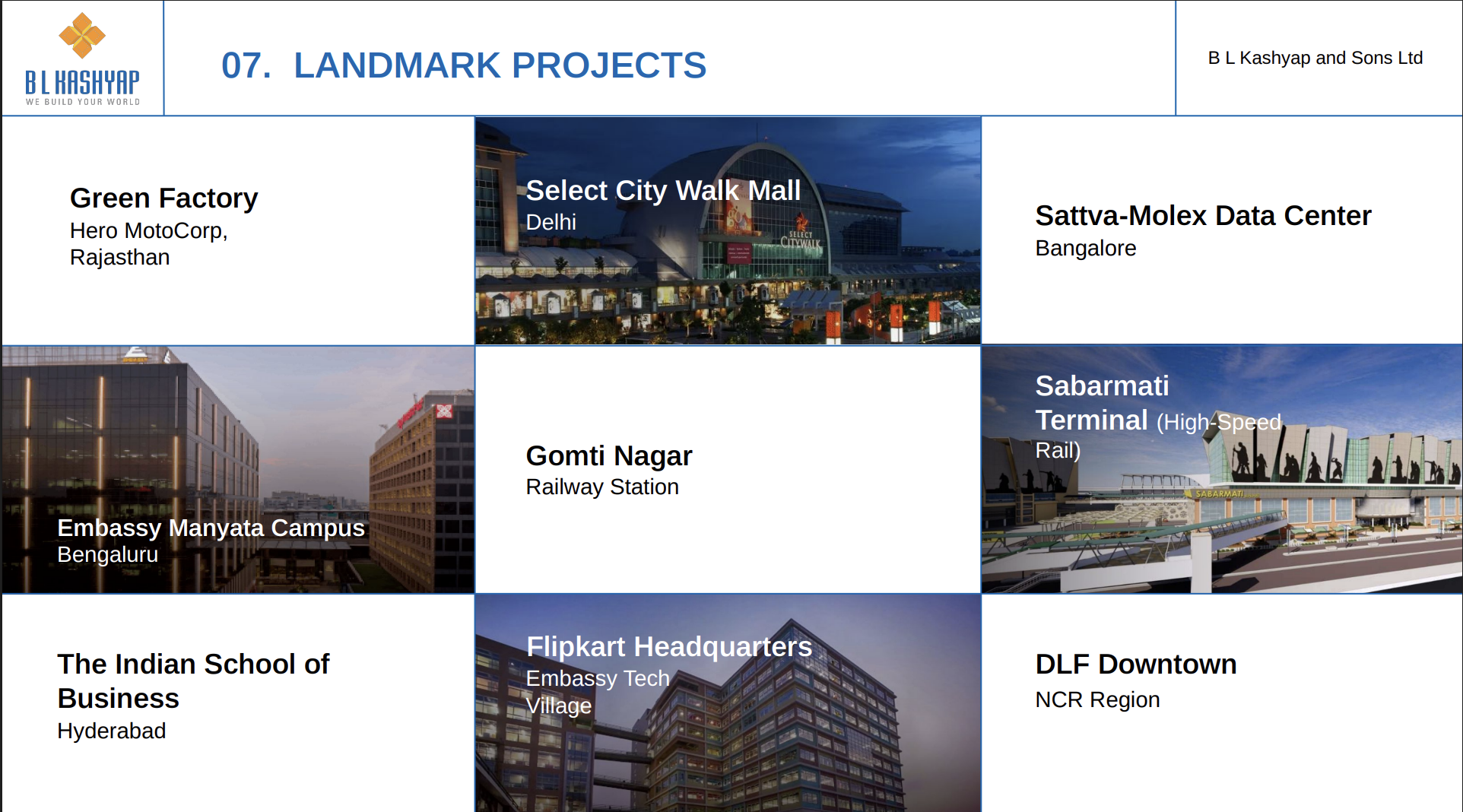
The advantage: once you’ve proven you can execute — on time, on budget, not cutting corners — clients come back. DLF has hired BLK for mall work, Embassy for tech parks, and BPTP for large residential towers.
The current portfolio is split: 78% commercial (malls, offices, data centres), 10% residential, 7% infrastructure (railways, metros), 5% institutional.
The geographic concentration is severe. Haryana (NCR region) accounts for 52% of the order book, Karnataka 18%, Tamil Nadu 18%, and the rest scattered. This is a Delhi-and-Bangalore contractor first, pan-India contractor second.
4. Financials Overview
Figures are consolidated, in ₹ crore.
Metric
Q4 FY26
Q4 FY25
Q3 FY26
YoY Change
QoQ Change
Revenue
363.7
294.2
323.9
+23.6%
+12.3%
EBITDA
26.9
7.3
28.9
+269%
-7.0%
Net Profit (Loss)
(12.5)
(3.2)
11.8
(Loss swing)
(Loss swing)
EPS (₹)
(0.56)
(0.14)
0.52
—
—
Full Year FY26 Performance:
Full year revenue grew to ₹1,379.1 crore from ₹1,153.6 crore in FY25 — a 19.5% jump. EBITDA rose to ₹102.2 crore (7.41% margin) from ₹65.3 crore. Yet net profit crashed to ₹1.6 crore from ₹27.5 crore because of the ₹37.8 crore exceptional item.
The company’s annualized EPS (full year figure) was ₹0.07 — effectively the company was in loss-carryforward after the arbitration settlement hit.
5. Valuation Discussion: Fair Value Range (Educational Only)
What follows is a walkthrough of how three valuation methods work, using this company’s numbers as the example — not a target, not a forecast, not advice.
Method 1 (P/E Multiple): Annualized EPS at full-year FY26 was ₹0.07. Peers in the construction space trade at a band of 22–32x forward earnings (Larsen & Toubro at 32.7x, NBCC at 42.3x, Kalpataru at 21.5x). Applying the peer band to BLK’s full-year EPS of ₹0.07 produces ₹1.54–₹2.24 per share as a theoretical range.