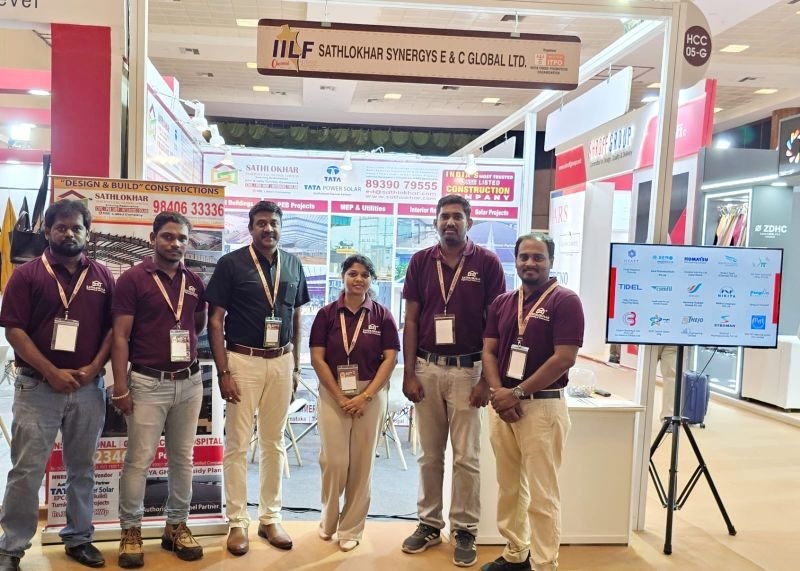
Sathlokhar Synergys E&C Global Ltd FY26: ₹820 Cr Revenue, 111% Profit Growth, and a 10.7x Multiple That Leaves Room to Breathe
General information and entertainment, not investment advice. The author is not a SEBI-registered adviser or research analyst. No recommendation, no promised returns. Markets carry risk including loss of capital. Figures may not be current. Consult a registered adviser before acting.
1. At a Glance
Revenue crossed ₹820 crore in FY26, up 106% from ₹399 crore a year earlier. Net profit nearly doubled to ₹82.3 crore, growing 92% YoY. The order book sits at ~₹840 crore (executable in 4–10 months), providing a year’s revenue visibility.
At ₹340 per share (as of early June 2026), the company trades at 10.7x annualised earnings—a compression from its 5-year average of 16.4x. The market pays less than the sector median of 17.4x despite the company’s ROCE of 37.1%, one of the highest in the peer set.
Cash flow tells a harder story: operating cash flow swung to negative ₹162.95 crore from ₹90.85 crore negative a year prior. Yet management points to unbilled revenue of ₹234 crore sitting in current assets—work done, not yet invoiced. The tension: explosive top-line growth and world-class returns on capital colliding with a working capital monster.
Does a balance sheet with no visible debt and a ₹840 crore order book redeem a cash flow that’s headed underwater?
2. Introduction
Sathlokhar Synergys started as a Chennai-based EPC contractor in 2013, just over a decade ago. The company lists on NSE’s SME board as of August 2024 and is pursuing mainboard status by 2027–28.
For most of its life, Sathlokhar was small—₹87 crore in revenue by FY23, then ₹247 crore in FY24. But FY25 and FY26 saw something shift. In FY25, sales hit ₹399 crore. In FY26, they doubled again to ₹820 crore—a 106% year-on-year sprint.
The business is turnkey EPC: design, procurement, execution, handover. It runs projects across industrial plants, pharma campuses, solar installations, warehousing, hospitality. The company laid a foundation stone for a pre-engineered building (PEB) factory on January 28, 2026, targeting full production by September 2026. In May, it secured an additional ₹125 crore in new orders.
In May 2024, CRISIL assigned a ‘BBB+/Positive’ rating, citing the promoters’ two-decade construction pedigree, healthy order visibility, and low gearing. Class 1A PWD registration (achieved in FY26) unlocks government tender eligibility.
3. Business Model: WTF Do They Even Do?
Sathlokhar executes industrial and infrastructure projects from concept to commissioning. The work spans civil construction (concrete, steel), pre-engineered buildings (PEB—the company now fabricates in-house), mechanical-electrical-plumbing (MEP) systems, solar installations, and interior fit-out.
The client mix leans private: 98.6% private sector, 1.4% government in FY24. But the company’s earnings call in June 2026 stressed that it is not a pure civil contractor: only 30–35% of work involves conventional labor-heavy civil construction; the rest is engineering-intensive (PEB, MEP, utilities, automation). This mix, the company argues, scales faster and sustains margins better than commodity concrete-pouring.
Geography started narrow—Tamil Nadu dominated historical revenues. By FY26, execution spread across TN (~40%), Karnataka, Odisha, Uttar Pradesh, and other states (collectively ~60%). The company started bidding in Sri Lanka (first order booked in Q3 FY26).
Order book composition: ₹840 crore confirmed, ₹17,000+ crore in bids pending across existing and new clients. The bid pipeline is thick, but conversion trails: management cites macro uncertainty and post-election government change as slowdowns. A bid conversion rate of 10–12% (historical range stated by management) would suggest ₹1,700–₹2,000 crore annual order inflows if the full pipeline converts—a tall claim, but the company is leaning on existing-customer expansion (Phase II, III, IV of multi-phase campuses) for another ₹500–₹600 crore in FY27 expectations.
Key customer: Reliance Consumer Products (Campa-Cola expansion). Two projects were delivered within 198 days each, and FY27 is expected to bring 2–3 more Reliance orders. This is the company’s marquee relationship and its proof-of-concept for fast execution.
4. Financials Overview: The Numbers (Consolidated, ₹ Crore)
Metric
FY24
FY25
FY26
YoY Growth
Revenue
246.97
399.37
820.28
+105.5%
EBITDA
~36
57
117.88
~107%
PAT
26.13
42.77
82.32
+92.6%
EPS (reported)
~13
17.72
31.69
+78.8%
Q4 FY26 (Quarter ended Mar 31, 2026) ran ₹277.37 crore in revenue, ₹42.66 crore operating profit (15.4% OPM), ₹30.26 crore net profit. That’s a 48.9% QoQ sales increase and 64.6% profit jump. The annualised EPS from Q4 alone (₹11.65 reported) × 4 = ₹46.6 suggests an intra-year acceleration, but FY26 full-year EPS of ₹31.69 (from consolidated net profit ₹82.32 ÷ 2.6 crore shares) reflects the ramp.
Margin consistency: FY26 EBITDA margin hovered around 14.3%, up from FY25’s 14.3% as well. The company hit 10.1% net margin (PAT ÷ Revenue) in FY25 and 10.0% in FY26, a sign that cost control has kept pace with scale.
Order book and execution cadence: The company carried forward ~₹700 crore in confirmed orders into FY27. The concall transcript (June 2026) confirmed ₹840 crore order book post-May order wins. At an annualised execution pace (assuming similar project duration and margin), that suggests ₹800–₹1,000 crore in FY27 revenue is achievable if the company does not stumble on project delivery or working capital.
5. Valuation Discussion: Fair Value Range (Educational Only)
What follows is a walkthrough of how three valuation methods work, using this company’s numbers as the example — not a target, not a forecast, not advice.
Method 1 (P/E): Annualised EPS × Peer Band
Sathlokhar’s annualised EPS (FY26 full-year basis): ₹31.69. The peer band for construction/EPC trades at P/E multiples ranging from 21x (Kalpataru Projects at 21.33x) to 54.4x (Rail Vikas, cyclical/execution pressure). The sector median sits at 17.38x.
At the sector median multiple of 17.38x, the arithmetic produces ₹31.69 × 17.38 = ₹550–₹585 (allowing for ±5% variance in the peer estimate).
Method 2 (EV/EBITDA): EBITDA × Peer EV/EBITDA Band