Uni Abex Alloy FY26: The Exceptional Gain That Ate the Operating Story
General information and entertainment, not investment advice. The author is not a SEBI-registered adviser or research analyst. No recommendation, no promised returns. Markets carry risk including loss of capital. Figures may not be current. Consult a registered adviser before acting.
1. At a Glance
Uni Abex Alloy delivered FY26 net profit of ₹280 crore—a 735% leap year-on-year. But ₹283 crore of that was “other income,” mostly a land sale windfall. Operating performance: revenue climbed 13% to ₹219 crore, net profit from core operations was closer to ₹-3 crore.
The equity is almost debt-free: borrowings sit at ₹13 crore against a ₹413 crore reserve base. But working capital days have exploded to 455 days, and debtor days stretch to 87. The cash balance jumped to ₹75 crore, courtesy the land proceeds.
Melting capacity hit 6,000 MT—no new increase, stalled since Mar 2023. Operating margin held at 24%, but the business hasn’t grown the top line visibly faster than inflation. Price referenced is ₹4,431 (close, 8 Jun 2026).
2. Introduction
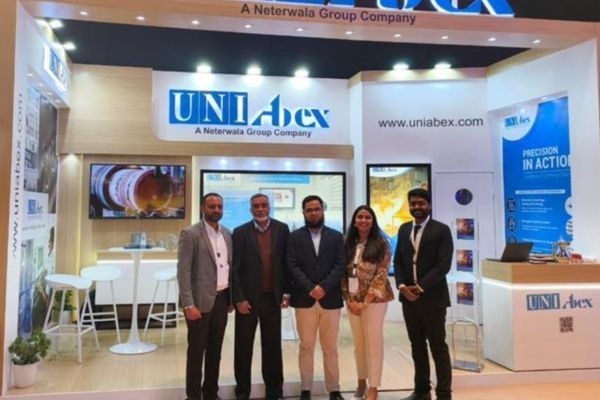
Incorporated in 1972, Uni Abex Alloy Products (UAAPL) manufactures centrifugal and static castings in heat and corrosion-resistant stainless steel alloys. The company is part of the Neterwala Group, an ISO-certified, One Star Export House, and MSME-registered.
In October 2025, UAAPL signed a deal to sell 9.45 acres of Thane land for ₹244 crore; advance received ₹49 crore. By February 2026, the full sale closed for ₹258 crore, yielding the ₹283 crore other income that dominated FY26 earnings.
In May 2025, the board approved a ₹85 crore capex plan for a Dharwad plant expansion, targeted by H2 FY27. In September 2024, Nisar Hasan was appointed Chief Operating Officer. CEO elevation followed in May 2026. The COO role itself is newly held after the prior incumbent, Achintya Chandra, resigned in January 2024.
3. Business Model: WTF Do They Even Do?
UAAPL’s product set spans three categories.
Vertical centrifugal casting: decanter bowls, bowl cones, bowl cylinders—kit for centrifuge separators in petroleum, chemicals, and pharma.
Horizontal centrifugal casting: reformer tubes, catalyst tubes, furnace rollers, radiant coils, radiant tube assembly. The reformer tube business is the marquee; these are critical components in oil refining and petrochemical cracking.
Geographically, FY23 split was 29% export, 71% domestic. The export base is North American (CRU 2025 announcement in April 2025 signalled entry into that region). Domestic buyers span iron & steel, petroleum, petrochemicals, fertilizers, and process industries.
Capacity: Melting capacity 6,000 MT annually; finished casting capacity ~2,250 MT. The Omega static casting plant from the UK can handle 1,200 MT per year. The company can produce single-piece castings up to 3,000 kg.
The model lives or dies on customer retention and spec win cycles. In commodity-like casting, switching costs are low if spec-compatible alternates exist. Margins have been stable at 22–27% OPM over the last three years, suggesting either monopoly-like captive demand or differentiation on metallurgy and finish. Or both. The business is not mass production; it is made-to-order alloy engineering.
4. Financials Overview
Figures are consolidated, in ₹ crore, quarterly basis.
Metric
Latest Q (Q4 FY26)
YoY
QoQ
Revenue
78.3
+132.8%
+72.1%
EBITDA
25.3
+103.4%
+204.2%
PAT
257.6
+7,405%
+4,609%
EPS (full year)
1,417.01
—
—
The Q4 number must be read as an abnormality: PAT of ₹257.6 crore includes ₹276.6 crore other income. Operating profit in Q4 was ₹24 crore, and net profit before exceptional items was ₹22–23 crore.
TTM (trailing twelve months) revenue stands at ₹219 crore; TTM net profit (excluding exceptional) is approximately ₹47 crore.
Full-year FY26 reported net profit ₹280 crore; adjusted for the ₹283 crore land sale, operating net profit was ₹-3 crore. The gap reveals the cost structure: gross margins have narrowed due to raw material and employee costs rising faster than revenue.
Revenue grew 13% in FY26 (from ₹193 crore to ₹219 crore). In prior years: FY25 +6%, FY24 +17%. The sales growth has decelerated into the low-to-mid-teens range. Cost of goods (raw