PC Jeweller FY26: The Comeback Kid’s Balance Sheet Gets Its Moment
General information and entertainment, not investment advice. The author is not a SEBI-registered adviser or research analyst. No recommendation, no promised returns. Markets carry risk including loss of capital. Figures may not be current. Consult a registered adviser before acting.
1. At a Glance
The jewellery company clawed back ₹3,353 Cr in FY26 revenue—49% higher than the ₹2,244 Cr stumble in FY25.
Net profit swung to ₹714 Cr in the latest year, reversing five years of losses that had crushed the balance sheet.
Debt fell 72% to ₹1,167 Cr from ₹4,150 Cr two years ago, courtesy of warrant conversions that diluted equity dramatically.
The company holds ₹7,214 Cr of jewellery inventory—down slightly from ₹6,649 Cr a year prior.
Operating margin punched to 20% in FY26, a sharp recovery from the −28% pit in FY24.
One alert: the credit rating agency still assigns a ‘D’ grade, citing the issuer’s non-cooperation on information. The balance sheet numbers are real; the governance smoke is not.
2. Introduction
PC Jeweller emerged from insolvency hell in 2023—literally: SBI and 13 other creditors had petitioned the NCLT in January 2023 for the company’s liquidation.
By June 2024, 12 of 14 banks had accepted the One-Time Settlement (OTS) terms; SBI withdrew its petition in Q1 FY25.
The settlement came with a price: the company issued ₹2,702 Cr of fully convertible warrants in FY25, followed by another ₹500 Cr wave in FY26.
Warrant conversions reduced Balram Garg’s stake from 43.89% (March 2024) to 21.04% (April 2026)—a dilution of 22.85 percentage points in two years.
The inventory court case resolved in October 2025: ₹264 Cr in outstanding export receivables remains uncollected, a relic from the 2022 export sales (12% of revenue that year).
In January 2026, a mining venture in Chad received a one-year gold mining licence—a beta move for a retailer.
3. Business Model: WTF Do They Even Do?
PC Jeweller manufactures, retails, and exports gold, diamond, and silver jewellery.
The product line spans physical jewellery—rings, mangal suras, chains, pendants, bracelets, coins—and a digital gold platform (invest in 24K 99.5% pure gold online, minimum ₹100, redeem as bullion or jewellery).
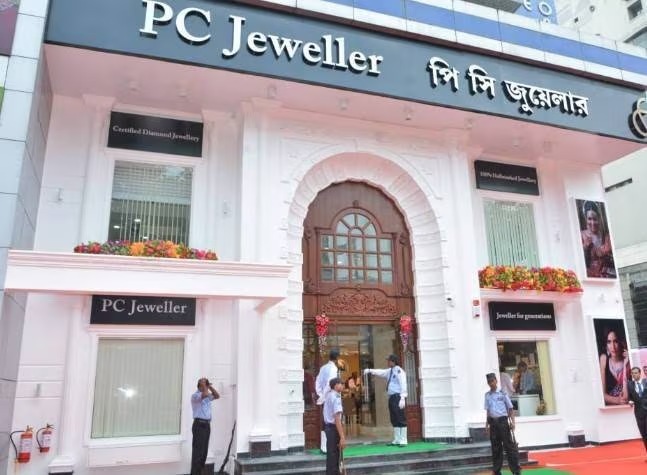
As of Q1 FY25, the company ran 57 showrooms (49 owned, 3 franchise, 5 in pipeline) across 42 cities in 15 states. In March 2026, the count sat at 52 locations.
The export business, which accounted for 12% of revenue in FY22, has flatlined—no exports in the last four quarters.
Four manufacturing units (all in Noida, UP) feed the retail network.
Domestic product mix: 31.52% diamond/studded, 68.48% plain gold and silver—not a luxury ornament house, but a volume-and-margin play in the core Indian family jewellery market.
4. Financials Overview
Figures are consolidated, in ₹ crore.
Metric
FY24
FY25
FY26
FY26 vs FY25
Revenue
604
2,244
3,353
+49%
EBITDA
−150
414
691
+67%
PAT
−629
578
714
+24%
EPS (annualised)
−1.35
0.91
0.83
−9%
Key notes:
Revenue jumped 49% on a restart of normal showroom operations post-inventory recovery.
EBITDA (operating profit + depreciation) swung from negative to ₹691 Cr, though the FY25 base was already recovering from the FY24 nadir.
PAT climbed to ₹714 Cr—the strongest profit in five years—but dilution compressed EPS to ₹0.83 (FY25: ₹0.91).
Interest expense halved from ₹505 Cr (FY24) to ₹133 Cr (FY26), a direct result of debt paydown.
Tax was negligible (−₹0.97 Cr), likely reflecting loss carry-forwards from the 2023–24 devastation.
5. Valuation Discussion: Fair Value Range (Educational Only)
What follows is a walkthrough of how three valuation methods work, using this company’s numbers as the example—not a target, not a forecast, not advice.
Peer P/E band for Indian jewellers: 12x–30x (Titan ₹73.47, Kalyan ₹27.87, Thangamayil ₹47.07, PC ₹12.47).
Method 1 arithmetic: ₹0.83 × 12x–30x = ₹10–25.
Method 2: EV/EBITDA
FY26 EBITDA ≈ ₹691 Cr.
Enterprise Value = Market Cap (₹8,914 Cr) + Net Debt (₹1,031 Cr) = ₹9,945 Cr.
EV/EBITDA = 14.4x (current trading level).
Peer EV/EBITDA: 11.5x–25.8x.
Reversing the median (14.4x) against ₹691 Cr EBITDA: ₹9,933 Cr ÷ 971 Cr shares = ₹10.23 per share.
Method 3: Simplified DCF
Assume 15% annual revenue growth for 5 years, declining to 5% terminal growth.
FY26 PAT ₹714 Cr; assume stable 21% net margin and 10% WACC.
5-year free cash flow discounted at 10% + terminal value discounted at perpetuity: back-of-envelope ₹1,500–2,100 Cr net value, or ₹1.50–2.15 per share (highly sensitive to margin and growth assumption).
These figures show how the methods work and are not a valuation, a target, or advice.
6. What’s Cooking
Warrant conversion bonanza: By April 2026, ₹2,703 Cr of warrants had converted into 971 Cr shares (from ~465 Cr pre-warrant). Dilution is real; cash from conversion (net of OTS settlement to banks) is what reset the debt clock.
Showroom expansion MOU: In January 2026, the UP Chief Minister signed an MOU for up to 1,000 franchise-owned showrooms across the state. A pilot showroom opened in Pitampura, Delhi in Q2 FY26—a shift toward franchise-light capex.