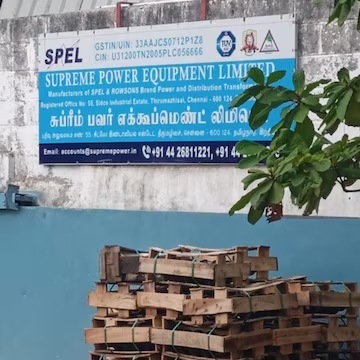
Supreme Power Equipment: ₹588 Cr Order Book, ₹30 P/E, and a Quiet Bet on India’s Grid
Section 1: At a Glance
Supreme Power Equipment (SPEL) just wrapped FY26 with ₹182.10 Cr revenue, up 22% year-on-year, and a net profit of ₹20.44 Cr — respectable, but not dazzling. What matters more: capacity. The company’s new Chennai facility hit commercial production in February 2026, expanding annual manufacturing from 2,500 MVA to 9,000 MVA. That’s a 3.5x step-change. The order book sits at ₹588.17 Cr — nearly 3.2x annual revenue — a fortress of visibility. The stock trades at ₹245, pricing in a 30x P/E on FY26 EPS of ₹8.15. The tension: is this a smallcap transformer maker about to scale into relevance, or a momentum bet that’s priced too far ahead of execution?
One wisdom line to carry: Manufacturing capacity without utilization is just an expensive asset. SPEL’s new plant ran at low utilization in FY26; management expects “2 to 3 years” to hit 90%. That timeline is neither punchy nor assuring.
Section 2: Introduction
SPEL was born in 1994 as a partnership firm, went limited in 2005, and listed on the NSE Emerge platform in December 2023 — a decade-long journey from obscurity to public markets. The promoters, Vee Rajmohan (Chairman & MD, 30+ years) and K V Pradeep Kumar (Whole-Time Director, 30+ years), are transformer veterans; the former worked at Venus’s Herbo Aromatics before founding SPEL, the latter came from Indotech Transformers (a PROLEC GE affiliate). Both have supply-chain DNA in their bones. The company has been operating profitably since at least FY18, and the last five years saw profit grow at 138% CAGR — strong, but volatile.
FY26 was a strategic turning point. Revenue jumped to ₹182.10 Cr from ₹148.72 Cr in FY25 (+21.78% YoY). But the profit margin compressed: net profit grew only 9.89% despite revenue growing 22%. Why? Two reasons: raw material cost inflation (copper, transformer oil) and the new facility’s manufacturing ramp-up burden. The company guided for FY27 revenue of ₹275–300 Cr, signaling confidence in order book conversion and new-plant utilization.
Section 3: Business Model: WTF Do They Even Do?
SPEL manufactures transformers — the unglamorous but essential devices that step voltage up and down across power grids. The product portfolio spans nine types: power transformers (up to 200 MVA / 220 kV at the new plant), distribution transformers, energy-efficient designs, windmill transformers, solar/inverter duty units, generator transformers, converter & rectifier types, isolation transformers, and oil-cooled variants with tanks.
The addressable market spans the entire power value chain. Power generation plants need generator transformers to evacuate electricity to grids. Transmission networks need high-voltage power transformers. Distribution networks need smaller distribution transformers for neighborhoods. Renewables — solar parks and wind farms — need specialized inverter duty transformers. Data centers (the dark horse in India’s energy story) need power conditioning transformers.
The business model is tender-driven. SPEL bids for contracts, wins orders from state electricity boards (Tamil Nadu Power Distribution, Kerala State Electricity Board), EPC contractors (especially in Karnataka), and private industrial clients. Lead times vary: distribution transformers take ~4 weeks post-material arrival, power transformers range from 6–8 weeks (25 MVA) to 3–4 months (50–100 MVA). Execution happens in-house across two facilities: the old Thirumazhisai plant (2,500 MVA capacity, 70–78% utilization) and the new Kannur facility near Chennai (6,000–6,500 MVA capacity, commercial since Feb 2026).
Revenue by product (FY26): Power Transformers 41%, Distribution & Energy Efficient 32%, Solar/Inverter Duty 19%, Others 8%. Revenue by customer: Non-government (EPC, private industry) 68%, Government utilities 32%. Top 10 clients account for ~66% of sales — concentrated, but improving as private orders grow.
The margin picture is modest. Operating margin in FY26 was 18.28% (EBITDA ÷ revenue). Net margin was 11.22% — respectable for a capital-intensive, tender-based business, but under pressure from raw material volatility and manufacturing scale-up costs.
Section 4: Financials Overview
Figures are consolidated, in ₹ crore.
Metric
Latest Half (H2 FY26)
H1 FY26
H-o-H
Revenue
106.45
75.36
+41.4%
EBITDA
19.01
14.27
+33.2%
Net Profit
11.03
9.41
+17.2%
EPS (₹)
4.40
3.76
+17.0%
H2 FY26 was a comeback half. Revenue jumped 41% sequentially, driven by order execution pickup and the new facility’s gradual ramp. EBITDA grew faster than revenue (33% vs 41%), a sign that new-plant overhead was stabilizing. EPS climbed to ₹4.40 from ₹3.76 — solid momentum into the year-end.
Full-year FY26 (annualized, recalculated):
Metric
FY26
FY25
YoY
Revenue
182.10
149.54
+21.8%
EBITDA
33.29
29.07
+14.5%
Net Profit
20.44
18.60
+9.9%
EPS (₹)
8.15
7.44
+9.5%
The full year shows slower profit growth than revenue growth — a margin squeeze. Raw material inflation (copper up, transformer oil volatile due to geopolitical tensions) nibbled 1–1.5% off PAT margins. Management pointed to pass-through clauses for orders with >3–4 month delivery windows, but near-term orders face absorption.
What Management is Promising (Concall, June 2026):
Management laid out an explicit roadmap. FY27 revenue target: ₹275–300 Cr (implying 51–65% growth). FY28: “another ₹100 Cr added” — interpretable as a path toward ₹375–400 Cr. The rationale: order book of ₹588 Cr (as of late May), with ~30% execution planned for FY27 (~₹170–175 Cr). The rest rolls into FY27/FY28.
Margin guidance: PAT margin to remain at ~10–12% (unchanged from guidance given earlier). Operating margin to stay “15–16%” — management acknowledged that large power transformers carry “1–2% higher margin,” but incremental skilled manpower and overhead offset the gain.
The new facility is the lynchpin. Commercial production started in February 2026. Workforce expanded from baseline to 200 people, plus another 150–200 recently hired. Management expects “2–3 months, 4 months” for output normalization. The facility’s revenue potential at 90% utilization: ₹500–550 Cr annually.
Section 5: Valuation Discussion: Fair Value Range (Educational Only)
What follows is an educational look at what the numbers imply — not a price target, and not advice.
The stock trades at ₹245 (as of June 5, 2026). Current market cap: ₹613 Cr. Shares outstanding: 2.50 Cr.
Method 1: P/E Multiple
Annualised EPS: FY26 full-year EPS is ₹8.15 (latest full year; Q4 × 4 would double-count). At ₹245, the P/E is 30.0x.
Peer P/E band: Look at the transformer/electrical equipment peers in the Screener table. Voltamp Transformers (₹2,154 Cr revenue) trades at a lower P/E than SPEL (specific multiples not visible in the table, but larger players tend to compress). Transformers & Rectifiers India (₹2,509 Cr revenue, 10x larger) also likely at a tighter multiple.
Small-cap transformer makers with growth visibility typically trade at 20–28x P/E. SPEL’s 30x implies:
Bear case (20x): ₹8.15 × 20 = ₹163
Base case (25x): ₹8.15 × 25 = ₹204
Bull case (30x): ₹8.15 × 30 = ₹245 (current price)
Method 2: EV/EBITDA
EBITDA FY26: ₹33.29 Cr. Annualised (using full-year), that’s the base.
Net cash position: Borrowings ₹50 Cr, cash ₹9.75 Cr → net debt ₹40.25 Cr. Enterprise value = Market cap (₹613 Cr) + net debt (₹40.25 Cr) = ₹653 Cr. EV/EBITDA = ₹653 ÷ ₹33.29 = 19.6x.
Small-cap transformer makers typically trade at 15–22x EBITDA. Assuming a terminal EBITDA of ₹35–37 Cr (post-FY27 ramp) and an 18x multiple:
Implied EV: ₹36 Cr × 18 = ₹648 Cr
Less net debt: ₹648 − ₹40.25 = ₹608 Cr market cap
Implied price per share: ₹608 Cr ÷ 2.50 Cr = ₹243
This is almost current price, suggesting the market has priced in modest EBITDA growth but not a big margin expansion.