Vikram Thermo Mar 2026: 40% Operating Margins Meet a 15.5x Multiplier
Date of Publishing -
Spotted a factual error — a wrong number, date, or fact? Tell us and we will check the source.
Section 1 — At a Glance
A micro-cap company crossing the threshold of 40% operating margins is usually accompanied by premium valuations, market euphoria, and a crowded shareholding structure. For Vikram Thermo (India) Ltd, the conclusion of March 2026 reveals a completely different reality. The corporate architecture completed a major operational cleaning exercise, concluding its structural demerger from Vikram Aroma while simultaneously pushing its annual operating profit to a record ₹54 crore.
Yet, public equity markets are valuing this entire enterprise at just ₹598 crore, which sets up a highly unusual statistical gap of a 15.5x price-to-earnings multiple against a 36.4% return on capital employed. This mismatch between core industrial performance and public valuation marks out a clear zone of inquiry. Capital efficiency metrics of this magnitude rarely remain priced at a steep discount to general commodity chemical peers unless the structural framework contains hidden operational traps or temporary balance sheet anomalies.
The primary operational question is whether these high margins represent a sustainable technological moat within the pharmaceutical excipient market or a temporary pricing window that will reverse as capacities adjust. For global buyers looking to diversify away from legacy supply lines, specialized polymer manufacturers present a unique operational case study. When core capital returns compress into a narrow valuation window, the market is usually signaling either structural disbelief or a simple lack of structural volume liquidity.
Section 2 — Introduction
Vikram Thermo (India) Ltd operates within a highly technical corner of the pharmaceutical supply chain that receives minimal public attention. Established in 1985, the company has spent four decades specializing in the production of basic pharmaceutical co-polymers and excipients. Excipients are the vital, functional substances formulated alongside an active pharmaceutical ingredient (API) to ensure proper drug delivery, stabilization, and taste-masking.
By executing a structural corporate demerger from Vikram Aroma in May 2024, the management team explicitly separated its legacy aromatic chemical operations from its core, higher-margin pharmaceutical polymer lines. Operating out of two distinct manufacturing units in Gujarat, the business has transitioned from a localized chemical supplier into an integrated export operation. Its structural footprint is designed around regulatory compliance certifications like EXCiPACT and GMP, which are mandatory entry tickets for international pharmaceutical supply networks.
Section 3 — Business Model: WTF Do They Even Do?
To understand Vikram Thermo, you have to realize that nobody actually eats their products on purpose; they eat them because they cannot swallow bitter medicine without them. The company manufactures specialized polymers that wrap around actual pharmaceutical molecules so patients do not instantly throw up.
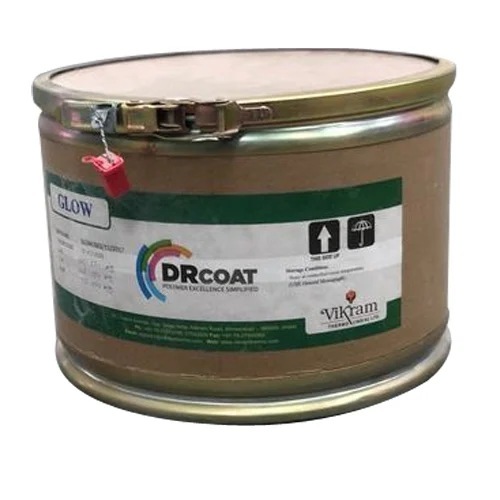
Their flagship brand portfolio includes DRCoat, an enteric and film coating system that stops pills from dissolving in your stomach when they are meant to dissolve in your intestines, and Apion, an ion-exchange polymer used for masking the terrible taste of liquid suspensions. They also run a line called AquaPol for cosmetic formulations, acting as thickeners that give gels their premium texture.
With two manufacturing units in Gujarat dividing up a combined capacity—Unit 1 handling approximately 6,000 tonnes per annum (TPA) and Unit 2 handling 4,000 TPA—the business is structurally geared toward specialized chemical processing. In terms of product mix, the sale of finished goods makes up 99% of its revenue, leaving just 1% for random operating side-hustles. They make the invisible structural scaffolding that holds the global generic pill market together.
Section 4 — Financials Overview
Figures are consolidated, in ₹ crore.
Metric
Latest Quarter (Mar 2026)
YoY
QoQ
Revenue
37.77
39.32%
11.02%
EBITDA / Operating Profit
11.96
79.31%
-20.95%
PAT
8.52
109.34%
-22.26%
EPS
2.71
108.46%
-22.35%
The year-on-year revenue surge of 39.32% to ₹37.77 crore indicates a strong structural expansion in underlying volume shipments. Quality of earnings remains resilient on a annual trajectory, even though the sequential drop of 20.95% in operating profit from December 2025 emphasizes that specialized chemical shipments are inherently uneven and lumpy between quarters.
Financial Wisdom Drop: Short-term sequential fluctuations in raw margins are the price an investor pays for structural concentration in high-spec niche processing. Evaluating a business on sequential quarter-on-quarter movements can cause you to mistake normal operational scheduling for an actual corporate breakdown.
Reviewing recent structural notifications, the board has authorized a final dividend of 12.5% (amounting to ₹1.25 per share on a face value of ₹10) alongside the fresh appointment of cost and internal auditors to monitor operational efficiency.
Section 5 — Valuation Discussion: Fair Value Range Only
To determine where Vikram Thermo sits without inventing fictional targets, we must evaluate the business through standard, cold math lines using a current market price of ₹191 and full-year FY26 basic EPS of ₹12.26.
Method 1: P/E Multiple Range
The peer group for broader chemical and specialty businesses trades inside a valuation band between 15x and