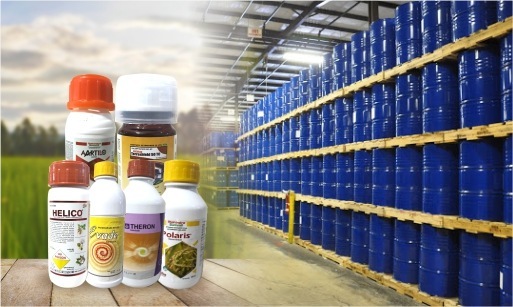
Bharat Rasayan Mar 2026: The Agrochemical Survivalist Flaunting a 52% Profit Surge and a 1.23 Crore Debt Line
Date of Publishing -
Spotted a factual error — a wrong number, date, or fact? Tell us and we will check the source.
Section 1 — At a Glance
The structural transformation of corporate earnings becomes apparent only when macro-economic headwinds begin to subside. Bharat Rasayan Limited enters the final stretch of the financial year showing pronounced divergence between volume resilience and global realisations. The headline figures indicate a recovery in progress, yet the underlying operational matrix signals that the domestic agricultural landscape is carrying the weight of a slow-moving international market.
Total operating revenue for March 2026 reached ₹308 crore, showing flat performance sequentially but hiding a more structural 52% expansion in quarterly net profit, which stood at ₹43.25 crore. This compression and subsequent expansion of margins highlights the inherent cyclicality of the technical grade pesticide market. Investors tracking the business are balancing two contrasting realities: a robust domestic demand profile buoyed by normalized monsoon patterns against an export framework still healing from intense Chinese destocking and severe global inventory gluts.
The primary structural risk continues to be customer and product concentration. The top ten customers command more than half of the total operating income, leaving capital deployment highly sensitive to the supply chain strategies of a few global agrochemical majors.
Earnings quality is determined not by peak performance during regulatory tailwinds, but by capital preservation capabilities when realization prices drop across the sector.
The transition from basic technical manufacturing toward specialized formulations and collaborative joint ventures represents the next operational chapter for the company. Whether this migration can insulate the return profile from erratic climatic patterns remains the core thesis for long-term capital allocation.
Section 2 — Introduction
Bharat Rasayan is not your typical high-street chemical enterprise spinning generic liquids into fancy plastic bottles. Established in 1989, this entity operates as a backbone manufacturer for some of the biggest institutional names in the global crop protection universe. When global agricultural giants need the pure, unadulterated active molecules that actually keep bugs from throwing a party in a paddy field, they route their procurement orders through this low-profile player.
The corporate narrative over the last twenty-four months has been a textbook study in industrial endurance. The business has shifted from a heavily export-reliant engine to a domestic-heavy supplier out of pure tactical necessity. As international chemical valuations experienced a massive correction due to excess supply from across the border, management chose to fortify its Indian distribution channels instead of fighting margin-destructive price wars abroad.
Section 3 — Business Model: WTF Do They Even Do?
To understand Bharat Rasayan, you have to realize they are the folks who bake the raw flour, not the ones selling the frosted cupcakes at a premium retail counter. They manufacture Technical Grade Pesticides and Intermediates. In the agricultural chemical hierarchy, “Technical” means the raw, high-concentration chemical compounds.
The business model is heavily skewed toward these raw active ingredients:
Technical Pesticides: 80% of sales
Intermediates (The ingredients for the ingredients): 18% of sales
Formulations (The actual consumer product): 2% of sales
They boast massive industrial infrastructure, with a 29,200 MTPA plant at Dahej in Gujarat and a 4,260 MTPA facility at Mokhra in Haryana. They sell these molecules to massive aggregators like Syngenta, Sumitomo Chemical, and Rallis India. The setup is highly concentrated: their top 10 products account for 66% of total sales, and their top 10 institutional customers buy up 63% of their entire output. If a single global customer decides to alter its inventory policy, the sales graph experiences immediate turbulence.
Section 4 — Financials Overview
Figures are consolidated, in ₹ crore.
Quarterly Performance Trend
Metric
Latest Quarter (Mar 2026)
YoY
QoQ
Revenue
308.00
0.49%
14.07%
EBITDA / Operating Profit
50.00
-7.41%
21.95%
PAT
39.00
15.82%
14.71%
Reported EPS (₹)
23.54
15.84%
15.11%
The top-line growth seems to be moving with all the urgency of a snail on a cold morning, printing a minuscule 0.49% YoY revenue increase at ₹308 crore. However, look at the net profit line: it managed a 15.82% YoY increase to land at ₹39 crore. Sequentially, the revenue jumped 14.07% from ₹270 crore in December 2025, showing that domestic demand is doing some heavy lifting while the international segments iron out their pricing disputes.
What is Management Promising in the Coming Quarters?
Based on recent operational communications, management is steering the ship toward long-term asset creation rather than chasing short-term volume metrics. They are currently evaluating a massive ₹500 crore greenfield capex for an entirely new manufacturing plant in Gujarat, which will be