HeidelbergCement India FY26: The Zero-Debt Flex With a 12% Margin Reality Check
Section 1 — At a Glance
HeidelbergCement India Limited is standing at a fascinating financial crossroads where its balance sheet strength is throwing a fierce challenge to its growth reality. In FY26, the company achieved total sales of ₹2,329.59 crore, recovering from the ₹2,148.88 crore it logged in FY25, while expanding its volume by 8.8% to 4.9 million tonnes. More spectacularly, the company achieved its highly publicised goal of becoming completely debt-free, wiping its long-term borrowings line to absolute zero and accumulating ₹403.70 crore in cash and bank balances.
Yet, underneath this flawless fortress lies a structural growth puzzle. Operating profit margins, which scaled a heights of 24% in FY21, have structurally cooled down to 12.32% in FY26. Return on Equity lingers at 10.08%, failing to cross the company’s cost of capital comfortably. The domestic market has priced this defensive cash machine at a Price-to-Earnings multiple of 26.36 times, reflecting a premium that expects Germany’s engineering parentage to unleash aggressive capacity expansion or complete its long-delayed merger with Zuari Cement. True value cannot hide behind a debt-free flag forever; operational efficiency must ultimately lift the heavy weight of capital returns.
Section 2 — Introduction
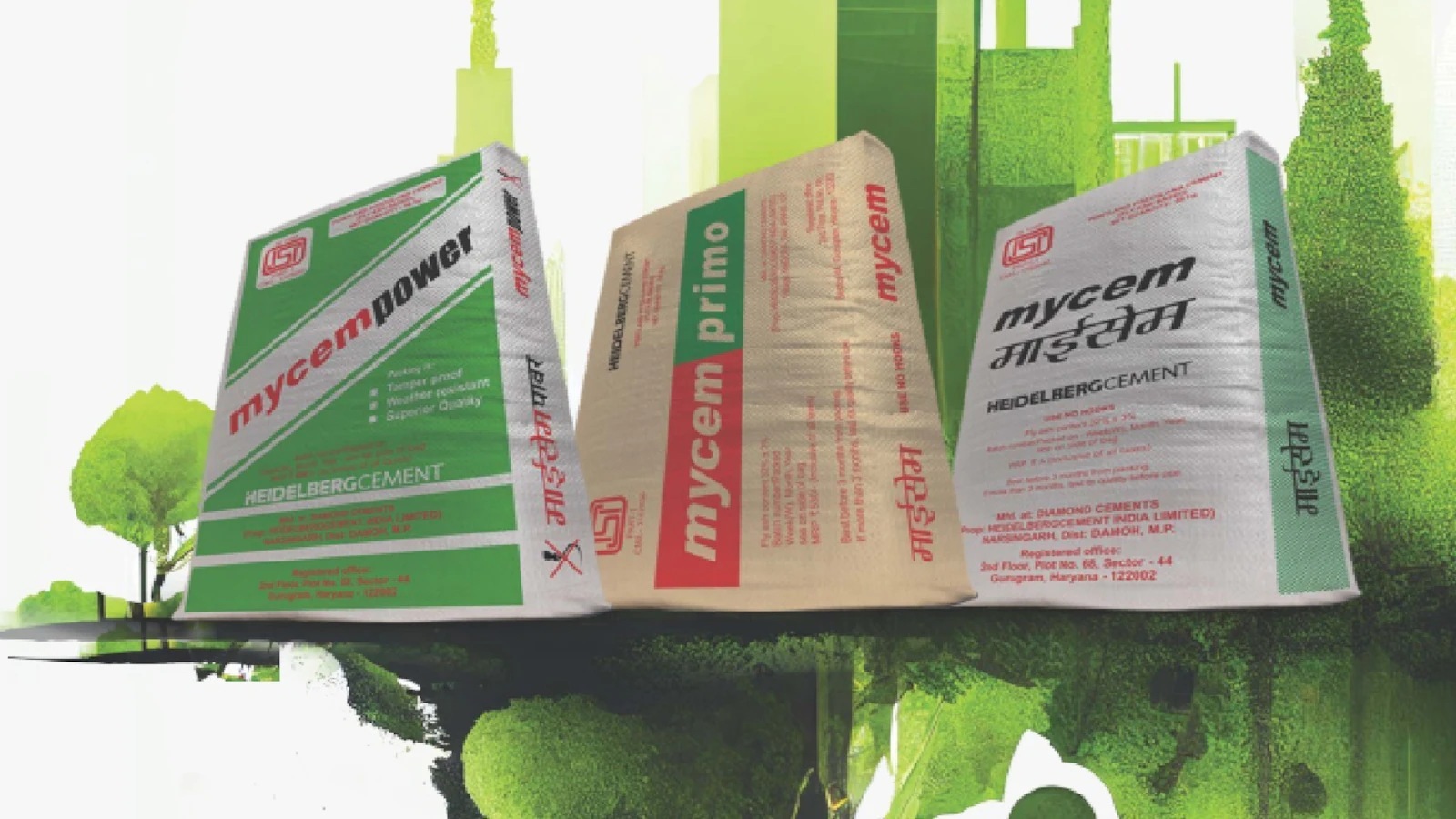
Welcome to HeidelbergCement India, the domestic listed arm of Germany’s Heidelberg Materials Group. While the global parent flexes its muscles as the absolute heavy-weight champion in international aggregate production, its Indian child operates a more focused, compact playground. With principal grinding and blending operations spanning Central India (Damoh in Madhya Pradesh, Jhansi in Uttar Pradesh) and an isolated Southern outpost in Ammasandra, Karnataka, the company handles a total capacity of approximately 6.26 million tonnes per annum. It doesn’t pretend to be an UltraTech or an Ambuja. Instead, it contents itself with reigning over its regional pockets under the MyCem and MyCem Power brands, trying to turn geographic focus into an absolute economic moat.
Section 3 — Business Model: WTF Do They Even Do?
If you think cement manufacturing is a complex technological frontier, let’s demystify it: Heidelberg basically digs up limestone in Madhya Pradesh, carries it over a ridiculously long 21-kilometer mechanical conveyor belt to its grinding plants, mixes it up with fly ash, and bags it for retail consumption.
The company is a 100% blended cement purist, which is corporate shorthand for saying they don’t sell ordinary Portland cement if they can avoid it. Instead, they focus heavily on sustainability and premiumization. They managed to push their alternative fuel ratio to 11% this year, while green power now constitutes more than 40% of their total energy consumption. They claim their trade segment volume share jumped by 9% to make up 81% of total sales, which means they are heavily reliant on individual home builders buying premium bags from retail dealers rather than selling cheap cement to infrastructure developers in bulk. It’s an admirable strategy, right until localized pricing wars disrupt the neighborhood.
Section 4 — Financials Overview
Figures are consolidated, in ₹ crore.
Metric
Latest Quarter (Mar ’26)
YoY Change (%)
QoQ Change (%)
Revenue
646.20
5.51%
12.58%
EBITDA
87.90
-2.98%
65.85%
PAT
45.21
-5.67%
191.68%
EPS (₹)
2.00
-5.66%
189.86%
While the sequential recovery from the dismal December quarter looks like a rocket ship, the yearly comparison tells a story of intense pricing pressure. Sales volumes are up, but realizations are flat to negative.
What is Management Promising in the Coming Quarters?
During the earnings interaction, management sounded cautiously optimistic, pointing directly to the upcoming state elections in Uttar Pradesh to provide a massive infrastructure impetus for cement demand in Central India. Senior Vice President of Finance, Amit Angra, explicitly highlighted a significant structural tailwind, stating that the recent reduction in GST on cement from 28% to 18% during FY26 will cushion short-to-medium term consumption. However, the swagger was tempered by real-world friction. Management noted, “With an increase in input prices, we will try to pass on the same to customers,” while simultaneously warning that El Niño patterns could threaten agricultural output and suppress rural homebuilding demand.
Section 5 — Valuation Discussion: Fair Value Range Only
To find out what this concrete mixer is actually worth, we deploy our three-step quantitative filter. With 22.66 crore shares outstanding, Heidelberg’s FY26 reported EPS lands exactly at ₹5.91.
P/E Multiplier Method: Historically, mid-sized cement peers trade in a band of 20x to 28x earnings. Multiplying our FY26 EPS of ₹5.91 by this band gives us a valuation range