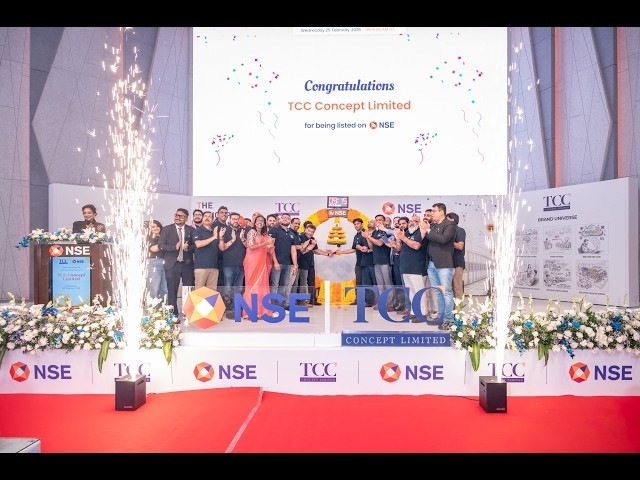
TCC Concept FY26: The ₹661 Crore Furniture Gamble on an Empty Stomach
Section 1 — At a Glance
The corporate evolution of smaller enterprises frequently features unexpected operational shifts, but few present as complex a financial architecture as TCC Concept Limited. Over a brief multi-year window, the entity has transitioned from its historical origins in textile trading to operating as an office space aggregator, subsequently absorbing a series of technology, data center, and consumer digital platforms via equity-swapping arrangements. The structural changes culminated in late FY26 with the ambitious consolidation of e-commerce marketplace Pepperfry and its logistics arm Pepcart for a consideration of ₹661.47 crore.
While headline figures indicate significant scale expansion, the underlying corporate vitals demand rigorous examination. Consolidated revenue for FY26 reached ₹179.39 crore, supported by an operating profit of ₹96.97 crore. However, a substantial portion of the bottom-line expansion is driven by non-operating elements, with Other Income surging to ₹26.95 crore. Concurrently, the operational framework exhibits a persistent divergence between accounting profits and actual cash realization, with trade receivables expanding significantly to ₹57.80 crore.
The primary point of investor focus sits on the massive transformation of the balance sheet. Total assets have expanded to ₹2,106 crore, heavily weighted toward fixed assets and investments acquired through share-swap diluted equity rather than organic cash generation. With return on equity (ROE) remaining constrained at 5.35% and return on capital employed (ROCE) at 5.65%, the core dilemmatic focus rests on whether the massive asset base can be productively monetized. Corporate earnings quality depends entirely on structural cash conversion rather than the sheer velocity of asset gathering. The immediate forward outlook remains tied to whether this collection of distinct business verticals can function as an integrated ecosystem or if it remains an expensive assembly of disparate corporate parts.
Section 2 — Introduction
TCC Concept Limited, originally born in 1984 under the modest avatar of Aaswa Trading and Exports Ltd, spent its early decades engaged in cotton fabric trading. In FY24, the company executed a hard pivot, changing its name, shifting its registered corporate office from Gujarat to Pune, and altering its main object clause to enter commercial real estate, co-working aggregator solutions, and tech-enabled lead generation platforms.
The strategy has been defined by rapid inorganic growth. Through successive share-swap transactions, the company acquired Brantford (flexible workspaces), EMF Clinic (healthcare infrastructure), Altrr Software, and Natural Environment Solutions (NES Data). The final months of FY26 witnessed its largest transaction yet: the acquisition of a 98.98% stake in online furniture marketplace Pepperfry and 100% of Pepcart.
Section 3 — Business Model: WTF Do They Even Do?
Trying to map TCC Concept’s current business model feels like watching someone try to assemble a jigsaw puzzle using pieces from five different boxes. At its lower tier, the company functions as a capital-light, flexible office space aggregator, pulling in traditional real estate brokerage commissions and project management fees. It services corporate clients by facilitating co-working transactions and generating workspace leads through digital systems.
Then the technology layers arrive. Through its subsidiaries, the company sells private cloud setups on user-owned hardware (MyFlopy) and licenses a real estate artificial intelligence tool called TryThat.ai, which charges builders hefty subscriptions ranging from ₹50,000 to ₹2,000,000 per project.
Just in case that did not provide enough variety, the company also operates a 4 MW Tier-III data center in Hinjewadi under NES Data, renting out physical racks for enterprise colocation. To complete the mosaic, the massive FY26 entry into Pepperfry transforms them overnight into an omnichannel consumer e-commerce retailer selling coffee tables and homegrown artisan décor alongside a big-box logistics distribution network. It is an end-to-end ecosystem where your real estate broker also hosts your cloud servers and delivers your sofa.
Section 4 — Financials Overview
Figures are consolidated, in ₹ crore.
Quarterly Performance Trend
Metric
Latest Quarter (Mar 2026)
YoY
QoQ
Revenue
83.87
162.1%
235.5%
EBITDA / Operating Profit
28.00
115.4%
-6.7%
PAT
30.98
209.8%
416.3%
Reported EPS (₹)
6.14
156.9%
109.6%
The top-line numbers for the March 2026 quarter show an explosive absolute jump, heavily influenced by the closing phases of the Pepperfry consolidation. Quarterly revenue experienced a 162% year-on-year surge to touch ₹83.87 crore. However, sequentially, while revenue grew by 235.5% over December 2025’s print of ₹25.00 crore, Operating Profit actually downshifted by 6.7%, dropping from ₹30.00 crore to ₹28.00 crore. This severe margin compression is a stark reminder that high-volume consumer retail revenues do not pack the same structural profitability punch as asset-light tech platforms.
What is Management Promising in the Coming Quarters?
During the latest earnings deliberations, management focused heavily on their ambitious long-term projections, targeting a consolidated platform revenue potential of ₹3,000 crore by FY30. For the immediate upcoming quarters, the leadership team outlined plans to scale B2B monetization for TryThat.ai and expand the data center infrastructure footprint with a 100 MW hyperscale campus blueprint. For the consumer tech segment, the stated goal is to add over 50 omnichannel Pepperfry studios in FY27 while leveraging Pepcart to drive down delivery costs.
Section 5 — Valuation Discussion: Fair Value Range Only
To find where TCC Concept should realistically sit on the valuation spectrum, we must navigate a cap table that has been diluted extensively via share swaps.
1. P/E Multiple Method
The company’s reported full-year FY26 Net Profit stands at ₹64.83 crore. With a closing share capital base of 4.75 crore shares outstanding, the non-annualized, full-year Reported EPS comes to ₹13.65. Looking across the broader internet and catalogue retail peer universe, valuation multiples occupy a wide band. Premium players like Info Edge trade at historical P/E multiples north of 45x, while mature or alternative transactional platforms like IndiaMart and Matrimony trade between 25x and 26x. Applying a peer-justified, conservative P/E band of 22x to 28x to TCC’s FY26 EPS of ₹13.65 yields a valuation range of ₹300 to ₹382 per share.
2. EV/EBITDA Method
For FY26, the calculated consolidated EBITDA (Profit Before Tax of ₹54.40 crore + Interest of ₹2.20 crore + Depreciation of ₹4.80 crore) stands at ₹61.40 crore. Based on the current close price of ₹370, the equity market capitalization sits at ₹1,760 crore. Factoring in total borrowings of ₹291 crore and cash balances of ₹79.60 crore yields an Enterprise Value (EV) of ₹1,971 crore, placing the trailing EV/EBITDA multiple at a rich 32.1x. Applying a normalized infrastructure-plus-platform EV/EBITDA multiple range of 24x to 30x to our core EBITDA of ₹61.40 crore frames an alternative enterprise value zone, which translates to a per-share value range of ₹311 to ₹389.
3. Discounted Cash Flow (DCF) Approach
A simplified two-stage DCF model was constructed utilizing the FY26 Free Cash Flow print of negative ₹35.00 crore as the initial base, but adjusting for normalized operating cash flows of ₹14.20 crore as the Pepperfry supply chain efficiencies stabilize. Assuming a cost of capital (WACC) of 12.5% reflecting small-cap equity risk, an optimized high-growth phase of 15% for the platform verticals over the next 5 years, and a conservative terminal growth rate of 4.5%, the discounted asset value range clusters tightly around the asset’s tangible net worth base.
Blending these three quantitative methodologies highlights a clear structural valuation channel.
Lower Bound Valuation Zone: ₹303
Upper Bound Valuation Zone: ₹385
This fair value range is for educational purposes only and is not investment advice.
Section 6 — What’s Cooking: News, Triggers, Drama
The corporate announcements pipeline at TCC Concept plays out like a high-stakes financial thriller, dominated by continuous structural changes.
The Pepperfry Mega-Deal: The company completed the preferential share-swap acquisition of a 98.98% stake in Pepperfry for a total valuation consideration of ₹661.47 crore.
Pepcart Absorption: In tandem with the marketplace, TCC took 100% control of Pepcart for ₹7.50 crore, bringing an active big-box delivery engine into the corporate fold.