Excel Industries FY26: A ₹1,095 Cr Chemistry Experiment in Survival
Section 1 — At a Glance
A multi-year supply glut from international manufacturing hubs combined with severe domestic weather anomalies has forced a strategic structural shift at Excel Industries. The company concluded FY26 with a consolidated revenue of ₹1,094.52 crore, representing an 11.91% increase from the previous year’s base of ₹978.07 crore. However, this expansion in volume and topline scale came at a significant cost to operating leverage. Core operating earnings faced severe compression as inflationary pressures across key raw material chemical groups could not be fully absorbed, driving a deceleration in profit margins.
Investor sentiment remains divided between structural vulnerabilities and emerging long-term catalysts. The business continues to struggle with high concentration risk, where a single product group represents more than 40% of standard operations, directly exposing performance to international regulatory shifts and global commodity price cycles. Furthermore, working capital cycles have elongated dramatically, driven by inventory accumulation and extended credit terms to downstream agricultural clients.
Conversely, speculative attention is intensifying around a multi-year contract manufacturing pipeline. Dedicated production capacities are scheduled to come online in mid-2026, backed by structural capital deployment and non-refundable customer advances. Capital deployment efficiency remains a core focal point for market observers evaluating the company’s ability to transition away from low-margin seasonal intermediates into value-accretive performance solutions.
Structural structural shifts in commodity chemical cycles demonstrate that volume scaling without concurrent pricing power serves to deplete equity returns rather than preserve them.
The critical question for long-term allocators is whether a debt-free balance sheet provides enough runtime for these contract pipelines to fundamentally alter the return profile of the firm.
Section 2 — Introduction
Excel Industries Limited is a veteran of the domestic specialty chemical and intermediate landscape. Established with the legacy mandate of developing import-substitution process chemistry, the company has grown into a highly specialized manufacturer operating across basic and advanced phosphorus derivatives.
Operationally, the business is integrated across complex chemical unit processes, servicing sectors ranging from crop protection to pharmaceuticals and industrial water treatment. The company has historically calibrated its operational footprint across three major manufacturing hubs and an established network of industrial research scientists.
In recent months, the company has focused its corporate strategy on defensive structural balancing. To insulate the consolidated business from the extreme boom-and-bust cycles characteristic of domestic agricultural inputs, management has operationalized new research infrastructure in Navi Mumbai and initiated selective product expansions. These investments aim to transition the organization from a merchant supplier of volatile intermediates into a high-barrier contract synthesis partner for multinational corporations.
Section 3 — Business Model: WTF Do They Even Do?
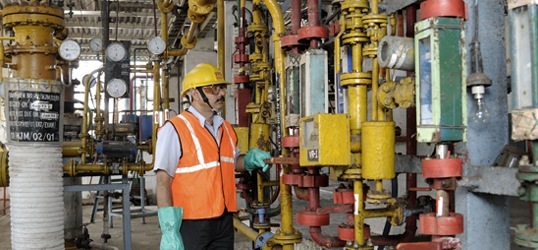
At its core, Excel Industries functions as an industrial kitchen that transforms toxic yellow phosphorus into components that either keep crops alive or stop industrial boilers from rusting away. The business model is heavily anchored to phosphorus chemistry, which management proudly describes as a “double-edged sword”—though lately, it looks more like a sword without a handle.
The company’s commercial operations are divided into two highly unequal parts:
Chemicals (98% of Revenue): This is where the heavy lifting happens. They produce Diethylthiophosphoryl Chloride (DETC)—a mouthful of a chemical where they boast a global number-one market position—and a suite of phosphonates where they sit in the global top five. These go into organophosphorus insecticides, herbicides, and water treatment systems.
Environment and Biotech (2% of Revenue): A tiny corporate side-hustle that deals in municipal solid waste management and organic waste converters. It provides excellent material for sustainability brochures, but practically zero impact on the consolidated cash generation of the firm.
The structural risk here is glaring product concentration. DETC alone accounts for approximately 40% of total revenue. Because DETC is a primary raw material for generic agrochemical technicals like chlorpyrifos, Excel’s fortunes are permanently tied to global generic crop protection cycles and regulatory bans. When global generic agrochemicals sneeze, Excel goes into commercial intensive care.
Section 4 — Financials Overview
Figures are consolidated, in ₹ crore.
Performance Trend Table
Metric
Latest Quarter (Mar ’26)
YoY (%)
QoQ (%)
Revenue
281.24
13.48%
20.42%
EBITDA / Operating Profit
21.98
80.02%
39.64%
PAT
12.28
-1.05%
45.50%
EPS (₹)
9.77
-1.21%
45.60%
The top-line performance shows clear signs of volume restocking, with revenue climbing 13.48% year-on-year to ₹281.24 crore. Operating profit lines staged a dramatic optical recovery, vaulting 80.02% over the severely depressed baseline of the previous year’s final quarter.
However, net profitability failed to follow this upward trajectory, with quarterly PAT down slightly due to shifts in tax provisions and compressed non-operating incomes.
Did Management Walk the Talk?
During previous interactions, management expressed confidence that the severe destocking cycle that decimated the chemical industry would normalize, paving the way for structural volume recovery. The numbers show they were right about the volumes, but wrong about the friction involved in getting them.
Topline volume recovery arrived, but it brought along an unfavorable raw material pricing environment that crimped consolidated margins. On the latest calls, the team adopted a far more defensive posture:
“Uncertainty about agrochemical intermediates demand going forward on account of the possibility of suboptimal monsoon as per the El Niño forecasts… Given the overall uncertainty and volatility, it is not possible to make any forward statements.”
This total withdrawal of forward visibility reveals that while structural asset expansions are progressing on schedule, management is entirely at the mercy of global supply chains and erratic cloud formations.
Section 5 — Valuation Discussion: Fair Value Range Only
To evaluate the intrinsic positioning of Excel Industries, we analyze its financial structure using multiple historical and peer-derived metrics based on its current market capitalization of ₹1,166.69 crore and current market price of ₹928.10.
P/E Multiplier Method
The company reported a consolidated full-year EPS of ₹60.20 for FY26. Over the trailing five-year period, the historical median P/E for the business has gravitated around 16.1x.
Applying a conservative peer-discounted band of 14x to 17x to the current earnings base yields an estimated valuation range of