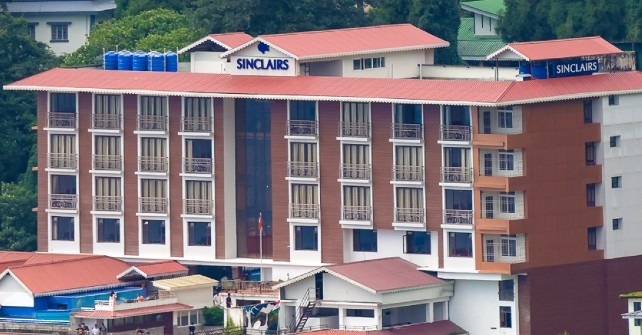
Sinclairs Hotels FY26: The Sinking Net Profit vs The Expanding Footprint
Section 1 — At a Glance
The financial narrative of Sinclairs Hotels Limited in the fiscal year ended March 31, 2026, presents a stark divergence between operational scale and bottom-line reality. Total revenue from operations reached an all-time high of ₹59.24 crore, representing an 10.89% expansion year-on-year from ₹53.42 crore in FY25. However, this top-line expansion failed to transmit down the income statement. Net profit dropped precipitously by 35.36%, closing the year at ₹9.05 crore against ₹14.00 crore in the prior fiscal period. This earnings contraction comes at a time when the market is demanding aggressive performance, squeezing return metrics and leaving investors to parse whether this drop indicates structural strain or temporary adjustments.
The operational backdrop reveals an aggressive multi-property asset pivot, with the company expanding its footprint via leasehold properties in newer geographies such as Rajasthan. Total room inventory expanded from 503 keys across 9 properties to 581 keys across 10 properties by the end of FY26. While physical capacity scales up, capital efficiency metrics show significant compression. Return on Equity (ROE) slipped to 7.63% , down from historic double-digit baselines, while the stock continues to command a steep market valuation.
True underlying corporate health is rarely revealed by physical expansion alone; real performance is measured by the ability to extract profits from every new room added to the balance sheet.
Investors are now left to evaluate whether this aggressive lease-driven footprint will yield sustainable profitability or permanently dilute the asset-light premium that the market had previously priced into the equity shares.
Section 2 — Introduction
Sinclairs Hotels Limited operates as a notable player within India’s boutique leisure hospitality space, historically maintaining a focused presence across regional tourism clusters. The company specializes in identifying and building out hospitality assets in premium leisure, heritage, and gateway hubs, primarily across West Bengal, Sikkim, the Andaman Islands, and South India. Over the decades, management built a reputation for running high-margin, cash-generative operations backed by debt-free, freehold property ownership across several core assets.
However, the strategic playbook is undergoing an unmistakable transformation. The traditional emphasis on owning freehold properties in localized geographies has shifted toward an asset-light, leasehold model designed to rapidly capture market share in competitive north-western corridors like Rajasthan. Managing leased multi-star inventory in geographically dispersed areas introduces structural dynamics quite distinct from operating a legacy portfolio of family-owned hillside retreats. As the company steps onto the national stage, the operational overheads are shifting ahead of revenue maturation, forcing a realignment of expectations across its shareholder base.
Section 3 — Business Model: WTF Do They Even Do?
Sinclairs sells rooms, food, and banquet spaces to tired corporate executives, sun-seeking tourists, and families looking to host weddings without managing the logistics themselves. Historically, they focused on West Bengal and regional micro-markets like Darjeeling, Siliguri, Kalimpong, Burdwan, and the Dooars plains. They also maintain long-standing strongholds in Ooty and Port Blair.
The corporate architecture has recently mutated. Management has added leasehold properties in Rajasthan, bringing online Sinclairs Udaipur (56 rooms) and the sprawling Sinclairs Palace Retreat Udaipur (95 rooms).
[Legacy Freehold Assets] --------> Cash Generation ---------> [New Rajasthan Leases]
(West Bengal, Ooty, Port Blair) (Udaipur, Haldighati Expansion)
The model relies on capturing premium room rates while trying to keep fixed employee costs from eating the house. However, transitioning from a cozy cluster of local properties to managing multi-state lease agreements means paying fixed rents even when the tourist season takes a breather. While their properties boast high rankings on travel platforms, the business model remains fundamentally exposed to the realities of a cyclical industry: you cannot store unsold room nights for next quarter.