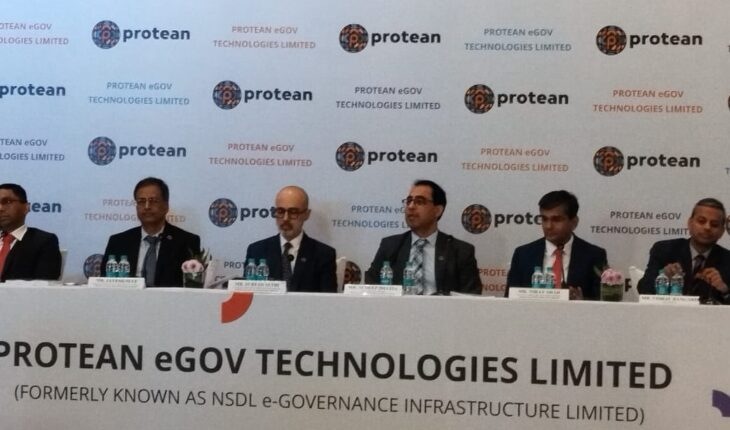
Protean eGov FY26: A ₹44 Crore Storage Party Masking the High Cost of Public Service
1. At a Glance
The structural transformation of a sovereign-grade digital utility is rarely linear, and Protean eGov Technologies Limited’s FY26 financial print demonstrates why. The headline numbers present a business operating at historic scale, with annual revenue touching a record ₹997.75 crore —a 18.68% year-on-year expansion —while consolidated profit before tax (PBT) reached ₹130.24 crore. However, this growth trajectory requires careful inspection. Beneath the top-line acceleration lies a fundamental shift in business mix, characterized by a rapid scaling of low-margin, operationally intensive new verticals alongside a mature, highly profitable core that is experiencing structural pricing recalibrations.
A primary focal point for investor attention is the quality of earnings delivered in the final quarter of the fiscal year. Q4 FY26 revenue accelerated sharply to ₹307.54 crore, but this spike was heavily driven by a non-recurring billing of ₹44 crore recognized as storage charges from the Income Tax Department. This billing relates to accumulated services spanning the last 2.5 to 3 years and is subject to a matching cost structure that alters the company’s traditional operating profit margins (OPM).
Concurrently, the company is embarking on a massive, physically intensive rollout of 190 Aadhaar Seva Kendras (ASKs), requiring the addition of approximately 2,000 entry-level personnel. This creates a structural timing mismatch where costs precede steady-state transaction revenues.
When a digital platform business starts scaling via brick-and-mortar infrastructure and massive headcount additions, its economic profile shifts from pure technology leverage to managed services. Investors must distinguish between structural volume growth and one-time billing windfalls to accurately assess long-term capital efficiency.
As the company transitions to a new leadership regime under an incoming Managing Director and CEO effective June 1, 2026, the strategic path forward is clear. Protean is intentionally trading near-term margin predictability for a dominant position in emerging Digital Public Infrastructure (DPI) rails. The core investment thesis now rests on whether these new, lower-margin project wins can achieve the operating leverage necessary to sustain historical return profiles.
2. Introduction
Protean eGov Technologies Limited, historically born as NSDL e-Governance Infrastructure Ltd, has spent the better part of three decades operating as the central nervous system for India’s population-scale digital architecture. The company has moved from managing tax identities to acting as the primary custodian for public recordkeeping and identity verification registries.
It is a business that essentially functions as a regulated digital monopoly or duopoly across its primary operating fields, building deep competitive moats through complex technological integrations with multiple ministries and regulatory bodies.
The fiscal year 2026 has been characterized by an aggressive push to diversify away from this legacy footprint. While the market has traditionally valued Protean as an asset-light, transactional technology play, management’s current blueprint involves building out expansive physical and digital hybrid networks.
This includes everything from open digital ecosystems like the Open Network for Digital Commerce (ONDC) and Bima Sugam to a massive district-level footprint for identity management. The operational transition is substantial, moving the business model into uncharted territory where execution risk shifts from software code stability to large-scale human resource management.
3. Business Model: WTF Do They Even Do?
If you have ever applied for a permanent account number, checked your pension accumulation under the National Pension System (NPS), or had your identity validated via an e-KYC prompt during a bank onboarding process, you have interacted with Protean’s infrastructure. The company operates through four primary segments that are structurally distinct but highly dependent on the same underlying software engines:
Tax Services (PAN): This is the legacy cash engine. Protean manages the backend infrastructure for fresh issuances, updates, and database verifications of PAN cards, holding a cumulative market share of 64%. It is essentially a prepaid, transaction-driven utility business where volume scales alongside the formalization of the Indian economy.
Central Recordkeeping Agency (CRA): Acting as the primary ledger keeper for the National Pension System (NPS), the Atal Pension Yojana (APY), and the newly minted Unified Pension Scheme (UPS). This segment boasts a near-monopolistic 98% market share and generates highly predictable, recurring annuity fees linked to subscriber additions and assets under management (AUM).
Identity Services: The operational core for foundational verification layers—covering online validation protocols, digital signatures (eSign), and e-KYC infrastructure. It is a pure B2B and B2G transactional volume play that thrives on every digital credit appraisal or account opening across the country.
New Businesses & Open Digital Ecosystems (ODEs): The strategic frontier. This involves constructing the foundational protocol layers for ONDC, building out national agriculture registries (Agristack), and developing custom sovereign cloud solutions.
The structural irony of the business model is delicious: it is a technology company that is currently building out 190 physical centers to scale its footprint, proving that even the most advanced digital stack in a developing economy eventually requires a real-world counter and a human being sitting behind it.