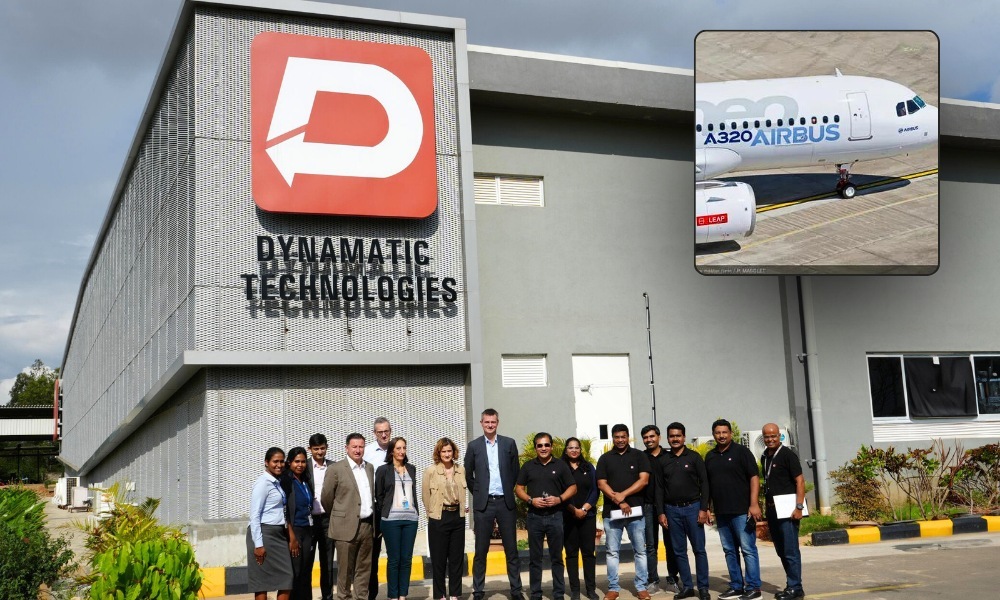
Dynamatic Technologies Ltd Mar 2026 : Aerospace Anchors Growth at 154x Earnings Trajectory
Section 1 — At a Glance
Dynamatic Technologies Limited closed its fiscal year 2026 with an operating revenue of ₹1,621.34 crore, reflecting a top-line expansion of 15.5% over the previous fiscal year. Operating Profit (EBITDA) tracked this trajectory precisely, climbing 15.4% to ₹182.68 crore. However, reported Net Profit for the full year contracted by 24.8% to ₹32.41 crore. This bottom-line friction was primarily induced by an exceptional item drag of ₹27.57 crore linked to the structural reorganization and intellectual property migration within its European subsidiaries.
The structural divergence across business divisions continues to dictate the company’s valuation framework. The high-margin Aerospace and Defence engine expanded by 27.6% annually to achieve a turnover of ₹775.61 crore, anchoring more than 60% of consolidated group earnings. Conversely, the lower-margin Metallurgy segment and shifting domestic Hydraulics operations continue to face localized operating friction, elevated energy costs, and restructuring costs in the United Kingdom.
Investor attention is heavily concentrated on the execution milestones of high-value international aerospace programs, notably the Airbus A220 door ship-sets and the strategic partnership alongside Dassault Aviation for regional defense platforms. However, an elongated net working capital cycle of 105 to 115 days, steep valuation relative to historical asset returns, and compressed performance across core European operational subsidiaries remain vital points of scrutiny for public market participants.
Financial Wisdom Drop: Operational expansion unbacked by capital optimization frequently masks underlying cash flow friction. Scaled revenue expansion is structurally hollow if it demands a proportionate increase in debt to support uncollected ledger balances.
The forward performance curve remains contingent on whether internal cost rationalization measures can efficiently bridge the gap between capital consumption and cash generation.
Section 2 — Introduction
Dynamatic Technologies Limited, established in 1973, occupies a specialized niche at the intersection of precision global aerospace tooling, automotive components, and hydraulic infrastructure systems. Operating high-precision manufacturing infrastructure across manufacturing clusters in Bangalore (India), Bristol and Swindon (United Kingdom), and Schwarzenberg (Germany), the organization operates as a highly specialized engineering partner to major global original equipment manufacturers (OEMs).
The business is undergoing a fundamental structural transition. Historically dependent on cyclical industrial asset cycles like agricultural tractors and automotive castings, the management has systematically deployed capital to pivot the revenue architecture toward long-gestation, high-entry-barrier global aerospace structural programs.
This comprehensive analysis evaluates the underlying execution trends of this multi-year operational repositioning, dissects the financial strains emerging from legacy overseas structures, and assesses whether the current market valuation aligns with corporate execution metrics.
Section 3 — Business Model: WTF Do They Even Do?
To the uninitiated public market investor, Dynamatic looks like a complex industrial conglomerate. Strip away the corporate jargon, and the business functions via three distinct operational engines:
Aerospace (48% of FY26 Revenue): This is the crown jewel division. The company operates as a Tier-I structural assembly supplier to global aerospace platforms like Airbus (A320 and A220 programs), Boeing, and Dassault Aviation. It manufactures wings, rear fuselages, complex door structures, and ailerons. High regulatory certifications ensure a virtual moat with multi-year contract visibility.
Hydraulics (30% of FY26 Revenue): The volume-driven utility engine. They produce high-pressure gear pumps and advanced control valves. The company commands an 80% market share in the organized Indian tractor manufacturer OEM base, alongside a 38% global agricultural machinery footprint.
Metallurgy (22% of FY26 Revenue): The legacy heavy-engineering vertical. Based out of advanced ferrous foundries in Germany, this segment delivers complex iron castings, turbocharger housings, and engine front manifolds for premium automotive groups including BMW, Audi, and Daimler.
The underlying corporate strategy focuses on shrinking the capital allocation toward low-margin casting operations while aggressively routing asset focus toward complex aerostructure programs where operating margins hover in the 25% zone.
Section 4 — Financials Overview
Figures are consolidated, in ₹ crore.
Quarterly and Full-Year Performance Trend
Metric
Latest Quarter (Mar 2026)
YoY (vs Mar 2025)
QoQ (vs Dec 2025)
Full Year FY2026
Full Year FY2025
YoY Full Year
Revenue
433.16
13.79%
1.95%
1,621.34
1,403.80
15.50%
EBITDA
48.61
28.12%
-2.88%
182.68
158.32
15.39%
PAT
12.56
-21.94%
117.68%
32.41
43.04
-24.70%
Reported EPS (₹)
18.51
-21.90%
117.76%
47.71
63.39
-24.74%
Source: Derived from raw quarterly statements and annual earnings summaries.*
Analytical Commentary
Top-line momentum during the final quarter of fiscal year 2026 remained positive, printing a 13.8% year-on-year improvement at ₹433.16 crore, driven by a 21.6% volume surge in the aerospace business pipeline. Quarterly EBITDA margins expanded by 120 basis points