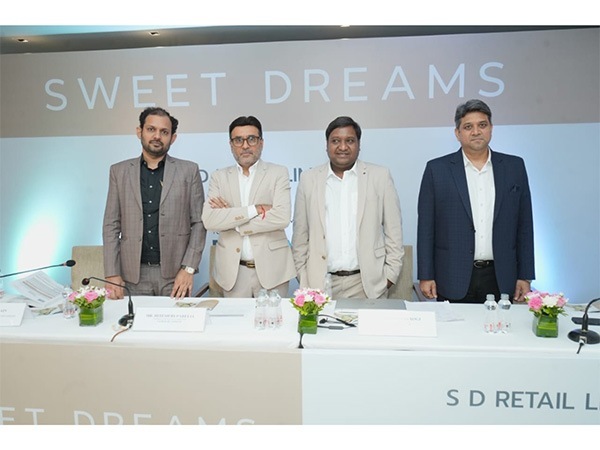
S D Retail FY26: Retail Footprint Expands 47% as Operating Cash Flow Sinks to -₹5.87 Crore
Section 1 — At a Glance
S D Retail Limited concluded the fiscal year ending March 31, 2026, with an annual revenue of ₹195.98 crore, achieving a top-line expansion of 31.91% compared to ₹148.60 crore in the prior fiscal year. Net profit for the full year reached ₹9.78 crore, up from ₹8.56 crore in fiscal year 2025 , yielding an annual reported earnings per share (EPS) of ₹5.22 based on 1.87 crore adjusted equity shares outstanding.
Metric
Value
Growth (YoY)
Revenue
₹195.98 Cr
+31.91%
Net Profit
₹9.78 Cr
+14.25%
Reported EPS
₹5.22
—
The primary catalyst captivating investor attention is the dramatic transformation of the company’s distribution matrix. S D Retail successfully expanded its Exclusive Brand Outlet (EBO) channel, scaling store count from 51 to 75 locations within twelve months and driving a massive 111% full-year revenue surge in this segment. Concurrently, the operational metric of annualized sales per square foot advanced marginally to ₹16,549.
However, this capital-intensive pipeline structural transition has introduced distinct operational frictions that are weighing heavily on structural efficiency. While the top-line expanded robustly, the full-year Operating Profit Margin (OPM) contracted to 8.16%, heavily diluting the benefits of operating leverage. This margin erosion was driven by deliberate overhead increases and upfront corporate investments. Furthermore, cash flows have decoupled severely from recorded accounting profits. The balance sheet remains trapped in an extended working capital cycle, with inventory days blowing out to 176 days , and cash generation dropping back into negative territory.
High top-line growth achieved via channel substitution is often an optical illusion that masks severe underlying balance sheet stress.
The primary structural enigma remains whether the high margin capture of direct retail can outrun the mounting cash burns of running brick-and-mortar operations.
Section 2 — Introduction
S D Retail Limited entered the public markets via an IPO on September 27, 2024, raising ₹65.00 crore on the NSE SME platform to fund an aggressive strategic pivot. For over two decades following its inception in 2004, the company functioned primarily as a legacy, general-trade apparel distributor. This analysis emerges at a vital juncture as management systematically attempts to transition from an unorganized multi-brand wholesaling model into a modern consumer-centric omnichannel lifestyle brand.
The company operates under the flagship “SWEET DREAMS” brand banner, focusing tightly on organized lounge and sleepwear. The structural rationale for tracking the entity right now rests upon its ongoing optimization moves, notably its recent decision to shut down underperforming Large Format Store (LFS) nodes. By sacrificing sub-scale revenue blocks, the business seeks to reposition its focus toward controlled premium retail pipelines. This transition presents a classic micro-cap case study: can a regional wholesaler successfully reposition itself as a national retail network without imploding its capital structure?
Section 3 — Business Model: WTF Do They Even Do?
S D Retail sells coordinated sleepwear sets designed for what it terms the “8 PM to 8 AM lifestyle”. Stripping away the marketing vernacular, they sell pyjamas, nighties, tracksuits, and casual loungewear targeted primarily at the mid-premium domestic apparel market. The product taxonomy covers three main demographics: women’s wear forms the clear bedrock of the business at 64% of revenues, followed by men’s wear at 28%, and kids’ apparel making up the remaining 8%.
Product Segment
Revenue Contribution
Women’s Wear
64%
Men’s Wear
28%
Kids’ Wear
8%
The underlying infrastructure leans heavily on an asset-light operating model. S D Retail maintains internal control over design, sampling, and data analytics while completely outsourcing actual manufacturing fabrication to third-party job workers in Ahmedabad, Gujarat. Products travel to consumers via four main pipelines: Multi-Brand Outlets (MBOs) still dominate the mix at 55% of full-year revenues, followed by the expanding EBO network at 24%, digital marketplace systems at 13%, and residual corporate or LFS spaces at 6%. Geographically, the brand faces severe concentration risks, with the North and West regions collectively swallowing 80% of total outbound volume.