Section 1 — At a Glance
JK Paper Ltd’s performance highlights a stark reality: volume growth means absolutely nothing if pricing power is stripped away by external global dynamics. While net sales managed to edge upwards to ₹7,076.03 crore in FY26 compared to ₹6,718.07 crore in FY25, the company’s bottom-line story took a severe hit. Net profit crumpled to ₹265.84 crore from ₹409.82 crore in the previous fiscal year, extending a bruising cyclical down-turn from its historic FY23 peak of ₹1,195.79 crore.
The primary trigger for this massive margin compression is a structural global oversupply. Domestic paper manufacturers have been severely hit by an influx of cheap imports from China and ASEAN countries, which forced widespread downward price corrections across the industry. At the same time, localized raw material pressures pushed wood feedstock costs up significantly over the last few fiscal periods. Investors are closely tracking JK Paper’s intensive expansion into non-paper packaging segments like corrugated boxes and mono-cartons, alongside a major ₹650 crore domestic pulp mill expansion aiming to shield future margins from erratic global pricing.
Cyclical commodity investing reminds us that peak-earnings valuations are almost always a structural mirage, as real capital destruction happens when deep multi-year capacity expansions collide with sudden global price corrections.
While a recent ₹49.53 crore tax demand deletion and a long-awaited corporate reorganization provide short-term sentiment relief, the central question remains whether regional capacity additions can successfully outrun structural macro headwinds.
Section 2 — Introduction
JK Paper Ltd, established way back in 1962, stands as one of India’s legacy paper manufacturers, traditionally known for dominating your office copier trays and printing presses. However, running a massive commodity business in the current economic landscape requires continuous structural adjustments.
This comprehensive review comes at a critical juncture for the company. Management is aggressively trying to pivot away from low-growth writing papers towards specialized packaging boards and value-added materials. In parallel, they are executing deep corporate restructuring. The National Company Law Tribunal (NCLT) finally sanctioned their composite scheme of arrangement in February 2026, creating structural consolidations across their core and allied paper entities. With corporate actions flying fast, evaluating what remains of the core earnings engine is critical.
Section 3 — Business Model: WTF Do They Even Do?
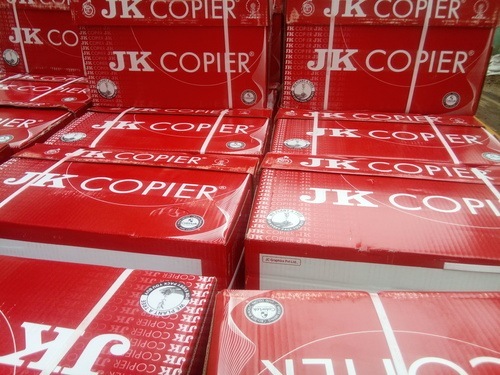
At its core, JK Paper turns wood, pulp, and massive amounts of energy into sheets of paper and packaging boards. However, the internal mix has dramatically evolved. In FY16, writing and printing paper brought in 90% of their revenue. Fast forward to FY24, and packaging paper makes up 40% of the revenue mix, followed by office copier paper at 35%, and writing/printing paper down to just 15%.
The company commands a solid 28% market share in copier paper and a 17% market share in the virgin packaging board segment. They run three major integrated manufacturing facilities located in Rayagada (Odisha), Songadh (Gujarat), and Kagaznagar (Telangana), pushing a total