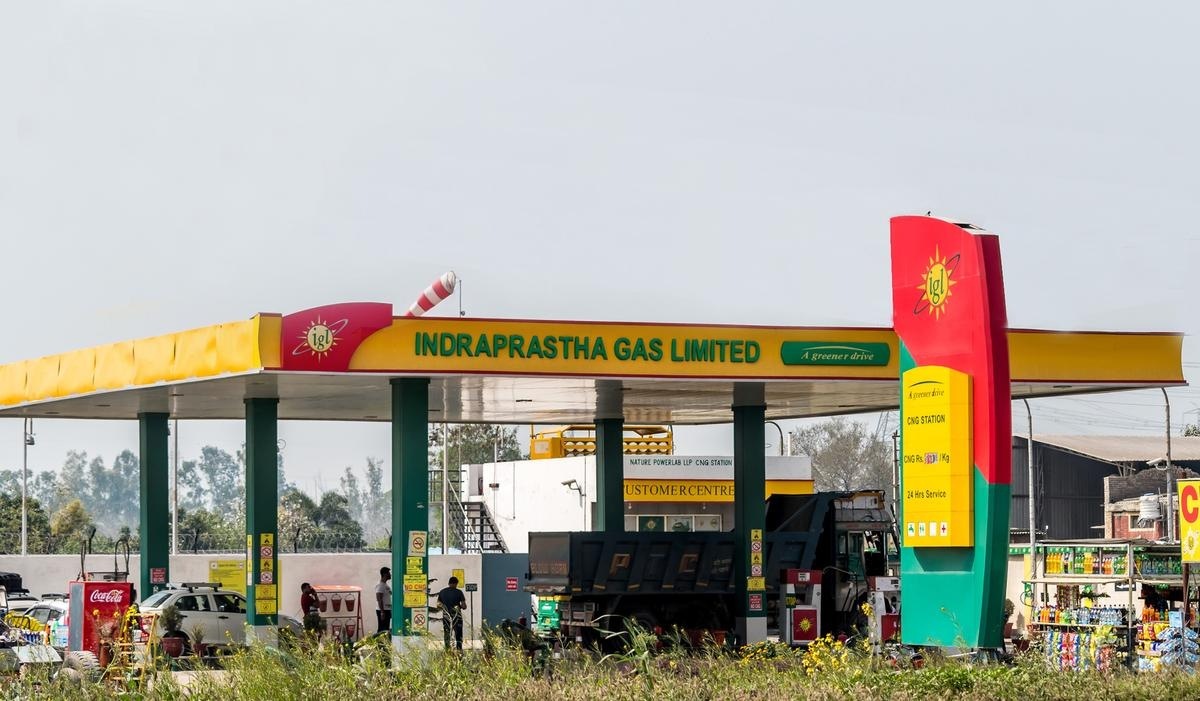
Indraprastha Gas LTD March 2026 : The 11% OPM Squeeze in the Capital’s Monopolistic Gas Pipeline
Section 1 — At a Glance
Indraprastha Gas Limited (IGL) presents a study in structural margin compression masked by resilient top-line execution. For the fiscal year ended March 31, 2026, the city gas distribution leader delivered a total revenue from operations of ₹16,167.59 crore, marking an 8.31% expansion over the previous year. However, this growth failed to translate down the income statement. Operating profit (EBITDA) contracted to ₹1,844.02 crore, forcing operating profit margins (OPM) down to an all-time low of 11.41%. Net profit after tax closely followed this downward trajectory, registering a 9.79% decline to settle at ₹1,549.62 crore.
Top-Line Revenue: ₹16,167.59 crore, representing a year-on-year growth of 8.31%.
Operating EBITDA: ₹1,844.02 crore, representing a year-on-year contraction of 7.52%.
Net Profit (PAT): ₹1,549.62 crore, representing a year-on-year decline of 9.79%.
The underlying friction stems primarily from a structural shift in raw material procurement economics. A sharp reduction in cheaper Administered Price Mechanism (APM) domestic gas allocation forced the company to fill its supply matrix with costlier imported Re-liquified Natural Gas (RLNG) and High-Pressure High-Temperature (HPHT) alternative gas sources. This supply disruption, coupled with a 7% to 8% domestic currency devaluation, pushed raw material costs up to ₹12,392.35 crore, consuming 76.65% of the operational revenue base. On the quarterly front, Q4 FY26 standalone numbers showed an operational revenue of ₹4,162.69 crore and a compressed net profit of ₹340.54 crore, as the entity grappled with intense raw material cost pressures.
Raw Material Cost Consumption: 76.65%
Investor focus remains divided between IGL’s structural capital efficiency and its near-term regulatory hurdles. While the balance sheet maintains its hallmark zero-debt status with an unencumbered cash balance of ₹2,926.21 crore, core return metrics like Return on Capital Employed (ROCE) have moderated to 17.90% from historic highs. Equity valuations must now reconcile a low structural leverage with an increasingly volatile geopolitical and regulatory gas-pricing ecosystem.
Section 2 — Introduction
Indraprastha Gas Limited remains an indispensable utility pillar across the National Capital Region (NCR) and adjoining geographies. Established in 1998 as a marquee joint venture between GAIL (India) Limited and Bharat Petroleum Corporation Limited (BPCL), the corporate vehicle controls a near-monopolistic city gas distribution network stretching across Delhi, Noida, Greater Noida, Ghaziabad, and a dozen multi-state geographical pockets. The enterprise operates a vast capital infrastructure comprising 925 active retail stations alongside a comprehensive household and commercial pipeline grid.
This analysis is triggered by a critical structural juncture for the company. The expiration of its core marketing and infrastructure exclusivity in Delhi NCT marks a transition into an era of potential legal and open-access infrastructure friction. Furthermore, a substantial retro-applied license fee demand totaling ₹330.73 crores from the Delhi Development Authority (DDA) remains caught in an active writ petition within the Hon’ble High Court of Delhi. With a leadership transition marked by the appointment of Manjeet Singh Gulati as Chief Financial Officer and Subhankar Sen as Non-Executive Chairman, this piece breaks down whether IGL can successfully navigate structural margin headwinds or if its prime distribution moat is facing permanent erosion.
Section 3 — Business Model: WTF Do They Even Do?
At its core, Indraprastha Gas Limited functions as a massive, capital-intensive logistical plumbing operation that converts high-pressure natural gas into predictable cash flows. The company operates across two principal product categories: Compressed Natural Gas (CNG), which commands a dominant 75% share of the volume mix, and Piped Natural Gas (PNG), which accounts for the remaining 25%. The corporate machine processes an average of 9.43 million metric standard cubic meters per day (MMSCMD), feeding commercial transit fleets, manufacturing clusters, and millions of domestic kitchens.
The underlying economics depend on structural regional exclusivity. While marketing exclusivity periods have technically lapsed, setting up a parallel, thousands-of-kilometers-long steel and medium-density polyethylene (MDPE) grid underneath hyper-congested metropolitan roads is a logistical nightmare that effectively blocks out any serious corporate competitors. IGL buys bulk molecular gas, routes it through its proprietary network, and sells it at a premium to captive consumer bases who have no short-term structural alternative.
Section 4 — Financials Overview
Figures are consolidated, in ₹ crore.
Quarterly Performance Trend
Metric
Latest Quarter (Mar ’26)
YoY Change (%)
Sequential QoQ Change (%)
Revenue from Operations
4,162.69
+15.73%
+2.34%
EBITDA / Operating Profit
421.06
-19.21%
-10.58%
Profit After Tax (PAT)
340.54
-21.50%
-13.51%
Reported EPS (₹)
2.43
-21.61%
-13.52%
Did Management Walk the Talk?
Reviewing the operational delivery against earlier forward guidance shows a distinct mismatch between executive projections and actual financial margins. Management had consistently targeted a long-term normalized operating band of ₹7.00 to ₹8.00 per SCM. However, the audited full-year performance shows that the actual EBITDA compressed down to ₹5.40 per SCM. This structural miss was primarily driven by an aggressive 20% reduction in domestic gas allocation enforced in late 2025, which completely destabilized the low-cost fuel base.
To soften the blow, the commercial team pointed to key regulatory adjustments rolling in at the close of the year. The Petroleum