GRP Ltd Q4 FY26: Trade War Reductions Clear the Way for a 241x P/E Valuation Balancing Act
Section 1 — At a Glance
Global rubber compounding specialist GRP Ltd closed its fiscal year 2026 under intense margin pressure, but external policy reversals are shifting investor interest back toward the recycling pioneer. Headline revenue from operations dropped slightly by 2.75% to ₹535.33 crore for FY26 compared to ₹550.46 crore in the previous fiscal year. However, the real pain point emerged in net profit, which collapsed 89.5% from ₹30.70 crore in FY25 to just ₹3.22 crore in FY26. The bottom-line contraction was exacerbated by an unexpected ₹159.20 crore cost surge recognized under other expenses in the final annual figures, despite steady quarterly execution.
What is holding investor focus is a massive cyclical operational shift. Management revealed a game-changing regulatory pivot in the external trade setup, with U.S. tariffs on Indian rubber imports slashed from a brutal 50% threat down to an actionable 18%. This structural relief arrives just as the company complete Phase 1 of its high-capacity crumb rubber and continuous pyrolysis ecosystem at Solapur. On the flip side, the market continues to punish the stock for highly diluted capital metrics. GRP’s trailing return on equity (ROE) collapsed to an inefficient 2.04% , while its debt pile grew to ₹207.50 crore to sustain under-utilized non-reclaim plastic facilities. Earnings quality remains deeply tied to raw material stabilization cycles. Volatility in underlying gross margins always rewards companies that possess integrated sourcing frameworks over pure transactional buyers. With key capacities expanding by 25% due to intentional engineering scale-ups, the question remains whether structural efficiency can outrun global raw material inflation.
Section 2 — Introduction
GRP Ltd entered 2026 traversing a difficult operational canyon, attempting to pivot from a pure-play tire recycling vendor into a deeply integrated circular sustainability platform. Operating out of its corporate headquarters in Mumbai and maintaining an extensive manufacturing footprint spanning over five strategic locations , the company has historically found safety in numbers by servicing 8 out of the top 10 global tire original equipment manufacturers (OEMs).
However, the past year has been nothing short of a stress test. A confluence of punitive global macro tariffs, structural disruptions in the pricing of virgin polypropylene from China, and internal investments that are running below optimal operational utilization have forced a hard reckoning. This analysis is prompted by the completion of GRP’s full audited financial year 2026 results alongside management’s updated execution timeline for its modern pyrolysis and recovered carbon black (rCB) assets. As the company addresses its near-term tariff shocks, we dig deep into the numbers to see if this value chain expansion is an authentic structural upgrade or an expensive asset trap.
Section 3 — Business Model: WTF Do They Even Do?
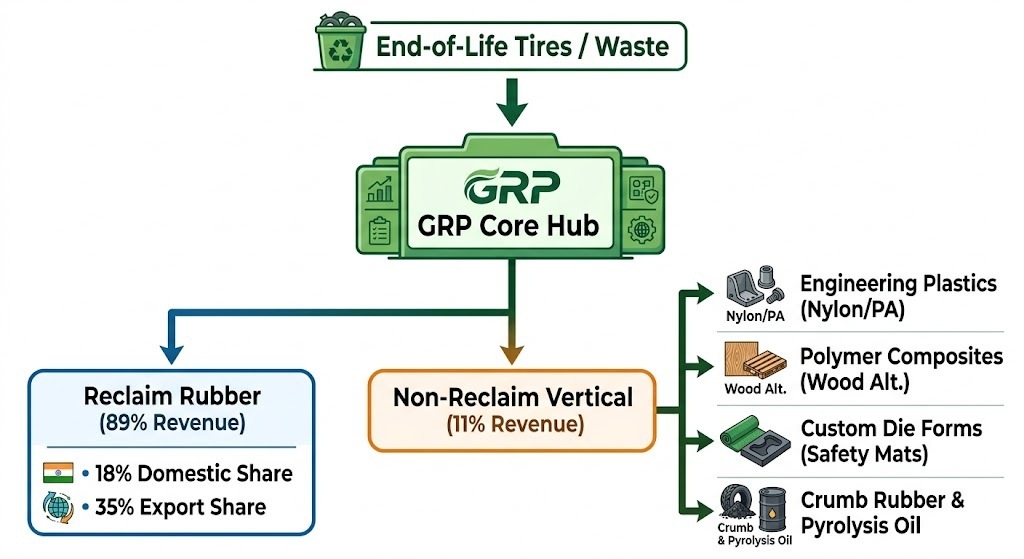
At its core, GRP takes the dirty, unyielding junk of the transportation world—end-of-life tires, rejected tubes, and discarded industrial rubber waste—and chews them up into reusable raw materials. It is a classic trash-to-cash operation with a technical twist. The engine room of the business is the Reclaim Rubber vertical, which commands a dominant 89% of operational revenues. GRP dominates this space locally, controlling an 18% market share in India and handling roughly 35% of all Indian reclaimed rubber exports shipped to over 55 countries.
The remaining 11% belongs to the Non-Reclaim rubber experiments. Here, they separate nylon fiber from tire cords to supply automotive engineering plastic lines, manufacture wood-substitute polymer composite pallets, and stamp out heavy-duty industrial safety link mats through their Custom Die Forms business. It sounds like a circular dream, but the non-reclaim segment has been heavily impacted by an unfavorable product mix and cheap virgin plastic imports from China, which compressed the recycled spread.
Section 4 — Financials Overview
Figures are consolidated, in ₹ crore.
The quarterly tracking reveals a company wrestling with an acute domestic-versus-export margin tug-of-war. While domestic reclaim rubber demand expanded robustly, export volumes collapsed under historical tariff weights in North America.
Quarterly Performance Trend
Metric
Latest Quarter (Mar 2026)
YoY (Mar 2025)
QoQ (Dec 2025)
Revenue
144.52
160.34
134.71
EBITDA / Operating Profit
8.93
32.85
10.74
PAT
-1.34
19.45
0.85
EPS (₹)
-2.51
36.47
1.59
(Note: Data derived from consolidated quarterly records. March 2026 PAT includes ongoing operational corrections.)
The operational mismatch is obvious: Q4 FY26 sales recovered sequentially to ₹144.52 crore, but operating profits shrank to ₹8.93 crore as raw material inflation hit the income statement before price pass-through actions could take effect. Volatile quarterly profit swings often expose structural lags in enterprise pricing models, warning investors that reported earnings can diverge significantly from true runtime cash creation.
Did Management Walk the Talk?
Reviewing the commentary from past fiscal cycles reveals a leadership group that correctly anticipated domestic resilience but underestimated global supply chain friction. Management previously promised that specialized non-tyre domestic applications would stabilize the top line, which was validated by a 27% YoY domestic reclaim surge in Q3. However, their forward timeline for project execution has slipped.
Phase 1b of the Solapur pyrolysis plant faced structural installation delays. Initially targeted for earlier commercialization, the operational launch of the Recovered Carbon Black (rCB) line has been pushed back to August 2026. Management stated they have “prudently deferred the next stage of expansion” to preserve capital until stable operating parameters are achieved.