Mukand Ltd Q4 FY26: Massive Land Monetization Sparks 4,992% Profit Surge, But Steel Margins Drop to -1%
1. At a Glance
Mukand Ltd has just delivered a financial performance that reads less like a traditional balance sheet and more like an investigative thriller. The absolute headline grabber for the quarter ended March 31, 2026, is a jaw-dropping, eye-popping 4,992% year-on-year surge in quarterly profit after tax, culminating in a consolidated PAT of ₹554.98 crore. On paper, it looks like this Bajaj Group company has suddenly discovered the secret alchemy of turning ordinary industrial iron into pure, unadulterated gold.
But as any seasoned financial detective knows, when a cyclical, low-margin steel manufacturer suddenly reports a net profit spike that mimics a hyper-growth tech startup, it is time to open up the hood and check the engine. The primary driver behind this monumental profitability leap is not an explosion in commercial steel demand or a sudden global supply deficit. Instead, it is an enormous structural accounting windfall. The company executed conveyance deeds for major land parcels at Dighe, Thane, pumping an extraordinary ₹553.70 crore into the “Other Income” bucket for the full year, with the vast majority hitting the books in the final quarter.
Beneath this dazzling layer of real estate gold paint lies a far more sobering industrial reality. If you strip away the massive real estate monetization and look directly at core operational metrics, Mukand’s fundamental steel engine actually choked during the quarter. The company’s Consolidated Operating Profit Margin crashed from a stable 6% in the previous quarter to a negative 1% in Q4 FY26. While the top line recorded a decent year-on-year growth to reach ₹1,269.09 crore for the quarter, total expenses outpaced operational incoming cash, resulting in a core operating loss of ₹17.01 crore before the real estate rescue squad arrived.
This sets up a fascinating corporate tug-of-war. On one hand, you have the backing of the premium, ultra-credible Bajaj Group, alongside a massive balance sheet deleveraging story that has seen net debt systematically brought down from the historic mountain of ₹2,500 crore in FY20. On the other hand, investors are left staring at an intensely volatile steel business that remains vulnerable to global raw material cost shocks and domestic pricing pressure. Is this real estate windfall a sustainable bridge to a high-margin, clean-energy industrial future, or is it a beautiful cosmetic cover-up for deteriorating core manufacturing economics? Let’s dig into the cold, hard data.
2. Introduction
Mukand Ltd is a veteran name in the Indian heavy industrial landscape. Established way back in 1937, the company found its true corporate identity when it was acquired by the iconic industrialist Jamnalal Bajaj in 1939. Today, it stands as a specialized arm of the legendary Bajaj Group, a multi-billion-dollar empire spanning automobiles, financial powerhouses like Bajaj Finance and Finserv, and consumer electricals. Being a part of this group provides Mukand with immense institutional credibility, corporate governance backing, and critical financial lifelines when macroeconomic cycles turn ugly.
Operating out of two primary manufacturing hubs—Thane in Maharashtra for its stainless steel products and a major facility at Hospet in Karnataka for its alloy steel division—the company boasts a combined production capacity of 5.70 lakh metric tonnes per annum. Historically, Mukand has positioned itself as an essential tier-1 vendor to the absolute titans of the Indian and global automotive ecosystems. Its order books are heavily integrated with major passenger car and two-wheeler manufacturers, counting Maruti Suzuki, Hyundai, Toyota, Nissan, Tata, Hero MotoCorp, and its sibling firm Bajaj Auto as key long-term corporate clients.
Over the last few fiscal cycles, the corporate narrative surrounding Mukand has been completely dominated by two structural themes: aggressive balance sheet cleaning and operational restructuring. The company has methodically executed a non-core asset monetization program to systematically eliminate the massive debt burden that dragged down its valuations for over a decade. Simultaneously, it has been executing complex corporate restructurings, including business demergers and the slump sale of its engineering division to wholly-owned subsidiaries, all in an attempt to present a clean, focused face to public markets.
3. Business Model – WTF Do They Even Do?
To understand how Mukand makes its money, you have to look past the real estate deals and dive straight into the brutal, capital-intensive world of specialized metallurgy. Smart but lazy investors often mistake Mukand for a standard commodity steel player like SAIL or Tata Steel. It isn’t. Mukand does not sell generic construction rebar for real estate housing projects. It operates in the highly technical domain of specialized alloy steel and stainless steel production.
The company manufactures over 650 highly specific grades of steel, transforming raw inputs into complex billets, blooms, rounds, wire rods, bright bars, and finished wires. This Specialty Steel division is the absolute operational anchor of the company, consistently generating approximately 96% of its gross revenue from operations. These aren’t just blocks of metal; they are custom-engineered inputs built to withstand extreme heat, friction, and rotational stress. Every time you drive a passenger car or ride a motorcycle in India, you are likely relying on Mukand’s steel, which forms the core architecture of engine crankshafts, transmission gears, steering knuckles, and high-tensile suspension wires.
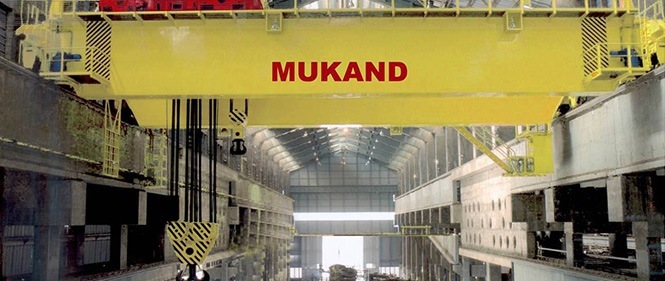
The remaining 4% of the business resides within its Industrial Machinery & Engineering Contracts division. This unit designs, constructs, erects, and commissions heavy-duty Electric Overhead Traveling (EOT) cranes, bulk material handling systems, and specialized industrial machinery for massive processing plants. While it adds a layer of heavy engineering capability to the portfolio, it has recently been a volatile drag on profitability, prompting management to execute a massive slump sale of the EOT crane business into a wholly-owned subsidiary, Mukand Heavy Engineering Limited (MHEL), to run it as a isolated commercial operation.
4. Financials Overview
Let us look past the corporate public relations narrative and dissect the audited consolidated financial figures for the quarter ended March 31, 2026.
Consolidated Financial Performance Matrix
Metric
Latest Quarter (Q4 FY26)
Same Quarter Last Year (Q4 FY25)
Previous Quarter (Q3 FY26)
YoY Change (%)
QoQ Change (%)
Revenue from Operations
₹1,269.09 cr
₹1,106.89 cr
₹1,329.27 cr
+14.65%
-4.53%
EBITDA (Core Operational)
-₹17.01 cr
₹59.96 cr
₹63.88 cr
-128.37%
-126.63%
Profit After Tax (PAT)
₹554.98 cr
₹10.90 cr
₹10.26 cr
+4,991.56%
+5,406.63%
Annualised EPS
₹167.24
₹43.60
₹4.12
+283.58%
+3,959.22%
Recalculated P/E Ratio
0.89x
3.42x
36.17x
-73.98%
-97.54%
A forensic examination of this table reveals an astonishing divergence between the top line, the core operational engine, and the final net profit. While Revenue from Operations grew a healthy 14.65% year-on-year to hit ₹1,269.09 crore, the core operational profitability completely collapsed. The company recorded a negative EBITDA of ₹17.01 crore, dragging the core Operating Profit Margin down to -1% for the quarter. This was driven by a sharp escalation in raw material consumption costs and flat realizations in the competitive steel landscape. Management had previously promised in older conference calls to defend their 5% to 6% operational margin bands through group captive solar power agreements and domestic supply optimization, but this quarter, they completely failed to protect the core business from cost shocks.
The only reason the PAT looks like an absolute powerhouse at ₹554.98 crore is the massive real estate monetization accounted under “Other Income,” which stood at ₹508.34 crore for the quarter. Because of this massive one-time accounting infusion, the annualized quarterly EPS skyrocketed to ₹167.24, dropping the trailing Price-to-Earnings (P/E) ratio to a hilarious, completely misleading 0.89x. Investors buying into this stock purely based on a low P/E screener alert are setting themselves up for a rude awakening once this real estate cash flow dries up.
5. Valuation Discussion – Fair Value Range
Evaluating a company like Mukand requires a hybrid analytical model.