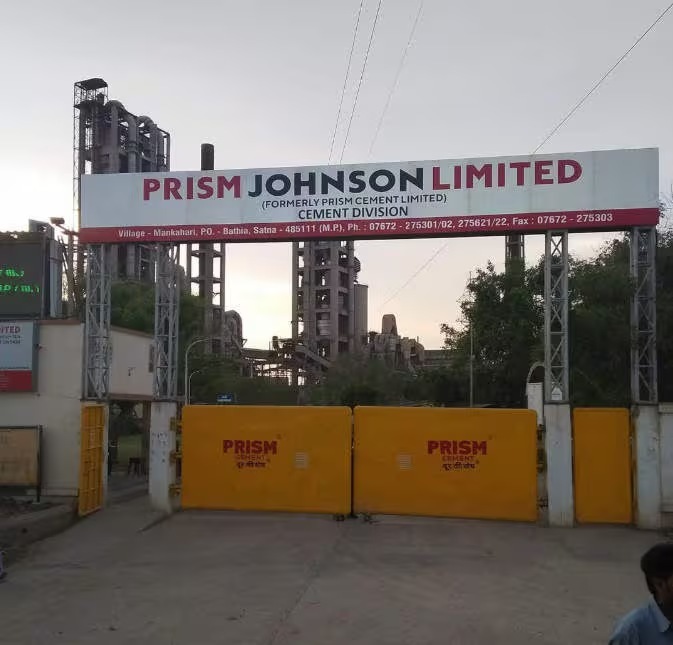
Prism Johnson Ltd Q4 FY26: Operating Profit Soars 52% to ₹693 Crore explicitly Driven by Strategic Infrastructure Shifts
1. At a Glance
Prism Johnson Limited is commanding intense attention in the building materials landscape. The company concluded its financial year on March 31, 2026, showcasing a complex financial architecture. Total consolidated operational revenue scaled up to ₹7,404 crore, matching an aggressive 52.1% Year-on-Year surge in Earnings Before Interest, Taxes, Depreciation, and Amortisation (EBITDA), which climbed to ₹693 crore.
Beneath this headline growth, serious structural adjustments and underlying cost pressures are creating operational hurdles. While the capital markets track the company’s expanding top-line, an forensic look at the numbers exposes tight operating constraints. For the full year, the consolidated Profit After Tax (PAT) stood at a modest ₹105 crore, reflecting a narrow PAT margin of 1.4%.
The company’s asset utilization raises urgent financial questions. With a total asset base standing at ₹7,333 crore, a net profit of ₹105 crore translates to a Return on Assets (ROA) of just 1.43%. This means large blocks of capital are locked into heavy plants, real estate, and long-lead supply chains while yielding razor-thin bottom-line returns.
Operational vulnerabilities became highly visible in the final quarter of the fiscal year. In Q4 FY26, the company suffered a sharp contraction in its core margins. Quarterly EBITDA fell 11.4% Year-on-Year to ₹175 crore, and the quarterly EBITDA margin compressed down to 8.3%.
This compression was explicitly driven by a sudden spike in operating costs within the Prism Cement division. The company shifted its traditional maintenance shutdown timeline into the Q3–Q4 period, which triggered significant plant downtime, major inventory drawdowns, and unabsorbed fixed overheads.
At the exact same time, geopolitical friction across the Middle East disrupted manufacturing hubs in the Morbi region. This directly restricted the export output of the H & R Johnson tiles division.
Financially, the business is operating on tight liquidity terms. Interest coverage ratios remain thin, and structural debt, though undergoing reduction, continues to demand substantial cash outflows for servicing.
The company is currently executing non-core asset liquidations, including a full divestment of its 51% stake in Raheja QBE General Insurance for ₹324 crore, alongside the sale of its corporate office space in Mumbai for ₹165.91 crore. These multi-crore asset sales represent a structural race to deleverage the balance sheet before high finance costs erode operating cash flows.
2. Introduction
Prism Johnson Limited operates as an integrated manufacturer across the domestic building materials sector. Established in 1992, the enterprise has built a diversified industrial infrastructure spanning three major business verticals: Prism Cement, H & R Johnson (HRJ), and Prism Ready-Mix Concrete (RMC). The company’s geographic footprint concentrates heavily on the central and eastern regions of India, making its financial performance highly dependent on regional real estate cycles and public infrastructure spending.
The structural composition of the business creates a unique matrix of operational risks. Unlike pure-play cement producers or standalone tile manufacturers, this corporate structure forces the management to balance three capital-intensive supply chains simultaneously. The logistics of moving heavy cement from central clusters must be managed alongside the energy-dependent economics of vitrified tile kilns and the highly perishable, time-critical delivery schedules of ready-mix concrete trucks.
From a macroeconomic perspective, the enterprise is highly exposed to structural shifts in input costs. The manufacturing processes across all three divisions require intense energy consumption. The cement kilns rely heavily on a dynamic fuel mix of domestic coal, imported petcoke, and alternative fuel raw materials, leaving margins exposed to international commodity volatility. Simultaneously, the tile manufacturing units require a continuous supply of natural gas, where global supply strains immediately impact plant economics.
Geographically, the company’s financial health is tied directly to localized demand dynamics. In its core cement segment, the states of Uttar Pradesh, Madhya Pradesh, and Bihar account for virtually the entire revenue base. This lack of pan-India geographic diversification means any regional slowdown, regulatory friction, or intensive capacity additions by competing mega-players in the Satna cluster creates direct downward pricing pressure on the company’s regional volumes.
3. Business Model – WTF Do They Even Do?
Prism Johnson breaks its operational machinery into three distinct segments, moving massive volumes of raw and finished materials across the construction value chain.
This is the heavy industrial core of the company, generating 46% of consolidated revenue. The operation relies on a central integrated manufacturing facility located in the Satna cluster of Madhya Pradesh, maintaining an installed capacity of 5.6 million tonnes per annum (MTPA).
To expand its commercial reach without incurring heavy capital expenditure, the division secures an additional 1.37 MTPA of capacity through strict supply agreements with four third-party grinding units located across Uttar Pradesh and Madhya Pradesh. The final product is pushed through a distribution channel comprising 2,300 effective dealers and 7,000 retailers, maintaining an average lead transport distance of 362 kilometers.
H & R Johnson (HRJ)
Contributing 33% to the top-line, this division focuses on lifestyle and finishing products. It commands a total tile manufacturing capacity of approximately 64 million square meters per annum, spread across 11 manufacturing plants, which include both wholly-owned facilities and strategic joint ventures.
The division extends beyond ceramic and vitrified tiles into sanitaryware and bath fittings, operating two dedicated faucet manufacturing plants and one sanitaryware joint-venture plant. The products are commercialized via 900 primary dealers and 22 large-format experience centers.
Prism RMC
Accounting for the remaining 21% of revenue, this vertical operates within the highly time-sensitive ready-mix concrete space. The division runs 89 manufacturing facilities operating across 46 cities and towns.
The business model splits into two distinct avenues: Commercial Concrete, which services urban real estate construction, and Mega Projects, which supplies high-volume concrete to public infrastructure developments such as bullet train corridors, highways, refineries, and ports.
Are the operational cash flows generated by these three distinct businesses sufficient to cover their individual capital expenditure requirements, or is one cross-subsidizing the other?
4. Financials Overview
The financial performance of the latest quarter reveals a significant divergence between volume growth and margin retention. An analysis of the consolidated quarterly financial results highlights exactly where structural pressures are impacting the bottom line.
Consolidated Financial Performance Comparison
The financial results declared are officially categorized as Quarterly Results.
Metric
Latest Quarter (Mar 2026)
Same Quarter Last Year (YoY – Mar 2025)
Previous Quarter (QoQ – Dec 2025)
Revenue
₹2,118.00 cr
₹1,966.00 cr
₹1,759.00 cr
EBITDA
₹175.00 cr
₹197.00 cr
₹158.00 cr
PAT
₹16.00 cr
₹121.00 cr
₹50.00 cr
EPS (Reported)
₹0.13
₹2.57
₹0.13
Annualized EPS
₹0.52
₹10.28
₹0.52
Financial Note on EPS and Valuation: The reported EPS for the latest quarter stands at ₹0.13. Following standard financial methodologies, the annualized EPS is calculated explicitly as 0.13 × 4 = 0.52. Based on the closing market price of ₹127 on May 15, 2026, the current Price-to-Earnings (P/E) ratio calculated against this annualized earning run-rate stands at 244.2. This presents a massive divergence from the backward-looking TTM P/E of 85.4 reported in historical blocks, underscoring the severe impact of recent quarterly earnings compression on true valuation multiples.
An analysis of past management commentary versus current execution reveals a mixed track record. Management previously highlighted that shifting maintenance schedules and investing in green alternative energy would structurally insulate the cement business from external shocks.
While the long-term cost benefits of the 32.5 MW solar capacity and 22.5 MW Waste Heat Recovery System (WHRS) are appearing in a full-year drop in power costs, the decision to defer major plant maintenance to the peak demand months of Q4 directly crippled the quarter’s profitability. The massive clinker inventory drawdown required to fulfill sales volumes during the shutdown added hidden costs, proving that tactical operational scheduling has failed to match management’s smoothing