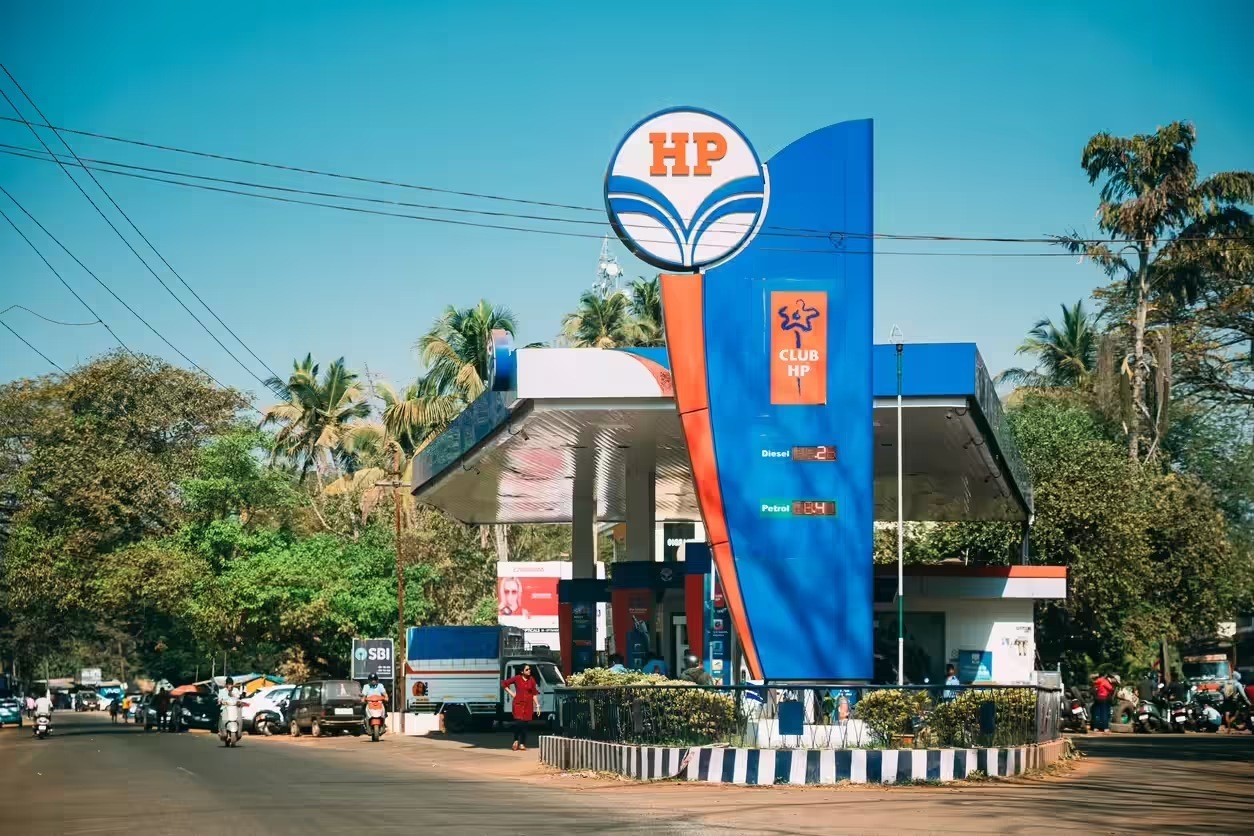
The Indian energy landscape has a new protagonist, and it’s wearing the “Maharatna” badge with renewed swagger. Hindustan Petroleum Corporation Ltd (HPCL) has just dropped a financial bombshell that reframes its entire investment thesis. For years, the narrative around HPCL was bogged down by “the harder exam questions”—massive capex delays, mounting debt, and the operational overhang of the Visakh refinery upgrade.
As of March 2026, those questions haven’t just been answered; they’ve been obliterated. The company reported a Standalone PAT of ₹17,175 Crore for FY26, a staggering leap that signals the transition from a “project-heavy” utility to a “cash-flow-positive” energy giant. The most provocative number in the latest data isn’t just the profit, but the Refinery Throughput of 26.0 MMT, the highest in the company’s century-long history.
1. At a Glance
If you were looking for a quiet, predictable PSU, you’ve come to the wrong place. HPCL is currently a financial high-wire act that has successfully made it to the other side. The headline numbers are sensational: a Consolidated Net Profit of ₹18,047 Crore for FY26 and a Dividend Payout of 29%, but the real story lies in the “Bottoms Up.”
The commissioning of the Residue Upgradation Facility (RUF) at Visakh is a global first, pushing bottom conversion to 93%. This isn’t just technical jargon; it’s a direct hit to the P&L. Management had promised a ~$2.5/bbl improvement in GRMs from this project, and the market is now watching the stabilization phase with bated breath.
However, the “badass” reality of the oil business is never without scars. The Mumbai refinery crude contamination (B-80) incident earlier in the year slashed Mumbai GRMs by ~$3.5/bbl for the quarter. While the operational issue is “fully behind” the company, the commercial disputes and claims remain a lingering red flag.
Furthermore, the LPG under-recovery ghost continues to haunt the hallways. Despite a government compensation package of ₹7,920 Crore to be received in installments, the Saudi CP (Contract Price) spikes in early 2026 have pushed under-recoveries back up to ₹120 per cylinder. HPCL is running a structural race against volatile global feedstock prices that it cannot control.
The teaser for the road ahead? Barmer. The Rajasthan Refinery (HRRL) is at 91.6% physical progress. The first products are expected to hit the market in the coming weeks. HPCL is no longer just a refiner; it is about to become a petrochemical powerhouse with a Nelson Complexity Index of 17.0—making it one of the most sophisticated complexes on the planet.
2. Introduction
HPCL is a behemoth that manages around 25 million daily customer interactions. Let that sink in. This isn’t just a company; it’s a vital organ of the Indian economy. With a legacy spanning over 100 years, it has evolved from the amalgamation of ESSO and Lube India into a Maharatna that controls 20.27% of the domestic market share in petroleum products.
The current phase of HPCL is defined by “Value over Volume.” In a bold move during Q3 and Q4 of FY26, management chose to ignore “bulk diesel” volumes that were being sold at deep discounts, focusing instead on high-margin retail sales. This disciplined approach is a departure from the traditional PSU “market share at any cost” mentality.
Structurally, the company is repositioning itself as a “Total Energy Company.” It’s no longer just about petrol and diesel. With 25,098 retail outlets and a rapidly expanding EV charging network (5,533 stations), HPCL is hedging its bets against the energy transition.
The balance sheet, which was once bloated with “Peak Debt,” is finally exhaling. The standalone Debt-to-Equity ratio has cooled to 0.80x, down from 1.38x a year ago. This deleveraging is creating a virtuous cycle: lower interest costs are flowing straight to the bottom line, providing the “right to grow” that management frequently highlighted in recent concalls.
3. Business Model – WTF Do They Even Do?
HPCL is essentially a giant industrial kitchen that buys crude oil (the groceries) and cooks it into everything from jet fuel to the bitumen on your roads. They operate in three main buckets:
- Refining: They own the largest lubricant refinery in India. With the Visakh expansion to 15 MMTPA and the Mumbai refinery at 9.5 MMTPA, they have a massive internal “manufacturing” engine.
- Marketing: This is the sexy part of the business—the 25,000+ gas stations and the 99 million LPG consumers. They don’t just make the fuel; they own the “last mile” to your car and kitchen.
- Midstream: They own the second-largest cross-country pipeline network (5,440 km). This is the “toll booth” of the business, moving products efficiently across India while keeping logistics costs lower than competitors.
They are also aggressively entering the Natural Gas space, participating in everything from LNG terminals (Chhara) to City Gas Distribution (CGD) across 25 Geographical Areas. If India is consuming energy, HPCL is likely the one delivering the invoice.
4. Financials Overview
The financial performance for the quarter ended March 2026 (Q4) shows a company firing on all cylinders, despite the global volatility in crude.
Consolidated Quarterly Results Comparison (₹ in Crore)
| Parameter | Latest Quarter (Mar ’26) | Same Qtr Last Year (Mar ’25) | YoY Var (%) | Previous Qtr (Dec ’25) | QoQ Var (%) |
| Total Income | 1,24,313 | 1,19,055 | +4.4% | 1,25,189 | -0.7% |
| EBITDA | 11,121 | 6,718 | +65.5% | 7,725 | +43.9% |
| Net Profit (PAT) | 6,065 | 3,415 | +77.6% | 4,011 | +51.2% |
| EPS (₹) | 28.50 | 16.06 | +77.5% | 18.85 | +51.2% |
Financial Wisdom: High EBITDA growth relative to revenue growth usually signals operational leverage. In HPCL’s case, the OPM improved to 8% in the latest quarter compared to 4% a year ago.
Management Walk the Talk?
In the Jan 2026 concall, management emphasized a steady run rate of “₹1,300 crore monthly PAT.” They didn’t just meet that; they exceeded it in the final quarter. They also promised the Visakh RUF commissioning by March 2026—and the project was indeed “Dedicated to the Nation” on schedule. Credibility is a rare commodity in PSUs; HPCL is currently hoarding it.
5. Valuation Discussion – Fair Value Range
Valuing an Oil Marketing Company (OMC) is like trying to catch a falling knife that’s also on fire—highly dependent on the “crack spreads” and government policy.
Method 1: P/E Approach
- Annualized EPS: Since the March result is the full year, we use the actual EPS of ₹84.81.
- Industry P/E: 14.5x.
- HPCL Current P/E: 4.45x.
- If HPCL were to trade at a conservative 6x-7x P/E (due to its PSU nature and regulatory risk), the value would be ₹508 – ₹593.
Method 2: EV/EBITDA
- FY26 Consolidated EBITDA: ₹33,182 Crore.
- Enterprise Value (EV): ₹1,36,129 Crore.
- Current EV/EBITDA: 4.1x.
- A fair target for a complex refiner is usually 5x-6x, suggesting an EV of ~₹1,65,000 – ₹1,99,000 Cr.
Method 3: DCF (Discounted Cash Flow)
Considering a 5-year growth rate of 5% (conservative energy growth) and a terminal growth rate of 2%, with a WACC of 11%, the DCF model yields a range between ₹440 and ₹490.
Fair Value Range: ₹460 – ₹540
This fair value range is for educational purposes only and is not investment advice.
6. What’s Cooking – News, Triggers, Drama
- The “Fire” in Rajasthan: On April 20, 2026, a fire broke out at the HRRL refinery (Barmer) CDU section. While the management says it’s localized and will be restored in 3-4 weeks, it’s a classic “drama” trigger that reminds investors of the risks of commissioning massive greenfield assets.
- The ADNOC Deal: HPCL signed a 10-year LNG deal with ADNOC Gas. Management calls it “one of the most competitive deals in India.” They are shifting from being a “trader of gas” to a “source of gas,” which is a massive strategic pivot.
- The B-80 Crude Saga: The Mumbai refinery processed crude with high salt/chloride levels in late 2025, leading to corrosion and reduced yields. They are now “pursuing supplier claims.” It’s a polite way of saying someone sold them bad groceries, and they want their money back.
How much of a company’s “profit” is actually just luck with inventory gains? Ask yourself that before checking the next table.
7. Balance Sheet
The balance sheet is where the “detective” finds the truth. HPCL’s long-term debt has finally peaked.
Consolidated Balance Sheet (₹ in Crore)
| Particulars | Mar 2026 | Mar 2025 | Mar 2024 |
| Total Assets | 2,03,039 | 1,94,770 | 1,82,794 |
| Net Worth | 65,556 | 51,144 | 46,921 |
| Borrowings | 50,899 | 66,429 | 66,684 |
| Other Liabilities | 86,584 | 77,197 | 69,189 |
| Total Liabilities | 2,03,039 | 1,94,770 | 1,82,794 |
- Borrowings fell by ~₹15,000 Crore in one year. That’s a massive deleveraging act for a company of this size.
- Net Worth jumped by 28%. The equity base is finally getting some meat on its bones.
- Other Liabilities are creeping up. The “hidden” debt in the form of trade payables and provisions is something to keep an eye on.
8. Cash Flow – Sab Number Game Hai
Profit is an opinion; cash is a fact. HPCL had a “monster” cash flow year.
Consolidated Cash Flow (₹ in Crore)
| Year | Operating Cash Flow (CFO) | Investing Cash Flow (CFI) | Financing Cash Flow (CFF) |
| Mar 2026 | 36,111 | -11,404 | -22,770 |
| Mar 2025 | 14,228 | -10,557 | -4,138 |
| Mar 2024 | 23,852 | -13,019 | -16,155 |
HPCL generated ₹36,111 Cr in cash from operations. They used it to pay down ₹15,587 Cr of debt (Financing) and spent ₹8,331 Cr on new assets (Investing). This is the cleanest cash flow profile the company has shown in a decade.
9. Ratios – Sexy or Stressy?
Key Ratios (Consolidated FY26)
| Ratio | Value | Verdict |
| ROE | 30.9% | Sexy (Top-tier PSU performance) |
| ROCE | 22.2% | Sexy (Efficiency is back) |
| Debt to Equity | 0.80 | Stable (Past the “peak debt” danger zone) |
| PAT Margin | 4.1% | Lean (Normal for OMCs, but improving) |
| Current Ratio | 0.64 | Stressy (Standard for OMCs, but tight) |
Commentary: A 30% ROE for a commodity business is insane. However, the current ratio of 0.64 means they are essentially running the business on credit from suppliers and short-term loans. One major “liquidity crunch” and the gears could grind.
10. P&L Breakdown – Show Me the Money
3-Year Consolidated P&L (₹ in Crore)
| Particulars | Mar 2026 | Mar 2025 | Mar 2024 |
| Revenue | 4,41,771 | 4,34,106 | 4,33,857 |
| EBITDA | 33,182 | 19,022 | 27,221 |
| Net Profit | 18,047 | 6,736 | 16,015 |
Revenue is almost flat, but profits nearly tripled. How? Operational efficiency. They stopped chasing unprofitable sales and started optimizing their internal “Samriddhi” cost-cutting program. Management claims they saved ₹1,260 Cr through cost initiatives alone.
11. Peer Comparison
| Company | Revenue (FY26 Cr) | PAT (FY26 Cr) | P/E Ratio |
| Reliance Industries | 9,40,590 | 80,402 | 22.8 |
| IOCL | 8,20,626 | 54,127 | 5.5 |
| BPCL | 4,76,117 | 28,740 | 5.1 |
| HPCL | 4,41,771 | 18,047 | 4.4 |
The Sarcastic Note: HPCL is the “cheapest” in terms of P/E, but it’s also the smallest in terms of scale. While Reliance is building a “green energy empire” with a luxury valuation, HPCL is essentially the underdog sibling that just realized it has a high-IQ for refining margins.
Is a low P/E a “bargain” or a “warning”? What do you think is holding back the valuation?
12. Miscellaneous – Shareholding and Promoters
Latest Shareholding (Mar ’26)
| Category | Holding (%) |
| Promoters (ONGC) | 54.90% |
| FIIs | 17.26% |
| DIIs | 19.58% |
| Public | 8.24% |
Promoter Roast: ONGC owns 54.9% of HPCL. It’s a marriage of convenience mandated by the government in 2018. FIIs have been increasing their stake (up from 13.8% in early 2024), which suggests the “smart money” is finally buying the turnaround story.
13. Corporate Governance – Angels or Devils?
HPCL is a Maharatna, which means it follows the “Rulebook” with religious fervor. However, a major auditor note in the FY26 report points out that the company does not have the required number of Independent Directors on its board as stipulated by SEBI. This is a recurring issue with Indian PSUs where government nominations take forever.
The company is also grappling with exceptional FX losses of ₹2,491 Cr due to currency volatility. While they are “Angels” in terms of transparency and CSR (touching 40 lakh lives), the structural “Devil” is the lack of board independence, which can lead to decisions that favor social/political goals over shareholder value.
14. Industry Roast and Macro Context
The Indian Oil & Gas sector is currently a paradox. On one hand, the government wants “Net Zero by 2070,” and on the other, they are asking OMCs to build massive refineries to meet the immediate 5% annual demand growth.
Refining is a “crying” industry globally where margins are shrinking, but in India, the growth is so robust that even inefficient players survive. The macro-risk is “Electric Vehicles.” While HPCL is putting EV chargers at its pumps, if the 2-wheeler and 3-wheeler market shifts faster than expected, these massive refineries in Visakh and Barmer could become very expensive museum exhibits.
15. EduInvesting Verdict
HPCL has transitioned from a “Capex-Caterpillar” to a “Profit-Butterfly,” but it’s still flying in a storm.
Past Performance: The stock has delivered a 30% CAGR over 3 years, backed by a recovery from the 2023 losses.
Headwinds: Volatile crude prices, rising LPG under-recoveries, and the execution risk of the Barmer petrochemical ramp-up.
Tailwinds: Full stabilization of Visakh RUF, deleveraged balance sheet, and a dominant position in the high-margin lubricant market.
SWOT Analysis
- Strengths: 2nd largest retail network, 93% bottom conversion tech, low debt.
- Weaknesses: Regulatory pricing risk, board independence issues, low current ratio.
- Opportunities: Petrochemical expansion via HRRL, Green Hydrogen (370 TPA plant commissioned).
- Threats: Rapid EV adoption, global recession hitting crack spreads, geopolitical oil shocks.
HPCL is no longer a “boring PSU.” It’s a complex, high-stakes industrial machine that has finally aligned its execution with its ambition. Whether the market rewards this “New HPCL” with a higher valuation remains the ultimate trillion-rupee question.