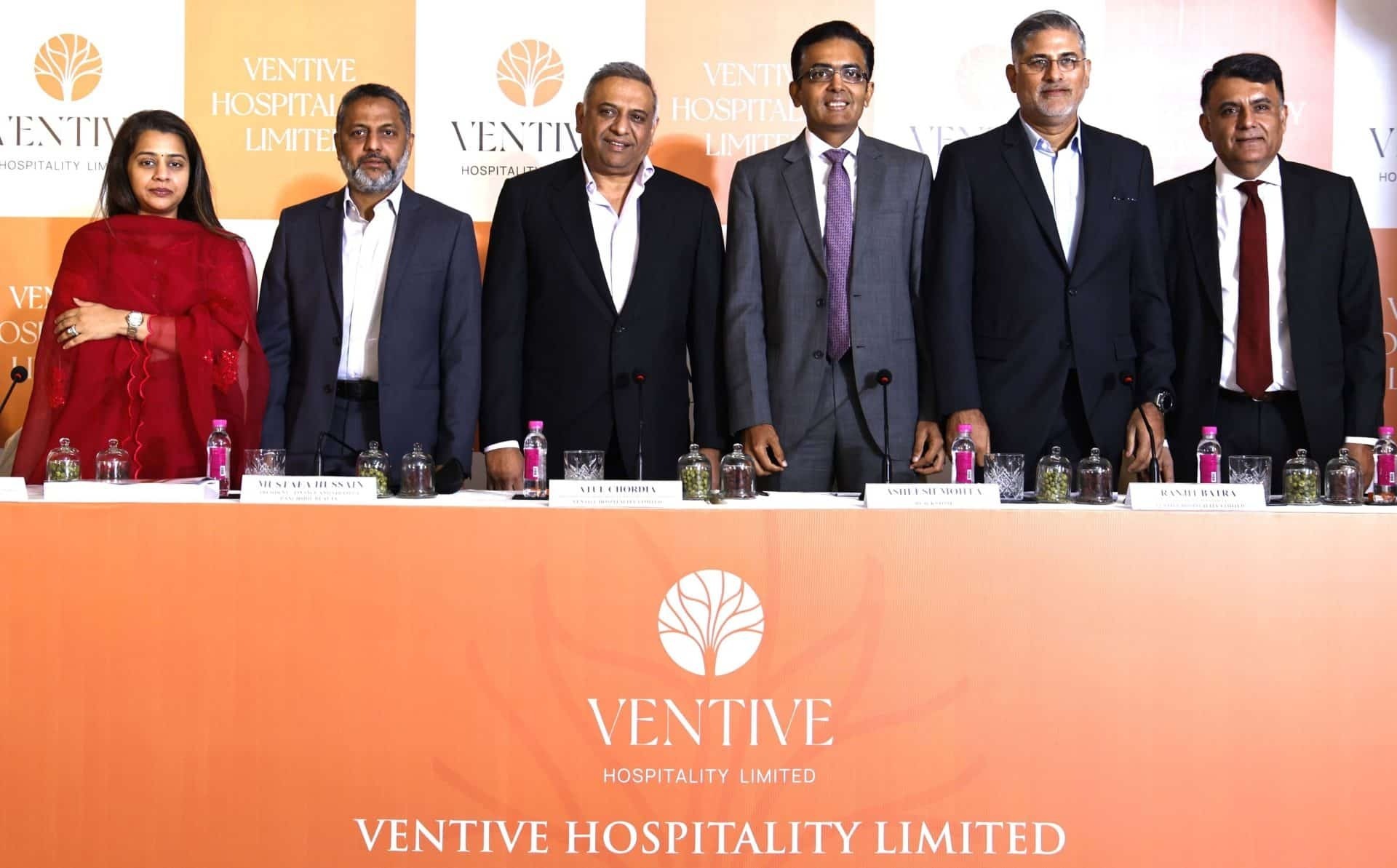
The hospitality sector in India is currently witnessing a massive structural shift, and Ventive Hospitality Ltd is positioned right at the epicenter of this luxury explosion. For a company that only listed in December 2024, the numbers coming out of the March 2026 quarter are nothing short of a financial statement masterclass. With a Net Profit of ₹259.2 cr for Q4 FY26—a staggering 82.2% YoY increase—the company is proving that premium positioning isn’t just a marketing tag; it’s a high-margin fortress.
1. At a Glance – The Luxury Leverage
Ventive Hospitality is not your average hotel chain. While competitors fight for occupancy in the mid-scale segment, Ventive has locked its focus on the top 1% of travelers. Operating as India’s largest luxury-focused platform, it manages a portfolio of 2,199 keys across three countries, with a heavy 80% focus on the luxury segment.
The numbers are startling. In Q4 FY26, the company reported a Consolidated Revenue of ₹869.6 cr, up 21% YoY. More importantly, the EBITDA surged 28% to ₹476.1 cr, leading to an EBITDA margin of 55%. This isn’t just growth; it’s a display of extreme operating leverage where the cost of adding a guest is negligible compared to the room rates they pay.
However, beneath the shiny surface of luxury linens and infinity pools, there are red flags that a serious analyst cannot ignore. The company carries a Debt of ₹2,574 cr. While the IPO proceeds were used to slash debt from ₹3,572 cr, the remaining leverage still requires a massive cash flow to service. Furthermore, 41.1% of the promoter’s holding is pledged. This is a classic “rich company, poor promoter” signal that often keeps institutional investors awake at night.
Then there is the Maldives concentration. Over 50% of the hospitality revenue comes from international operations, primarily the Maldives. While this provides a USD-denominated hedge, it also exposes the company to the whims of global geopolitical shifts and local environmental regulations. If the Maldives sneezes, Ventive catches a cold.
Is the current growth sustainable, or is this a post-IPO honeymoon phase fueled by high seasonal ADRs? The market is paying a P/E of 36.2, which suggests that investors are pricing in a lot of “happily ever after.”
2. Introduction
Ventive Hospitality Ltd has evolved from a developer into a sophisticated asset manager of luxury and business assets. Its strategy is simple yet aggressive: partner with the biggest global names—Marriott, Hilton, and Ritz-Carlton—to de-risk the brand element while owning the underlying high-value real estate.
The company operates a unique Hybrid Model. It isn’t just about hotels; it has a significant Annuity Portfolio of Grade-A commercial and retail spaces in Pune. This provides a steady, boring, but vital cushion of cash flow that offsets the cyclical nature of luxury tourism.
In the latest fiscal year, the company has completed its transition from a private entity to a public market heavyweight. The acquisition of assets like Hilton Goa and Soho House Mumbai signals that Ventive is no longer just a Pune-centric player but an aggregator of high-status assets.
The management has been vocal about its “Scale Ambition,” targeting a move from ~2,200 keys to over 4,000 keys in the next five years. This involves a mix of greenfield developments, brownfield expansions, and a “Right of First Offer” (ROFO) pipeline from its promoters.
3. Business Model – WTF Do They Even Do?
If you think Ventive is in the business of selling sleep, you’re wrong. They are in the business of Yield Arbitrage.
They build or buy high-end real estate, dress it up with a global brand like The Ritz-Carlton, and then charge guests upwards of ₹25,000 a night. By outsourcing the management to global operators, they save on the headache of day-to-day operations while keeping the lions’ share of the EBITDA.
The Three Pillars:
- Luxury Hospitality: The high-beta, high-reward segment. This includes the ultra-luxury resorts in the Maldives where TRevPAR (Total Revenue Per Available Room) can hit ₹90,818 during peak seasons.
- Business Hotels: Strategic assets in Pune and Bangalore that capture the “white-collar” spend. These are the workhorses that ensure occupancy stays stable even when vacationers are staying home.
- Commercial Annuity: They own 3.4 million sq. ft. of office and retail space. With 99% occupancy, this segment acts as a high-margin ATM, producing rental income with ~90% EBITDA margins.
Essentially, they are a Real Estate Investment Trust (REIT) dressed in a tuxedo. They build the stage, the global brands provide the actors, and Ventive collects the ticket sales.
4. Financials Overview
The performance for the quarter ended March 2026 shows a company that is finally hitting its stride after the post-IPO deleveraging.
Latest Results Comparison (Figures in ₹ Crores)
| Metric | Latest Quarter (Mar ’26) | Same Qtr Last Year (Mar ’25) | YoY % | Previous Quarter (Dec ’25) |
| Sales | 779 | 698 | +11.6% | 686 |
| EBITDA | 385 | 352 | +9.4% | 311 |
| PAT | 259 | 142 | +82.2% | 115 |
| EPS | 9.83 | 5.48 | +79.4% | 4.99 |
Annualised EPS Calculation: Since this is the Q4 (March) result, we use the full-year reported EPS of ₹18.2. No further annualisation is required as the full financial cycle is captured.
Management Walk the Talk:
During the February 2026 concall, management promised that the “Raaya” property in the Maldives would transition from ramp-up to stabilization. The Q4 results validate this, with International occupancy hitting 75% and international EBITDA growing by 19% YoY. They also managed to reduce their cost of debt, which dropped to 7.3% for INR loans, down from pre-IPO highs.
5. Valuation Discussion – Fair Value Range
Valuing a hybrid entity like Ventive requires looking at it from both a hotel and a real estate perspective.
Method 1: P/E Ratio
- Annualised EPS: ₹18.23
- Industry Average P/E: 28.2 (based on peers like IHCL and Chalet)
- Fair P/E Multiple: 32x to 35x (Premium given to the high-margin annuity business and luxury focus).
- Value: $18.23 \times 32 = 583$; $18.23 \times 35 = 638$.
Method 2: EV/EBITDA
- FY26 EBITDA: ₹1,094 cr (reported P&L)
- Net Debt: ₹1,481 cr
- Target Multiple: 14x to 16x
- Enterprise Value: $1,094 \times 14 = 15,316$ to $1,094 \times 16 = 17,504$.
- Equity Value: $13,835$ to $16,023$ cr.
- Value per Share: ₹593 to ₹687.
Method 3: DCF (Discounted Cash Flow)
Using a WACC of 10.5% and a terminal growth rate of 4%, the DCF model yields a range of ₹610 to ₹660, factoring in the heavy capex of ₹800-900 cr planned for the next 24 months.
Fair Value Range: ₹590 – ₹670
This fair value range is for educational purposes only and is not investment advice.
6. What’s Cooking – Triggers and Drama
Ventive is currently in “Acquisition Mode.” In March 2026, they announced the buyout of Narmada Estates for ₹88.68 cr to develop a Grade-A office park in Pune. They also swallowed Sol De Goa to expand their boutique footprint.
The drama lies in the Promoter Reclassification. Recently, 11 promoter-group entities requested to move to the “Public” category. While technically a cleanup, it often signals that the original backers might be looking for an exit door or a way to reduce their listed pledge visibility.
Also, watch the Varanasi Marriott. It’s set for an FY28 opening. If the religious tourism boom in India holds, this could be a cash cow. If not, it’s a lot of expensive marble in a Tier-2 city.
Does the shift from promoter to public category bother you as an investor, or is it just corporate housekeeping?
7. Balance Sheet – The Heavy Lifting
Ventive’s balance sheet is a story of transition from a debt-heavy developer to a lean asset owner.
Balance Sheet Breakdown (Figures in ₹ Crores)
| Row | Mar 2026 | Mar 2025 | Mar 2024 |
| Total Assets | 10,681 | 9,841 | 952 |
| Net Worth | 5,506 | 4,806 | 426 |
| Borrowings | 2,574 | 2,744 | 470 |
| Other Liabilities | 2,600 | 2,291 | 148 |
| Total Liabilities | 10,681 | 9,841 | 952 |
- Fixed Assets have ballooned to ₹9,343 cr, reflecting the massive consolidation of subsidiaries post-IPO.
- Borrowings are trending down, but ₹2,574 cr is still a hefty bill for a company with ₹500 cr in annual net profit.
- The Net Worth jumped by over ₹700 cr in one year—mostly through internal accruals and reserves. Slower than a turtle, but steady.
8. Cash Flow – Sab Number Game Hai
Cash is the only truth in a business where you can “depreciate” a building for decades.
| Cash Flow Type (₹ Cr) | Mar 2026 | Mar 2025 | Mar 2024 |
| Operating (CFO) | 950 | 677 | 265 |
| Investing (CFI) | -315 | -1,661 | -198 |
| Financing (CFF) | -822 | 1,364 | -57 |
| Free Cash Flow | 755 | 475 | 253 |
Ventive is finally generating serious Free Cash Flow (₹755 cr). The CFO/Operating Profit ratio stands at a healthy 87% (₹950 cr CFO vs ₹1,094 cr Operating Profit). This means the profits aren’t just on paper; the guests are paying their bills in real money.
The negative CFF of ₹822 cr shows they are aggressively paying back lenders. They are basically working for the banks right now, but at least the debt is shrinking.
9. Ratios – Sexy or Stressy?
Ratios tell you if the company is a Ferrari or a Rickshaw.
| Ratio | Mar 2026 | Mar 2025 | Mar 2024 |
| ROE % | 8.35 | 5.15 | 15.9 |
| ROCE % | 10.8 | 11.0 | 12.0 |
| Debt to Equity | 0.47 | 0.57 | 1.10 |
| PAT Margin % | 20.4 | 10.3 | 3.5 |
The ROE of 8.35% is painfully low for a “luxury” player. It suggests that while they own great assets, they aren’t sweating them hard enough yet. However, the PAT Margin doubling to 20% in one year is the “sexy” part of this table. It shows the operating leverage kicking in.
10. P&L Breakdown – Show Me the Money
| Metric (₹ Cr) | Mar 2026 | Mar 2025 | Mar 2024 |
| Revenue | 2,461 | 1,605 | 478 |
| EBITDA | 1,094 | 748 | 284 |
| Net Profit | 502 | 165 | 16 |
A 253% jump in Net Profit in two years? Either the management has a magic wand, or the low base of 2024 is doing some heavy lifting. The Expenses jumped to ₹1,367 cr, driven by higher “Other Expenses” like tour operator fees and corporate overheads. Luxury isn’t cheap to maintain—you can’t serve cheap coffee at the Ritz.
11. Peer Comparison
How does the new kid on the block stack up against the veterans?
| Name | CMP (₹) | P/E | Mar Cap (₹ Cr) | Sales Qtr (₹ Cr) | ROCE % |
| Indian Hotels | 650 | 48.9 | 92,551 | 2,765 | 17.2 |
| Chalet Hotels | 752 | 27.2 | 16,492 | 581 | 11.1 |
| Ventive Hosp. | 668 | 36.2 | 15,570 | 779 | 10.8 |
| Lemon Tree | 112 | 37.1 | 8,908 | 406 | 12.9 |
Ventive is already larger than Lemon Tree and knocking on the door of Chalet Hotels. It trades at a cheaper P/E than Indian Hotels but carries lower ROCE. Essentially, you’re paying for the “Blackstone & Panchshil” pedigree.
12. Miscellaneous – Shareholding and Promoters
The shareholding is a “Who’s Who” of real estate power players.
| Category | Dec 2024 | Mar 2026 |
| Promoters | 89.0% | 88.99% |
| FIIs | 3.31% | 1.43% |
| DIIs | 3.78% | 5.16% |
| Public | 3.93% | 4.44% |
Promoter Roast: The promoters, led by Atul Chordia (Panchshil Group) and Blackstone, own nearly 90% of the company. With 41% of that pledged, it’s clear they’ve been using their equity as a credit card for other ventures. The FIIs seem to be running for the hills (down from 3.3% to 1.4%), while domestic mutual funds like Quant are picking up the slack.
13. Corporate Governance – Angels or Devils?
Ventive’s governance profile is a mixed bag. On one hand, you have the backing of Blackstone, which usually brings institutional-grade rigor. On the other hand, you have a massive amount of Related Party Transactions. The company’s pipeline is heavily dependent on “ROFO” assets developed by the promoter group.
The recent tax drama—where an initial demand of ₹6.38 cr was reduced to nil after “rectification”—shows a company that knows how to handle the bureaucracy, but also one that is under the taxman’s microscope. The board includes heavyweights like Punita Kumar-Sinha, adding some much-needed independent oversight to a promoter-heavy room.
14. Industry Roast and Macro Context
The Indian hospitality industry is currently suffering from a severe case of “Greed is Good.” ADRs (Average Daily Rates) in cities like Pune and Bangalore have skyrocketed by 17-20% because there is simply no new luxury supply coming online.
The industry loves to talk about “structural demand,” but the truth is that air travel disruptions and rising ATF prices can easily derail the leisure segment. The Maldives, once a pristine sanctuary, is becoming a crowded marketplace for ultra-luxury brands. Ventive’s edge lies in its Annuity Portfolio—the boring office buildings are what will save it when the next tourism slump hits.
15. EduInvesting Verdict
Ventive Hospitality is a high-conviction bet on the “Premiumization” of India. It has the best assets, the best partners, and the best locations. However, the high promoter pledge and the geographical concentration in the Maldives are the two anchors dragging behind this luxury yacht.
SWOT Analysis:
- Strengths: 99% occupancy in the annuity portfolio; partnership with Marriott/Blackstone.
- Weaknesses: 41% promoter pledge; low ROE (8.35%).
- Opportunities: Expansion to 4,000 keys; recovery in foreign tourist arrivals (FTAs).
- Threats: Geopolitical instability in the Maldives; high interest rate environment for its ₹2,500 cr debt.
The company has successfully used its IPO to deleverage, but the next phase of growth requires flawless execution of its ₹900 cr capex plan. If they can move their ROE into double digits, the current valuation might look like a steal. If they falter, it’s just an expensive collection of buildings.
Disclaimer: This fair value range and analysis are for educational purposes only and do not constitute investment advice. Investing in equities involves risk.