1. At a Glance
Dixon Technologies (India) Ltd is no longer just a contract manufacturer; it is a sprawling industrial empire that has effectively cornered the Indian Electronic Manufacturing Services (EMS) market. The scale is staggering. In FY26, the company clocked a Revenue of ₹48,873 Crore, a massive 26% jump from the previous year. If you aren’t paying attention to the numbers, you are missing the forest for the trees. This is a company that is now handling a throughput of nearly ₹50,000 Crore while maintaining a lean, mean balance sheet.
However, beneath the headline growth, there is a complex narrative of shifting margins and aggressive capital deployment. The Operating Profit Margin (OPM) sits at a razor-thin 3.82%. In a world of rising input costs and memory chip inflation, Dixon is playing a high-stakes game of “volume over everything.” They are betting $3 Billion on a display fab unit. Read that again. They are moving from assembling parts to owning the most expensive part of the bill of materials—the display.
Investors are currently staring at a P/E of 47.0, which isn’t exactly “cheap” by any stretch of the imagination. But when you look at the ROCE of 42.0%, it becomes clear that Dixon is a master of capital efficiency. They are generating massive returns on every rupee they deploy into their 23 manufacturing facilities. The intrigue lies in the transition: can they move from a low-margin assembler to a high-value ODM (Original Design Manufacturer)?
The red flags? Promoter holding has slipped to 28.7%, a 5.38% drop over three years. While the market likes the growth, seeing the “captains of the ship” lighten their load usually warrants a second look. Furthermore, the reliance on the mobile segment is becoming absolute—now accounting for 84% of revenue. If the smartphone market sneezes, Dixon catches a cold.
How does a company with a 4% margin justify a ₹67,000 Crore valuation? The answer lies in the backward integration story that is currently unfolding.
2. Introduction
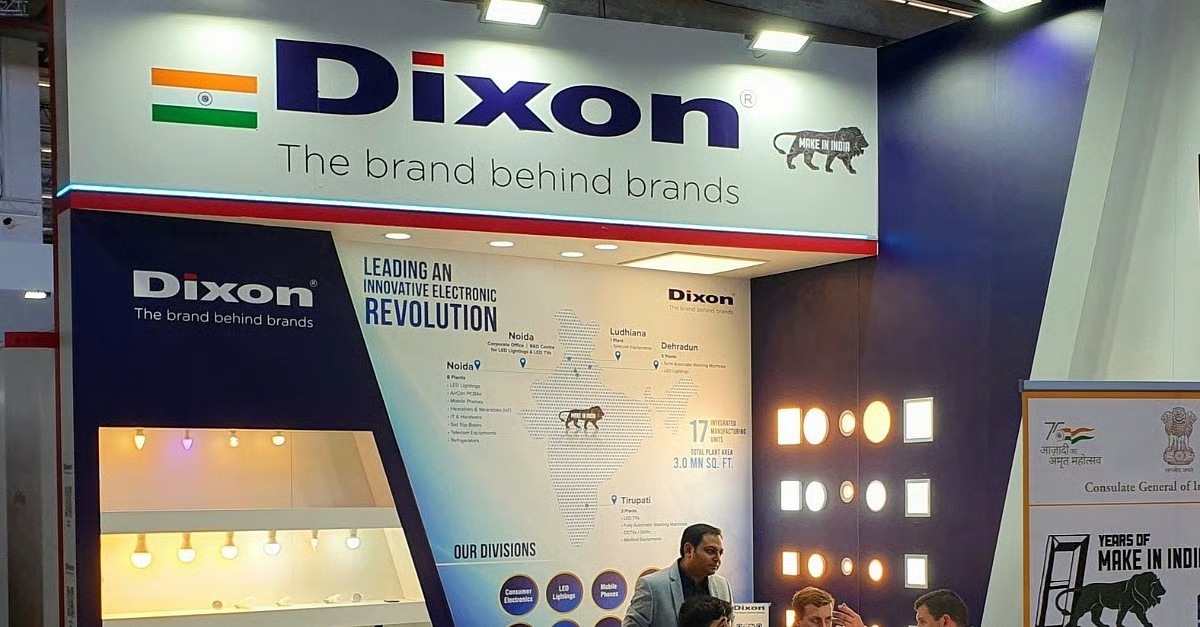
Dixon Technologies is the silent giant inside your pocket and your living room. Incorporated in 1993, it has spent three decades evolving from a small-scale TV assembler to the undisputed king of India’s EMS sector. It operates across multiple verticals: consumer electronics, lighting, home appliances, security systems, and the crown jewel—mobile phones.
The company’s strategy is built on the PLI (Production Linked Incentive) scheme. They haven’t just participated in it; they have devoured it. Dixon is a beneficiary across five different PLI segments, ranging from mobile phones to IT hardware. This government-backed tailwind has allowed them to scale at a CAGR that would make most Silicon Valley startups look sluggish.
But don’t be fooled by the “contract manufacturer” label. Dixon is increasingly moving toward the ODM (Original Design Manufacturing) model. This means they aren’t just building what brands tell them to; they are designing the products themselves and selling the designs to the brands. This shift is critical for margin expansion in an industry where survival depends on shaving off fractions of a percentage from production costs.
The company’s footprint is massive, with 23 facilities across Noida, Dehradun, Ludhiana, and Andhra Pradesh. Their client list reads like a “Who’s Who” of the tech world: Motorola, Xiaomi, Oppo, Samsung, and more recently, big moves into IT hardware with partners like HP and ASUS.
We are looking at a business that is currently in the middle of a massive “identity shift,” moving from the periphery of the global supply chain to the very center of India’s electronics manufacturing dream.
3. Business Model – WTF Do They Even Do?
To put it simply: Dixon is the “Foxconn of India,” but with more variety. They take the headache of manufacturing away from global brands so those brands can focus on marketing and spending millions on celebrity endorsements.
The business is split into four main buckets, though one bucket has become a massive water tank:
- Mobile & EMS (84% Revenue): This is the engine room. They are churning out 60 million smartphones a year. They recently acquired a majority stake in IsmartU to scale up for brands like Nothing and Transsion. If it rings and it’s made in India, there’s a high chance it came out of a Dixon plant.
- Consumer Electronics (10% Revenue): Primarily LED TVs and refrigerators. They are the largest LED TV manufacturer in