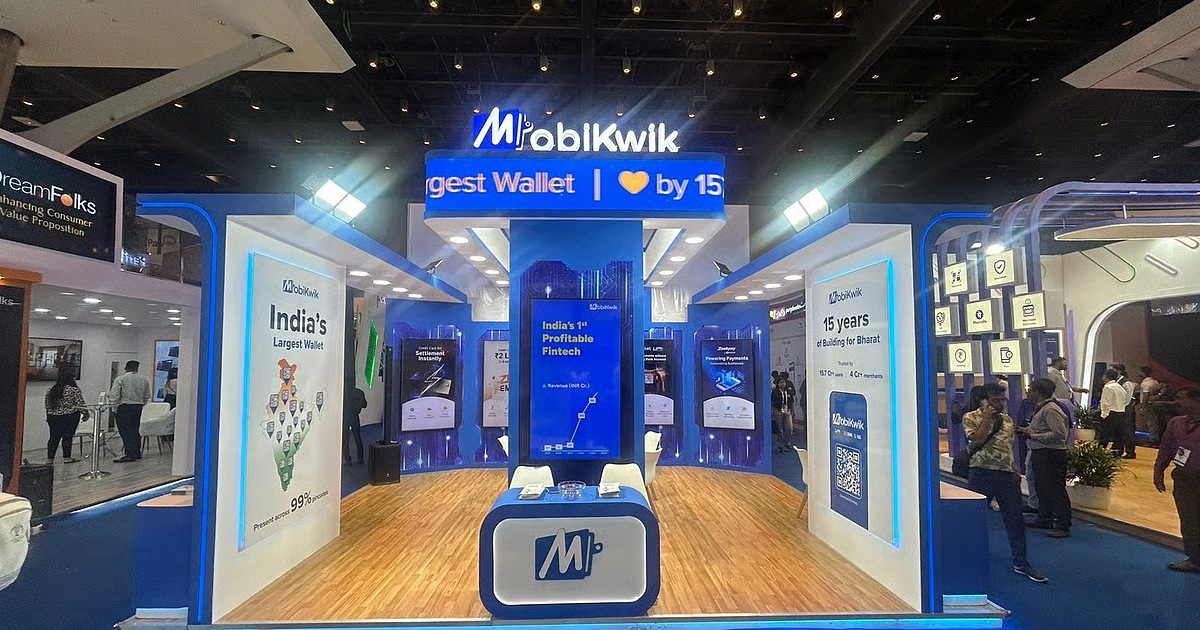
The fintech battlefield in India is littered with the remains of high-burn startups, but One Mobikwik Systems Ltd seems to be attempting a gritty second act. For a company that was bleeding profusely not too long ago, the latest numbers suggest a surgical turnaround—at least on paper.
While the headline screams “Profitable for two consecutive quarters,” the real story lies in the transition from a pure-play payment wallet to a high-margin lending machine. The company has successfully pivoted its revenue mix, with Financial Services now contributing a massive 64% of the top line.
However, a serious red flag waving in the Gurugram wind is the unutilized IPO proceeds. Out of the ₹572 crore raised to fuel organic growth and R&D, a staggering ₹187.61 crore remains untouched as of March 31, 2026. For a tech-first company, being “behind schedule” on R&D and financial services expansion suggests either extreme caution or an execution bottleneck that the market won’t ignore for long.
1. At a Glance
Mobikwik is currently performing a high-wire act. On one side, it has managed to claw back into the green, reporting a PAT of ₹4.38 crore for Q4 FY26. On the other, the growth in its primary “Payment Services” revenue is looking uncomfortably flat.
Investors are witnessing a classic “Margin over Volume” strategy. The company is letting go of low-margin, high-cost acquisition games and focusing on its “Super-Prime” and “Prime” lending cohorts. The Super-Prime mix has jumped from 10% to 32% in a year. This sounds great for risk management, but it inherently caps the explosive growth that fintech investors usually crave.
The Elephant in the Room: The IPO Cash
The monitoring agency report is quite blunt: there are significant delays in utilizing funds meant for the Financial Services and R&D objects. If you tell the public you need ₹150 crore for lending growth but only spend ₹89 crore by the end of the fiscal year, questions about the actual demand or your internal capacity are bound to arise.
Key Highlights to Note:
- Turnaround Year: FY26 EBITDA at -₹5 crore vs -₹79.4 crore in FY25. A massive swing of ₹74 crore.
- Lending Dominance: Financial services now carry the weight of the company’s profitability.
- The NBFC Gamble: RBI approval for an NBFC license is the new “holy grail” management is chasing to improve margins.
- Payment Pressure: UPI mix is diluting the payment revenue, and the “PPI-on-UPI” MDR is still a “waiting for Godot” situation.
Is the company finally becoming a sustainable financial powerhouse, or is this “profitability” just the result of extreme cost-cutting that might eventually starve future growth?
2. Introduction
Incorporated in 2009, One Mobikwik Systems Ltd is one of the oldest survivors of the Indian digital payment revolution. Unlike its larger rivals who burned billions to capture every single tea-stall QR code, Mobikwik has settled into a “tech-first” niche, focusing on its 161 million registered users and a modest 4.26 million merchant base.
The company operates a two-sided network. To the consumer, it is a wallet and a credit line (Zip). To the merchant, it is a payment gateway (Zaakpay) and a provider of soundboxes and EDC machines.
The narrative has shifted drastically in the last 12 months. Management is no longer talking about “Market Share” at any cost. Instead, they are obsessed with “Core Profitability.” They claim the core business is now generating enough cash to fund new growth engines like offline merchant acquiring.
But talk is cheap when your stock has seen a 20% decline over the last six months. The market is clearly asking: “Where is the revenue growth?” With annual sales dipping by 4.35%, the profitability might feel like a hollow victory if the top line keeps shrinking.
3. Business Model – WTF Do They Even Do?
Think of Mobikwik as a digital bank that doesn’t want to be called a bank (yet). They operate in three distinct buckets:
I. The “Free” Funnel (Payments)
This includes UPI, Wallet, and Bill Payments. This is where they get their users. UPI is booming (GMV up 170% YoY), but thanks to the government’s zero-MDR policy, it’s a charitable service. They make their money here through Wallet convenience fees and Bill payment commissions.
II. The Cash Cow (Financial Services)
This is where the real money is. Using the data from the payment funnel, they offer:
- MobiKwik ZIP: A 30-day interest-free credit line.
- ZIP EMI: Personal loans ranging from 3 to 24 months.Through an LSP (Lending Service Provider) model, they act as a bridge between banks/NBFCs and the user. They take a cut of the interest and processing fees.
III. The New Bet (Merchant Services)
They are trying to gatecrash the “Soundbox” and “EDC” party currently dominated by Paytm and PhonePe. They call it MobiKwik Vibe. The logic? Once a merchant takes your soundbox, you can see their cash flow and lend to them via Merchant Cash Advances.
In simple terms: They use UPI to attract you, the Wallet to keep you, and ZIP Credit to tax you.
4. Financials Overview
The numbers show a company that has successfully cut the fat, but is now struggling to grow the muscle.
| Metric (₹ Cr) | Latest Qtr (Mar ’26) | Same Qtr Last Year (YoY) | Previous Qtr (QoQ) |
| Revenue | 288.71 | 264.98 | 288.95 |
| EBITDA | 10.10 | -0.72 | 6.70 |
| PAT | 4.38 | -0.67 | 4.05 |
| EPS (₹) | 0.56 | -0.12 | 0.51 |
| Annualized EPS | 0.56* | -0.48 | 2.04 |
| *Note: Q4 EPS is not annualized as per rules. |
Author’s Commentary: Management “walked the talk” on turning PAT positive. In previous concalls, they promised a turnaround by H2 FY26, and they delivered exactly that. However, the Operating Profit Margin (OPM) of 3.5% is razor-thin. One bad quarter of credit defaults could wipe this out.
The P/E ratio is currently non-existent/volatile due to the recent shift from losses to marginal profits. Based on the current Market Cap of ₹1,552 Cr and a TTM PAT of -₹62 Cr (due to H1 losses), the stock is still technically in the “recovery” valuation zone.
5. Valuation Discussion – Fair Value Range
Calculating the value of a fintech in transition is like trying to pin a tail on a moving donkey. We use a mix of P/E (forward-looking), EV/EBITDA, and a conservative DCF.
I. P/E Method
Assuming an annualized run-rate PAT of ₹18-20 Cr (based on H2 performance) and an industry median P/E of 21x for fintech/service platforms:
$$Value = 20 \times 21 = 420 \text{ Cr}$$
II. EV/EBITDA Method
With a current Enterprise Value (EV) of ₹935 Cr and an annualized EBITDA of ~₹40 Cr:
$$EV/EBITDA = 935 / 40 = 23.3x$$
This is relatively fair for a growing tech company, though “growth” here is the question mark.
III. DCF (Discounted Cash Flow)
Taking a 12% discount rate and a terminal growth of 4%, with the assumption that the NBFC license scales lending by 30% annually.
Fair Value Range: ₹165 – ₹215 per share.
Disclaimer: This fair value range is for educational purposes only and is not investment advice.
6. What’s Cooking – News, Triggers, Drama
The kitchen at Mobikwik is currently smelling of fresh regulatory approvals and a hint of smoke from internal fraud.
1. The NBFC License: The RBI has finally smiled upon them. They received approval for an NBFC application in April 2026. This is huge. It means they can move from being a “middleman” (LSP) to owning the book, which should theoretically boost margins by 2-3%.
2. The Merchant Fraud Hangover: In late 2025, the company got hit by an “unauthorized settlements fraud” in Haryana involving ₹40 crore. They recovered some, but it led to the resignation of the COO and a VP. It’s a reminder that in the world of fast payments, security loopholes can be expensive.
3. Peak XV Exit: One of the biggest backers, Peak XV (formerly Sequoia), has fully exited the company. While this clears the “overhang” of a large seller, it also begs the question: why did the smartest guys in the room leave just as the company turned profitable?
4. The “Wage Code” Surprise: Q4 profits were dampened by a ₹3.76 crore exceptional charge for the new labor wage code. Without this, the PAT would have been nearly double at ₹8.1 crore.
Are we looking at a clean slate for FY27, or are more “exceptional items” hiding in the cupboard?
7. Balance Sheet
The balance sheet is slowly getting restructured. Long-term debt has been wiped out, leaving mostly working capital lines.
| Row (₹ Cr) | Mar 2026 (Consol) | Mar 2025 (Consol) | Mar 2024 (Consol) |
| Total Assets | 1,409 | 1,360 | 855 |
| Net Worth | 539 | 573 | 115 |
| Borrowings | 276 | 292 | 223 |
| Other Liabilities | 594 | 495 | 517 |
| Total Liabilities | 1,409 | 1,360 | 855 |
- Net Worth took a hit: Despite the IPO, the accumulated losses of the past still haunt the equity base.
- Borrowings are stable: Most of this ₹276 Cr is “Settlement Bridge” money for weekends/holidays. It’s not “bad debt,” it’s “plumbing debt.”
- Asset Heavy? Not really. Total assets are growing, but a lot of it is “Other Assets” (Cash & IPO proceeds).
8. Cash Flow – Sab Number Game Hai
The cash flow statement is the ultimate lie detector.
| Metric (₹ Cr) | Mar 2026 | Mar 2025 | Mar 2024 |
| Operating Cash Flow (CFO) | -78 | -68 | -22 |
| Investing Cash Flow | 82 | 38 | -31 |
| Financing Cash Flow | -2 | 151 | 183 |
| Net Cash Flow | 2 | 133 | 130 |
Mobikwik is not generating cash from its operations yet. Even though they reported a profit, the CFO is negative ₹78 Cr. This is because money is getting stuck in “Working Capital” and lending cycles. They are essentially surviving on the ₹572 Cr “oxygen cylinder” provided by the IPO.
Free Cash Flow (FCF) is at -₹89 Cr. In plain English: The business is still eating cash to stay alive.
9. Ratios – Sexy or Stressy?
| Ratio | Value (Mar ’26) | Commentary |
| ROE | -8.26% | Still recovering from the massacre of previous years. |
| ROCE | -2.24% | Improving, but capital isn’t working hard enough yet. |
| Debt to Equity | 0.51 | Healthy. They aren’t over-leveraged. |
| PAT Margin | 1.5% | Razor-thin. A gentle breeze could turn this into a loss. |
| P/E | 112.2 (TTM) | Extremely high because the E (Earnings) is just starting to appear. |
Mobikwik’s ratios look like a patient in the ICU who has just been moved to a general ward. Stable, but don’t ask them to run a marathon.
10. P&L Breakdown – Show Me the Money
| Metric (₹ Cr) | Mar 2026 | Mar 2025 | Mar 2024 |
| Revenue | 1,119 | 1,170 | 875 |
| EBITDA | -40 | -102 | 22 |
| PAT | -62 | -122 | 14 |
If this P&L were a movie, FY25 would be a tragedy, and FY26 would be the “Training Montage” where the hero finally lands a punch. The Expenses dropped from ₹1,272 Cr to ₹1,159 Cr, proving that management finally found the “off” switch for burning money on useless marketing.
11. Peer Comparison
How does the “Purple App” stack up against the competition?
| Name | CMP (₹) | P/E | Mar Cap (Cr) | NP Qtr (Cr) | Sales Qtr (Cr) |
| PB Fintech (PolicyBazaar) | 1632 | 112.6 | 75,511 | 261 | 2,061 |
| One 97 (Paytm) | 1122 | 98.4 | 71,833 | 183 | 2,264 |
| One Mobikwik | 197 | – | 1,552 | 4.38 | 288 |
Sarcastic Note: Mobikwik is like the kid who stayed back in 10th grade while PolicyBazaar became an IAS officer. With a market cap of just ₹1,552 Cr, it is a micro-cap compared to the giants. While Paytm is fighting regulatory battles, Mobikwik is just trying to stay relevant.
12. Miscellaneous – Shareholding and Promoters
The promoter holding is a bit thin for comfort.
- Promoters: 25.09% (Bipin Preet Singh & Upasana Taku).
- FIIs: 4.24% (Government Pension Fund Global is a key name).
- DIIs: 4.07% (HDFC and Quant Mutual Funds have skin in the game).
- Public: 66.59% (This includes big names like Bajaj Finance at 10.14%).
Promoter Roast: Bipin and Upasana have successfully navigated a decade of fintech madness, but owning only 25% of your own baby suggests they’ve had to sell a lot of “furniture” (equity) to keep the lights on during the dark years.
13. Corporate Governance – Angels or Devils?
Mobikwik has been trying to “clean up” its act. They recently appointed Navdeep Singh Suri (former diplomat) as Board Chair, replacing the founder Upasana Taku. This is a classic “IPO-grade” move to separate ownership from management.
However, the ₹40 crore merchant fraud in 2025 and the subsequent resignation of the COO Mohit Narain (officially for “health reasons”) leaves a sour taste. When top executives resign immediately after a fraud discovery, the “governance” shield looks a bit dented.
The Monitoring Agency report also pointed out that ₹187 crore of IPO proceeds are still sitting in FDs. While the company says they will use it for “Post-approval” expansion, the delay raises eyebrows about their planning efficiency.
14. Industry Roast and Macro Context
The Indian Fintech sector is currently a chaotic mess of “regulation-first” mandates. The RBI is breathing down everyone’s neck.
The soundbox business, which Mobikwik is betting on, is already a “red ocean.” Everyone and their uncle is selling a QR code that talks. Unless Mobikwik finds a way to make their soundbox play better music or offer cheaper credit, they are just another commodity in a crowded market.
The PPI-on-UPI MDR is the big “if.” If the government allows wallets to charge for UPI transactions, Mobikwik becomes a gold mine. If not, they are just a very expensive data collection agency for banks.
15. EduInvesting Verdict
Mobikwik has achieved what many thought impossible: a return to PAT profitability. But the quality of this profit is fragile. It is built on a massive reduction in “User Incentives” (down 32% YoY) and a pivot to lending.
The SWOT Analysis:
- Strengths: Lean operations, positive H2 PAT, NBFC license approval.
- Weaknesses: Declining annual revenue, negative operating cash flow, low promoter holding.
- Opportunities: PPI-on-UPI monetization, scaling merchant credit via the new NBFC.
- Threats: Intense competition in the soundbox space, regulatory changes in digital lending.
The company is no longer a “growth” stock; it’s a “turnaround” play. The management has stopped the bleeding, but they haven’t yet proven they can grow the top line without breaking the bank again.
Final Thoughts:
Wait and watch for the utilization of the remaining ₹187 Cr. If that money goes into high-yielding lending assets, FY27 could be the real breakout year. If it continues to sit in FDs, it’s just a “wealth management” company masquerading as a fintech.
Disclaimer: This fair value range and analysis are for educational purposes only and do not constitute investment advice. Please consult a SEBI-registered advisor before making any financial decisions.