At a Glance
The 146-year-old Wadia group flagship, Bombay Dyeing & Manufacturing Company Ltd, is currently a financial paradox wrapped in a textile mill’s heritage. On one hand, you have a company that successfully executed a massive deleveraging act by selling its soul—specifically its Worli land parcel—for a staggering ₹ 4,685 crore (Phase 1) and ₹ 534 crore (Phase 2). This move effectively wiped the slate clean of debt, turning a once-suffocating balance sheet into a cash-heavy fortress with nearly ₹ 1,300 crore in liquid investments.
However, the “scare” factor remains palpable. While the debt is gone, the core operations are far from healthy. The Polyester Staple Fibre (PSF) segment, which contributes approximately 88% of the current revenue mix, is bleeding. Operating margins have turned negative, with an OPM of -3.82% for the trailing twelve months. The company is essentially surviving on Other Income (interest and mutual fund gains) and the residual fumes of its real estate monetization. In FY26, the company reported a net profit of ₹ 27.9 crore, but this was largely supported by an “Other Income” cushion of ₹ 134.7 crore. Without it, the bottom line would be deep in the red.
Furthermore, the SEBI shadow has only recently started to lift. After a years-long battle regarding alleged misrepresentation of financial statements, the Securities Appellate Tribunal (SAT) finally set aside the SEBI order in January 2026. While this is a massive victory for the Wadia family, SEBI has already knocked on the doors of the Supreme Court. The ghost of the past is not entirely exorcised. Investors are left staring at a stock trading at a P/E of 94.7, which is astronomically high for a commodity polyester player, unless you view it purely as a real estate play waiting for its next “big bang” launch.
The question remains: Is this a rejuvenated real estate giant in waiting, or a declining textile relic that has already sold its best assets?
2. Introduction
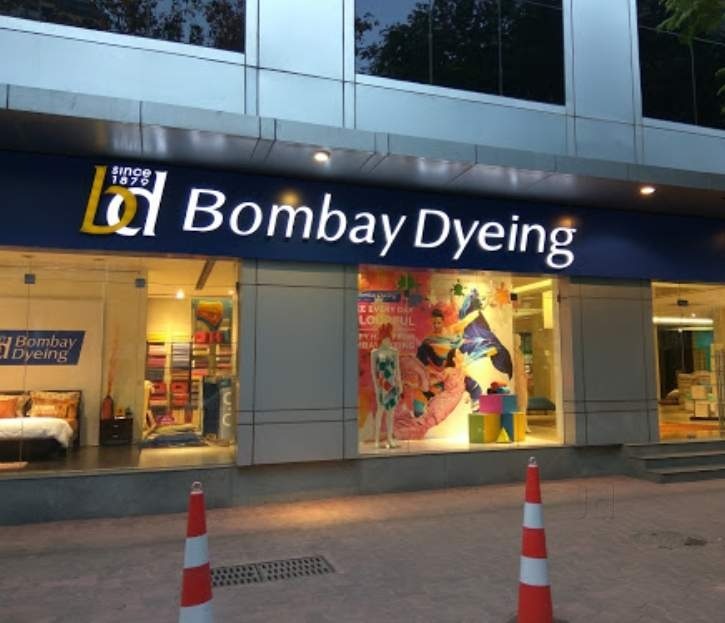
Bombay Dyeing is no longer the “textile” company your grandparents knew. Founded in 1879, it has evolved from a simple cotton mill into a complex conglomerate dealing in Polyester Staple Fibre (PSF), Real Estate Development, and a struggling Retail arm.
The company’s recent history is defined by a desperate, albeit successful, attempt to stay afloat. For years, interest costs were eating away at every rupee earned. The management made the bold, “burn the ships” decision to sell the iconic Worli land to Goisu Realty (Sumitomo). This provided the cash flow needed to pay off lenders and transition into a debt-free entity.
Today, the business is split into three distinct buckets. The PSF business is the volume driver but a margin killer. The Real Estate business is the potential “alpha” generator, with the recent launch of Three ICC in Dadar promising a revenue potential of ₹ 6,500 crore. The Retail segment is a tiny, 3% sliver of the pie that primarily serves as a legacy branding exercise.
As we dissect the FY26 results, we see a company that has the cash but lacks the operational efficiency to turn its core manufacturing into a profitable venture. It is a company in transition, and such transitions are rarely smooth or predictable.
3. Business Model – WTF Do They Even Do?
If you think they make bedsheets, you’re stuck in the 90s. Here is the modern-day breakdown of this Wadia beast:
- Polyester (The Heavyweight): They are India’s seventh-largest producer of Polyester Staple Fibre (PSF) with a 12% market share. They use high-end US technology (Invista) to make 100% virgin fibre. It accounts for 88% of their revenue. The problem? It’s a commodity. When crude prices dance, their margins die.