1. At a Glance
There are normal IT companies. Then there are companies that wake up one morning and decide they want to become India’s answer to NVIDIA-powered sovereign AI infrastructure. E2E Networks belongs to the second category.
This is a company that spent years as a niche cloud provider, then suddenly found itself sitting in the middle of India’s AI gold rush. In FY26 alone, revenue reached ₹2,456 million while EBITDA stood at ₹1,263 million. Sounds great. Then comes the twist: PAT was negative ₹156 million because depreciation exploded to ₹1,693 million after the company stuffed its balance sheet with GPUs, servers, and data center infrastructure.
So what do we have here?
A company with one of the fastest revenue growth rates in the Indian tech space.
A company whose quarterly revenue went from ₹335 million in Q4 FY25 to ₹956 million in Q4 FY26.
A company whose EBITDA margin is still above 50%, which is absurdly high for an infrastructure-heavy business.
And yet, despite all this, annual profits have gone negative because depreciation is hitting the P&L like a truck carrying 1,024 Blackwell GPUs.
This is the classic “future giant versus present pain” story.
The market is effectively betting that E2E’s massive GPU purchases, IndiaAI contracts, L&T partnership, sovereign cloud pitch, and Blackwell rollout will eventually produce monster cash flows. The risk, however, is equally obvious: if utilization does not rise fast enough, then E2E could end up looking less like an AI infrastructure leader and more like someone who bought a Ferrari fleet before learning how to drive.
Management sounds confident. Maybe too confident.
They are talking about reaching 80% to 90% GPU utilization in FY27, EBITDA margins closer to 70%, and Blackwell clusters capable of generating ₹250 crore annual revenue. That is a huge promise.
The real question for investors is simple.
Can E2E actually fill all these GPUs with paying customers before the next depreciation bill arrives?
Because if they can, this could become one of India’s most important AI infrastructure businesses.
If they cannot, then the company will continue producing world-class EBITDA and deeply confusing net profits.
2. Introduction
E2E Networks started life as a cloud infrastructure company long before “AI” became the favorite word of every investor presentation.
Back in the early years, it was mostly a small infrastructure-as-a-service player helping companies rent compute instead of buying servers. Over time, the company slowly moved up the value chain.
First came cloud GPUs.
Then came AI/ML platforms.
Then came sovereign cloud.
Then came IndiaAI contracts.
Then came L&T.
Now the company is basically pitching itself as the operating system for India’s AI future.
And to be fair, it has built real infrastructure.
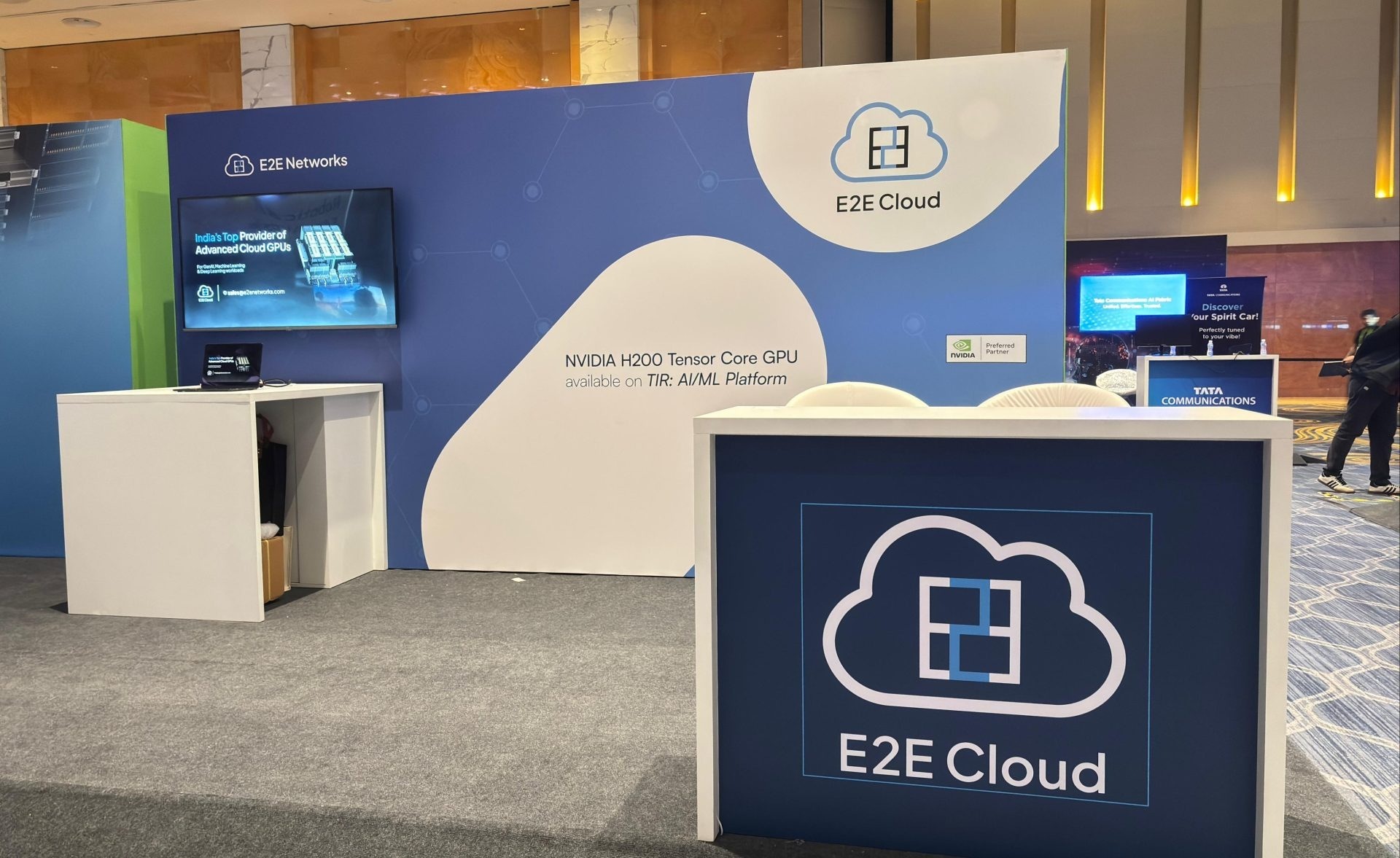
The company has data center presence in Delhi NCR, Mumbai, and Chennai. It has over 5,000 cloud GPUs. It offers H100s, H200s, Blackwell B200s, L40S and more. It has built its own TIR platform for AI development, deployment, and inference.
This is not some random company putting “AI” in its name and hoping retail investors forget to read the annual report.
But the scale-up has been aggressive.
Too aggressive, perhaps.
Revenue growth has been stunning, but the company is now in the most dangerous phase of its lifecycle: the phase where it has already spent a lot of money, but has not yet fully monetized the assets.
That is why FY26 numbers look so strange.
Revenue was up 50%.
Operating profit was up.
Cash flow from operations was ₹122 crore.
But PAT was negative ₹15.6 crore because depreciation and finance costs have started behaving like uninvited wedding guests who refuse to leave.
There is also dilution everywhere.
Promoter holding has dropped from nearly 60% to below 40%. L&T owns 18.45%. QIPs are happening. Preferential allotments are happening. Share split is happening.
At times, it feels like E2E raises money the way startups order coffee.
Still, the story remains compelling.
India is desperate for domestic AI infrastructure.
Government wants sovereign AI.
Hyperscalers are expensive.
Data localization is becoming more important.
And E2E is one of the few listed companies actually sitting at the center of this theme.
3. Business Model – WTF Do They Even Do?
Imagine AWS, but smaller, Indian, GPU-focused, and obsessed with AI workloads.
That is E2E.
The company rents computing infrastructure to customers.
But unlike generic cloud businesses, E2E focuses heavily on high-performance GPU infrastructure for AI, machine learning, model training, inference, and enterprise cloud workloads.
Its flagship offering is the TIR platform.
TIR is basically a full-stack AI environment where customers can train models, deploy models, run inference, use Jupyter notebooks, plug into vector databases, integrate with open-source frameworks, and do all the AI buzzword things investors love hearing.
Then there is the public cloud business.
Companies can rent Linux servers, Windows machines, GPU clusters, storage, networking, containers, load balancers, databases, serverless functions, and more.
Then comes the sovereign cloud pitch.
This is where E2E believes it has a genuine moat.
Many government agencies and enterprises do not want their sensitive data sitting on foreign hyperscaler infrastructure. E2E’s cloud runs in India, stores data in India, and claims lower exposure to foreign compliance laws.
This matters because IndiaAI, government contracts, defense, BFSI, and enterprise customers increasingly care about sovereignty.
Then there is AI Lab as a Service.
This is the “let us sell AI infrastructure to universities and training institutes” angle.
A lot of engineering colleges want students to experiment with AI but do not want