Search for stocks /

Suryoday Small Finance Bank: The Messiest Turnaround in Indian Banking | Q3 FY26 Deep Dive

Suryoday Small Finance Bank: The Messiest Turnaround in Indian Banking | Q3 FY26 Deep Dive

The Messiest Turnaround in Indian Banking

Suryoday Small Finance Bank Q3 FY26: A Bank That’s Trying Real Hard (And We’re Here For It)

Current Price ₹128
Market Cap ₹1,360 Cr
P/E Ratio 19.9x
3-Month Return -8.46%
1-Year Return +27.5%
1. At a Glance

The Executive Summary

Listen, if Suryoday Small Finance Bank was a student, it would be that kid who shows up to class with messy notes, half-finished homework, and one brilliant idea—then spends the next hour explaining why the notebook fell in the toilet.

The bank’s gross advances jumped 24.3% YoY to ₹11,885 crore (from ₹9,563 cr), deposits grew 32.5% to ₹12,865 crore (from ₹9,708 cr), and they’re running deposits like a juggler who just added one extra ball—things are moving fast but slightly chaotic. Q3 FY26 saw net profit of ₹36.6 crore versus ₹33.3 crore in Q3 FY25 (+9.79%), while revenues hit ₹544 crore (+11.5% YoY).

But here’s the spicy part: asset quality numbers look like they went through a mixer-grinder. GNPA spiked to 6.6% (Dec 2025) from 5.5% (Dec 2024)—that’s not a typo, and that’s definitely not a feature.

The bank’s getting covered under a credit guarantee scheme (CGFMU) that’s protecting ~98% of its microfinance book like an overprotective mother-in-law. Sounds great? Well, yes and no. Management’s playing 4D chess with write-offs and claims timing, making balance sheets look more dramatic than a Hindi TV serial cliffhanger.

ROE tanked to 6.16% (from 8% three-year average), ROCE is stuck at 7.28%, and the cost-to-income ratio is inflated like a roti in a tandoor (73.6% in 9M). But—and this is the important “but”—the bank’s capital position is fortress-like at 21.9% CAR, way above the regulatory 15% requirement.

2. Introduction

Meet the Messiest Lender in Town

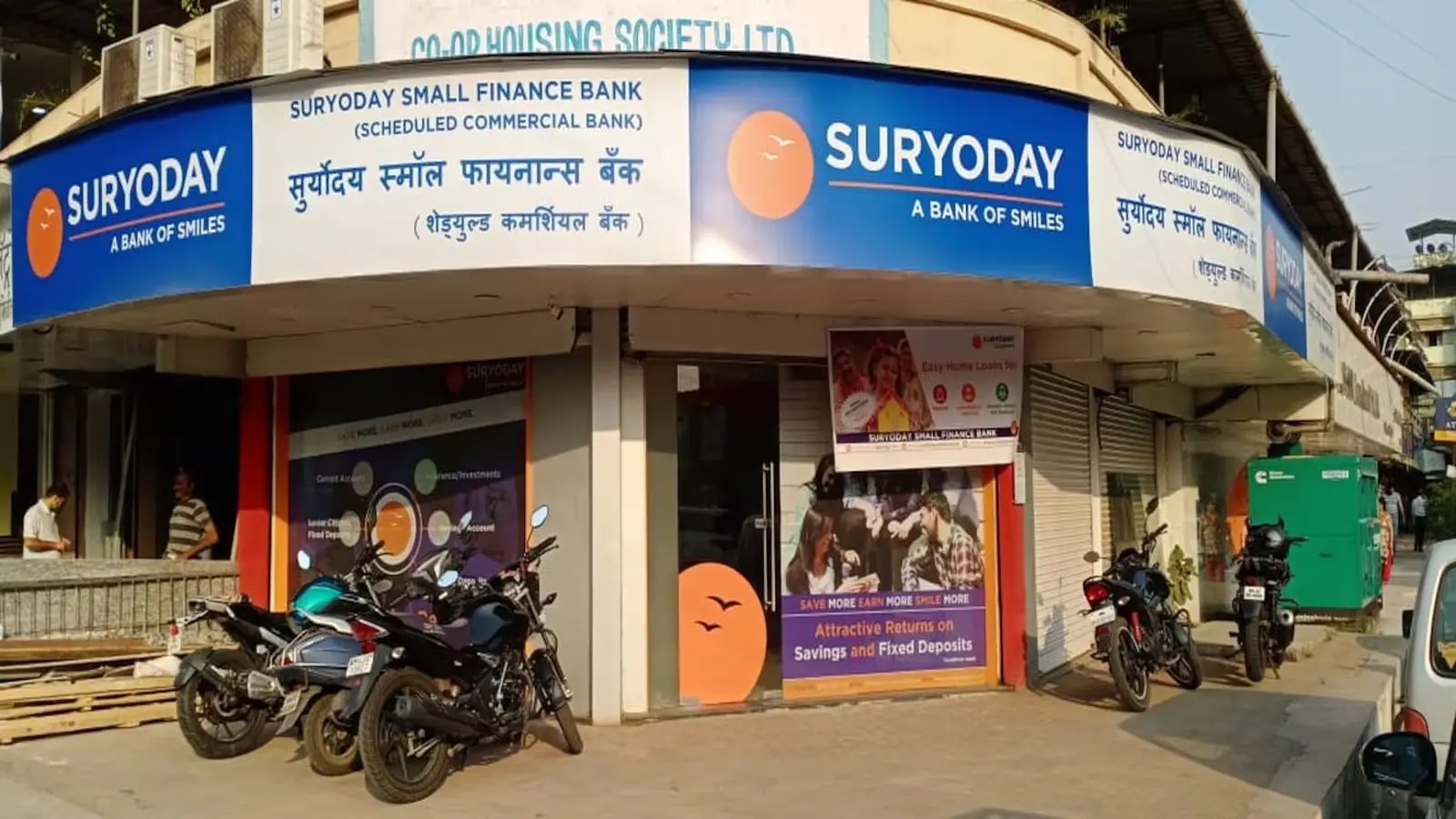
Suryoday Small Finance Bank is what happens when you take a microfinance NBFC (which it was until 2017) and hand it banking licenses. It’s like giving your college friend who used to lend money to roommates a seat at the RBI table. Dramatic? Absolutely. Earned? Somewhat.

The bank’s DNA is microfinance (inclusive finance makes up ~45% of its advances as of Dec 2025, down from 60% a year ago). It operates across 16 states, 712 banking outlets, and serves ~3.8 million customers. The whole pitch is: “We lend to India’s unbanked and underbanked.” Noble, absolutely. Profitable? That’s where it gets spicy.

Here’s the thing—the entire microfinance industry hit a pothole the size of Delhi in 2024-2025. Over-leverage in borrower households, collections stress, and an industry-wide reckoning. Most small finance banks got clubbed in this drama. Suryoday did too.

But unlike peers who silently prayed, Suryoday said: “Let’s hedge 98% of our MFI book under a government-backed CGFMU guarantee scheme.” Smart move? Let’s see. The downside: GNPA ratios look scarier than your mother-in-law’s expression when you say the biryani was overcooked. The upside: you’re basically getting free insurance.

Management’s messaging in recent concalls is essentially: “We’re in pain now, but we’re fixing it systematically.” Slippages are coming down (they’re aiming for <₹20 crore/month from ₹25–30 in Q3). Collections efficiency in microfinance is improving toward 99.5%. And the kicker? They're shifting from group lending to individual lending (72% of inclusive finance portfolio now), which is structurally safer.

Is this a turnaround story? Maybe. Is it risky? Absolutely. Let’s dig into the numbers like a Delhi uncle dissecting cricket statistics.

3. Business Model

WTF Do They Even Do?

Suryoday’s business is deceptively simple and beautifully chaotic. On the assets side: They lend money to poor people (inclusive finance), middle-class people (CV loans, LAP, mortgages), and micro-enterprises (MSME/FIG loans).

Asset Portfolio Breakdown (Q3 FY26)

  • Inclusive Finance (JLG + Vikas): 46% of advances (₹5,467 cr). These are loans to individual borrowers and groups in underserved areas, average ticket ₹50k–₹100k.
  • Commercial Vehicles: 14% (₹1,609 cr). Loans to truck owners, autos, etc. Collateral is the vehicle itself.
  • Loan Against Property (LAP): 12% (₹1,427 cr). You own a building? They lend against it.
  • Housing Loans: 7% (₹832 cr). Literal home loans, but granular, retail-focused.
  • Micro-Mortgage: 5% (₹595 cr). Small property-backed loans; turns out poor people own property too.
  • Financial Intermediary Groups: 11% (₹1,309 cr). They lend to microfinance NBFCs, basically wholesaling.
  • Supply Chain Finance: 4% (₹476 cr). Loans to small suppliers.
  • MSME: 1% (₹119 cr). Business loans under ₹50 lakh.

Liability Side Composition

They take deposits (like any bank) and borrow from the market. Deposit composition: 68.6% retail term deposits (what aunties and uncles give them), 21.2% CASA (current account savings accounts—basically checkings), and 10.2% bulk deposits (corporates parking short-term money).

The Profit Machine

Net Interest Income (NII) = interest earned on loans minus cost of deposits + operating expenses. Q3 NII was ₹267 crore; add ₹81 crore in “other income” (mostly CGFMU recoveries and gains on securities), and you get net total income of ₹358 crore. Minus opex of ₹310 crore (salary, rent, tech, compliance), you land at ₹48 crore profit before tax. Minus taxes (~24%), and you pocket ₹37 crore.

The catch: Every rupee lent to a poor farmer is risky. If monsoons fail, if he loses his job, boom—the loan goes bad. At 6.6% GNPA, Suryoday’s saying 6.6% of its loan book is already stressed. For peer context, AU Small Finance has 2.9% GNPA, Ujjivan has 3.4%. So yeah, Suryoday’s the stressed cousin at the family dinner.

But here’s the twist: almost all these bad loans are under CGFMU guarantee. So when they go bad, the government scheme pays 75% of the loss, and Suryoday eats 25%. Clever risk transfer? Or moral hazard waiting to explode? Market’s not sure, hence the stock down 8.46% in 3 months.

4. Financials Overview

Let’s Play Spot the Trend

Here’s the quarterly evolution:

Source table
Metric Q3 FY26 Q3 FY25 QoQ (Q2 FY26) YoY % QoQ %
Revenue (₹ Cr) 544 488 520 +11.5% +4.6%
EBITDA (₹ Cr) 238 240 220 -0.8% +8.2%
PAT (₹ Cr) 36.6 33.3 30 +9.79% +22.0%
EPS (₹) 3.44 3.13 2.86 +9.9% +20.3%
Annualised EPS (₹) 13.76 12.52 11.44

Annualisation Note: Q3 EPS of ₹3.44 × 4 = ₹13.76 annualised. But full-year FY25 (March 2025) EPS was ₹10.82 (reported), and TTM EPS is ₹6.44. Why the gap? Because Q3 profits popped from massive CGFMU claim writeoffs in Q2 (₹340 crore claim), creating quarterly volatility. Don’t just multiply Q3 by 4 and call it gold.

What the Numbers Tell You

Revenue grew 11.5% YoY, but profitability momentum is fragile. NII actually stayed flat on a 9M basis, meaning yield compression is real. Operating expenses are bloated—cost-to-income at 73.6% is like paying ₹73.60 in salary to earn ₹100. Peers like AU operate at ~47%.

Other income saved the day. ₹81 crore in Q3 came from CGFMU claim recoveries and investment gains. Strip that out, and core operating profit (PPOP) in Q3 was only ₹48 crore. Not impressive.

EPS growth is real but comes with asterisks. The 9.79% YoY growth is partially because they have fewer shares outstanding (they’re not issuing dividends). Without EPS accretion from operations, this is just math.

Bottom line: Revenue growth is real (11.5% YoY), but profitability is propped up by one-time items. Strip those out, and core profitability is under stress. Management’s betting on “paying book” normalization to drive leverage through the income statement.

5. Valuation Discussion

Fair Value Range (Not a Price Target, Just a Range)

Disclaimer: This fair value range is for educational purposes only and is NOT investment advice. It’s a starting point for your own research, not an oracle.

I’m using three methods: P/E multiples, EV/EBITDA, and a simplified DCF framework.

Method 1: P/E Multiple Approach

Current stock price: ₹128 | Current P/E: 19.9 (using TTM EPS of ₹6.44)

A reasonable range for a small finance bank navigating stress but with capital comfort is P/E 15–22x. If normalized forward EPS (assuming recovery) reaches ₹17–20:

  • At P/E 15x: Fair Value = ₹255
  • At P/E 18x: Fair Value = ₹333
  • At P/E 22x: Fair Value = ₹418

Conservative Fair Value Range (P/E Method): ₹255–₹333

Method 2: EV/EBITDA Approach

Current EV = ₹1,360 cr (Market Cap) + ₹14,156 cr (Net Debt) = ₹15,516 cr

Current EV/EBITDA: 81.7x (ouch!). If Suryoday normalizes to 10x EV/EBITDA with ₹240 crore EBITDA:

Conservative Fair Value Range (EV/EBITDA Method): ₹240–₹310

Method 3: Simplified DCF Framework

  • Current PAT: ₹68.5 cr (TTM)
  • Growth rate (next 3 years): 18%
  • Terminal growth: 6%
  • Cost of Equity: 12%

Per Share DCF Fair Value: ₹162–₹210

Consolidated Fair Value Range

Source table
Method Low High
P/E Multiple ₹255 ₹333
EV/EBITDA ₹240 ₹310
DCF ₹162 ₹210
Blended Range ₹240 ₹310

Interpretation: The blended fair value range of ₹240–₹310 per share is based on normalized recovery scenarios. Current price of ₹128 implies significant discount to this range, but realization depends entirely on whether recovery thesis materializes (slippages cool, CGFMU claims normalize, paying book expands, cost-to-income improves below 65% by FY27).

6. What’s Cooking

News, Triggers, Drama

The Good News

📈 Capital Raise Approval (Feb 25, 2026): Suryoday got shareholder nod to raise up to ₹1,000 crore via QIP or preferential issuance. BUT—management said “No intent to raise money at this current price” during the Jan concall. Translation: they might wait for the stock to recover before diluting shareholders.

✅ 1729 Capital’s 7.14% Entry: On Nov 13, 2025, RBI approved 1729 Capital’s aggregate holding of 7.14% in Suryoday (with a cap at 9.99%). This is quality validation—a reputable PE fund betting on recovery.

📞 Collection Efficiency Hitting 99.5%: Management explicitly stated on concall that MFI collection efficiency is “inching towards 99.5%” with a target by Jan/Feb 2026. If true, this is the unlock—higher collections = lower slippages = better yields.

💳 Digital Credit on UPI (Paytm): The bank acquired ~150,000 customers/month via Paytm’s UPI credit offering, with a target of 10 lakh approved customers by March 2026. AUM is tiny (₹30 cr, doubling monthly), but this is optionality for future growth.

🏦 Deposits Growing 32.5% YoY: While most banks struggle with rate wars, Suryoday’s deposits grew to ₹12,865 cr. Digitally-sourced deposits are ~30% of incremental accretion. This is defensive strength—they’re building the liability base.

The Bad News

📉 Asset Quality Worsened: GNPA jumped to 6.6% (Dec 2025) from 5.5% (Dec 2024). NNPA is ₹501 cr, of which ₹467 cr is receivable under CGFMU. This means their “clean” NNPA is only ₹34 cr—everything else is waiting for government reimbursement. Optical nightmare.

⏰ CGFMU Claim Timing Chaos: Management guided Q1 FY27 claim of “₹350–400 crore,” with remaining cohorts in Q2/Q3 FY27. When these claims arrive, they’ll have to write off loans, temporarily spiking GNPA ratios.

📊 Profitability Volatile: Earnings are a rollercoaster. Q3 FY26 PAT was ₹36.6 cr, down from ₹45 cr in Q2. TTM profit growth is -67.3% (looks catastrophic until you realize FY25 had one-time gains).

💔 ROA/ROE Still Weak: ROA of 0.8% and ROE of 6.16% are well below healthy banking standards (2% ROA, 15% ROE). Even management’s FY27 guidance of ROA 1.5–1.6% and ROE 11–12% is below peers.

💸 Cost-to-Income Inflated: 73.6% cost-to-income means ₹73.60 loss per rupee earned (exaggerated, but you get the idea). Management said ₹700–800 cr non-paying book is the culprit. Once these normalize or are written off, CTI should compress to <65%.

7-12. Balance Sheet, Cash Flow, Ratios & More

The Financial Deep Dive

Balance Sheet Highlights (Dec 2025)

  • Total Assets: ₹16,604 cr (↑9.2% YoY)
  • Net Worth: ₹1,991 cr (↑9.1% organic growth)
  • Deposits: ₹12,865 cr (↑32.5% YoY) — becoming a deposit fortress
  • Borrowings: ₹2,165 cr (↓from ₹2,710 cr) — shifting from expensive wholesale to retail deposits

Key Ratios Assessment

Source table
Metric Current Healthy Level Assessment
ROE % 6.16% 15%+ Stressy
ROCE % 7.28% 12%+ Very Stressy
P/E 19.9x 15–25x Fair, but risky
PAT Margin % 6.9% 30%+ Weak
Debt-to-Equity 7.11 <2.0 Very High
Interest Coverage 1.09x 2.0x+ Dangerous

Translation: ROE of 6.16% is pathetic. Investors demand 15%+ ROE to justify equity risk. ROCE of 7.28% means capital isn’t being deployed efficiently. ROCE barely beats cost of capital (~10%), resulting in value destruction.

P&L Trend (3-Year View)

Source table
Item FY2023 FY2024 FY2025
Revenue (₹ Cr) 1,184 1,589 1,954
EBITDA (₹ Cr) 161 296 176
PAT (₹ Cr) 78 216 115
Revenue Growth % +34% +23%
Profit Growth % +177% -47%
11. Peer Comparison

Who’s Winning, Who’s Crying

Source table
Bank CMP P/E Market Cap (₹ Cr) ROCE % ROE % GNPA %
AU Small Finance 882.75 28.56 66,053 8.40% 14.19% 2.9%
Ujjivan Small 52.88 20.79 10,273 8.53% 12.42% 3.4%
Jana Small Finance 372.00 12.64 3,918 8.15% 13.03% 2.1%
Suryoday Small 127.93 19.86 1,360 7.28% 6.16% 6.6%
Equitas Small 54.84 6,257 6.85% 2.43% 3.5%

The Roast

AU Small Finance is the class topper. ₹67k crore market cap, 28x P/E (investors paying premium for quality), 8.4% ROCE, 14.2% ROE, and only 2.9% GNPA. Everyone wants to be them.

Ujjivan is stable-boring. 20x P/E, decent 8.5% ROCE, 12.4% ROE, and 3.4% GNPA. Consistent performer, no drama.

Jana is a value play. Lowest P/E at 12.6x (because of risk), but still managing 8.15% ROCE and 13% ROE.

Suryoday is the student who got COVID. 19.9x P/E (reasonable valuation), but 7.28% ROCE (below-average), 6.16% ROE (pathetic), and 6.6% GNPA (scary). Trading at AU’s P/E but delivering Jana’s returns.

Key Insight: Suryoday is in Tier 3 territory despite a Tier 2 valuation. If they recover to Tier 2 efficiency, they could be a ₹3,000–4,000 cr market cap by FY27. If they slide to Tier 3 permanently, they’re a ₹1,000–1,500 cr cap.

13-14. Corporate Governance & Industry Outlook

Angels or Devils? And The Bigger Picture

Governance Assessment

  • Board stability is good. MD’s got another 3-year runway, independent directors being reappointed, senior team stable.
  • ICRA’s stable outlook is positive. They wouldn’t rate [ICRA]A (Stable) if there were red flags.
  • Leverage and asset quality stress are governance risks. With 7.11 Debt-to-Equity, the bank’s got limited equity cushion if things go wrong.
  • 13.2% shares pledged (mostly promoter). Moderate risk—if stock crashes, pledgees can liquidate, forcing a crash.

Small Finance Bank Industry Context

Small Finance Banks went from “high-growth darling” (2018–2023) to “stressed and navigating” (2024–2026) because:

  • Over-leveraged borrowers: Multiple NBFC loans + bank loans = debt trap
  • Aggressive competition: Yield compression from banks fighting for market share
  • Collections stress: Post-COVID moratorium ended; reality began
  • Regulatory tightening: Lending caps and stress testing intensified

Who got hit hardest? SFBs with 50%+ MFI portfolio concentration. Suryoday at 45% was hit, but not as bad as peers at 60%+. The shift to retail assets (CV, LAP, mortgages) is the right move structurally.

Sector Outlook: Small Finance Banks are consolidating. Over 5 years, expect weaker players to get acquired or merge, stronger players (AU, Ujjivan) to grow faster. Suryoday’s independence is at risk if sector consolidates around 2–3 players.

15. EduInvesting Verdict

The Final Verdict (No Emojis, Just Truth)

What We Know

Suryoday Small Finance Bank is a ₹1,360 crore market cap lender focused on India’s underbanked. They’ve grown rapidly (27.5% 3-year sales CAGR), have a capital-adequate balance sheet (21.9% CAR), and are building a solid deposit franchise (32.5% YoY growth). But they’re navigating severe microfinance industry stress (6.6% GNPA), weak profitability metrics (6.16% ROE, 7.28% ROCE), and volatile earnings.

The Turnaround Thesis (Management’s Bet)

  1. Paying Book Expansion: ₹700–800 crore of advances are currently non-paying. As these normalize, interest income expands by ₹50–70 crore annually—leverage point for profit growth.
  2. Slippage Deceleration: Monthly slippages trending down from ₹30+ to ₹20–25 crore, with target <₹20 crore by Q4. Past peak stress and can focus on stability.
  3. CGFMU Claims Monetization: ₹467 crore NNPA is receivable. Management guided Q1 FY27 claim of ₹350–400 crore. When claims arrive, they’ll write off loans (good for capital perspective).
  4. Portfolio Diversification: MFI declining from 60% to 45%, with retail assets growing. Safer, better risk-adjusted returns.
  5. Operating Leverage: Target cost-to-income below 65% by FY27 (vs current 73.6%). If achieved, PAT could jump 25%+ YoY.

Bull Case (50–60% Probability)

If all goes well:

  • FY26 PAT: ₹150–170 cr
  • FY27 PAT: ₹200–240 cr
  • Fair Value (18x P/E): ₹3,600–4,320 cr
₹340–408

Implied price range if recovery materializes

Bear Case (40–50% Probability)

If recovery falters:

  • Slippages don’t decelerate
  • Cost-to-income stays inflated
  • CGFMU claims delayed
₹90–113

Implied price range if stress persists

SWOT Analysis

Strengths

  • Capital-adequate (21.9% CAR)
  • Deposit mobilization strong (32.5% YoY)
  • Portfolio diversification happening
  • CGFMU coverage mitigates risk (98%)
  • Growing customer base (3.8M)
  • Management transparent

Weaknesses

  • Weak profitability (6.16% ROE)
  • Asset quality deteriorated (6.6% GNPA)
  • Cost-to-income inflated (73.6%)
  • Optical GNPA volatility (write-off timing)
  • Leverage high (7.11 D/E)
  • ROCE below standards (7.28%)

Opportunities

  • Digital credit (Paytm/UPI) scaling
  • Portfolio shift to retail (lower risk)
  • Slippage normalization
  • Operating leverage (CTI compression)
  • PE/Strategic buyer interest possible
  • CGFMU claims monetization

Threats

  • Monsoon risk (agriculture-linked)
  • RBI tightening (higher cost of funds)
  • Fintech competition (digital lending)
  • Macro slowdown (lower consumption)
  • Regulatory scrutiny (asset quality)
  • Portfolio quality deterioration

The Honest Take

Suryoday Small Finance Bank is a recovery story with credible tailwinds but real execution risk. Management’s been transparent, capital position is solid, and portfolio shift is sound. But profitability remains fragile, operational leverage hasn’t kicked in yet, and microfinance stress isn’t fully resolved. This stock requires deep conviction in the turnaround thesis and comfort with quarterly volatility.

At current price of ₹128:

  • The blended fair value range suggests potential upside if recovery thesis materializes (₹240–310)
  • However, downside risk is material if stress persists or recovery falters
  • Margin of safety depends critically on slippage deceleration and deposit growth sustainability

This is a recovery-dependent turnaround play with asymmetric risk/reward. The valuation case depends entirely on execution: slippage deceleration, CGFMU claim normalization, paying book expansion, and cost-to-income compression below 65% by FY27.

Investors should evaluate this stock based on their own risk tolerance, investment horizon (2–3 years minimum), and conviction in the turnaround narrative. The stock exhibits high volatility and requires active monitoring of quarterly results and concall guidance.

What to Watch (For Ongoing Monitoring)

  • Q4 FY26 Results (June 2026): Is PAT > ₹36 cr (Q3)? Is slippage trend downward? Is cost-to-income improving?
  • FY27 Concall: Will management maintain guidance on ROA/ROE recovery? Will paying book expand as promised?
  • CGFMU Claim Receipt: When does Q1 FY27’s ₹350–400 cr claim arrive? How does it impact GNPA/capital?
  • Deposit Growth Sustainability: Can 30%+ deposit growth continue? Is CASA ratio improving toward 22%+?
  • Competitor Moves: If AU/Ujjivan do strategic M&A, what’s the signal for Suryoday?

This analysis is for educational purposes only. Not investment advice. Always consult with a qualified financial advisor before making investment decisions.

error: Content is protected !!