01 — At a Glance
The Machine That Makes Machines (That Nobody Talks About)
- 52-Week High / Low₹1,286 / ₹683
- Q3 FY26 Revenue₹1,739 Cr
- Q3 FY26 PAT₹84 Cr
- Q3 EPS₹9.49
- Annualised EPS (Q3×4)₹37.96
- Book Value₹379
- Price to Book2.38x
- Dividend Yield0.55%
- Debt / Equity0.33x
- Order Book Value₹79.1 Bn
The Opening Act: ISGEC just delivered Q3 FY26 with ₹1,739 Cr revenue (+16% QoQ), ₹84 Cr PAT (but here’s the kicker — profit doubled YoY). The order book touched ₹87.1 Crore (consolidated, December 2025). Meanwhile, Anup Bhargava just retired. The MD is still settling into his postal ballot. And management says exports are “picking up” like it’s a casual chai conversation. In the heavy engineering world, this passes for excitement.
02 — Introduction
ISGEC: The Company Your Dad’s Boss Bought From In 1987
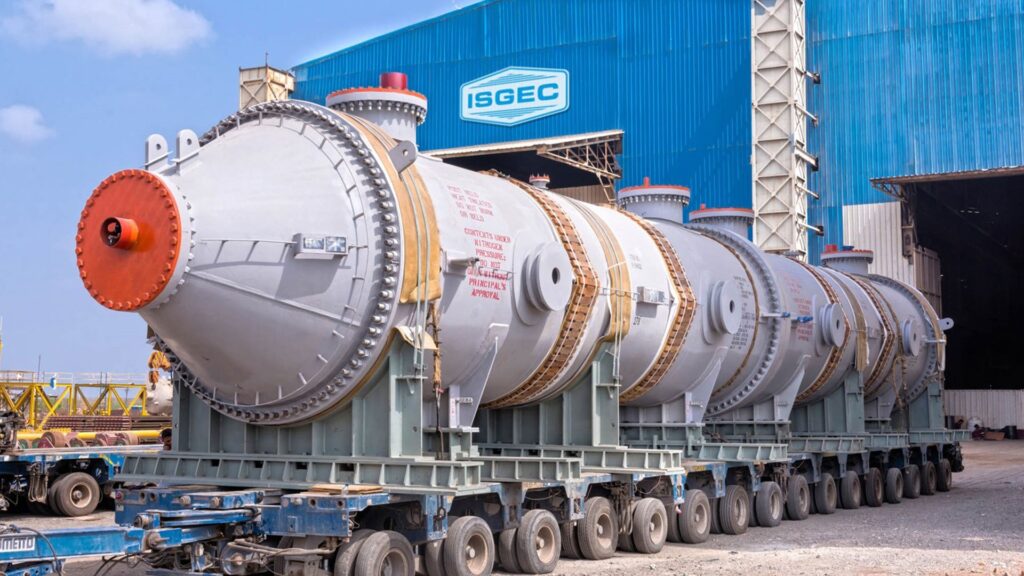
Established 1933. Let that sink in. When ISGEC was founded, India was still a British colony, independence was a Gandhian dream, and heavy engineering was the exotic frontier of Indian capitalism. Nine decades later, they’re still in the business of fabricating boilers, presses, heat exchangers, and other equipment that nobody at dinner parties asks about.
Here’s the thing though: ISGEC doesn’t sell lipstick, smartphones, or subscription juice plans. They manufacture and execute turnkey projects. They build the pressure vessels that power your city’s electricity. The sugar mills where your jaggery is made. The refineries that crack crude into petrol for your commute. And the air-pollution control systems that pretend to make industrial exhaust less toxic. In short, they are the unsexy infrastructure backbone of Indian manufacturing.
The company operates through three business segments: EPC (Engineering, Procurement, Construction projects — 53% of revenues in Q1 FY25), Machinery & Equipment (33%, up from 26% five years ago), and Sugar & Ethanol (14%, a profitable sidekick via subsidiary Saraswati Sugar Mills). Consolidated revenues sit at ₹6,515 Cr (FY25, TTM). Order book: ₹87.1 Crore as of Q3 FY26. That’s healthy medium-term visibility in a sector where projects run 18–24 months.
Now here’s what’s happening: management just announced ₹218 crore capex to double the presses/machine building capacity. Another ₹22.6 crore to add in-house machining for iron castings. Another ₹110 crore for skids and modules at a special economic zone facility. Translation: ISGEC is betting big on the idea that India’s industrial capex boom isn’t a four-quarter flash. And based on concall commentary, they’ve also decided to stop chasing low-margin government contracts and focus on private, export, and faster-cycle work. It’s a pivot nobody expected. Quite literally.
Concall Note (Feb 2026): “We are inching closer to the desired mix” (on private vs PSU orders). Translation: we finally figured out that PSU work pays terrible. Better late than never.
03 — Business Model: Making Invisible Things That Run Everything
If Your Factory Doesn’t Hum, ISGEC Didn’t Do Their Job
ISGEC operates as a diversified capital goods + EPC player. Three flavours of income:
Segment 1: EPC (53% of revenues, down from 64% in FY20) — Turnkey project execution. ISGEC designs, procures equipment, manages site construction, and commissions complete plants. Boiler houses. Sugar plants. Distilleries. Refineries. Power plants. Bulk material handling systems. Even wastewater treatment. Projects typically run 18–24 months, are fixed-price (hence commodity-price risk), and require 28–30% working capital intensity. Think of it as the “I sold you a promise” business. Execution is everything. Delays are catastrophic.
Segment 2: Machinery & Equipment (33% of revenues, up from 26% in FY20) — Manufacturing and selling standalone capital equipment. Hydraulic presses (for automotive, forging). Heat exchangers. Boiler tubes and panels. Iron and steel castings. Liquified gas containers. Contract manufacturing. Better margins than EPC (double-digit potential) because it’s not fixed-price. Shorter cycles too. Management is now hell-bent on growing this segment to ₹1,000 Cr annually from today’s ₹400 Cr. That’s a 2.5x bet.
Segment 3: Sugar & Ethanol (14% of revenues) — Via subsidiary Saraswati Sugar Mills. Crushing capacity ~10,000 TCD. Ethanol output 160 KLPD. It throws off 37% of company PAT despite being 13% of turnover. Thick margins when sugar prices cooperate. But government policy is a whimsical overlord, so margins are “favourable currently” (management’s exact words, meaning: don’t ask about next year).
Geographic split: 87% India, 13% exports. But management is aggressive on export ramp — Q3 standalone export revenue jumped to ₹378 Cr from ₹142 Cr (YoY). That’s 2.7x. Small base, but directionally significant.
Order Book₹8.7BCons; 1.2x Revenue
EPC Mix53%Declining; Strategic
Export Revenue+167%Q3 vs Q3 YoY
Strategic Note from Concall: CFO explicitly acknowledged the current private/export mix is 85:15, and management is “inching closer to the desired mix.” Translation: they now realize PSU work pays garbage. This pivot matters because private sector orders have “shorter cycle times and payment terms linked to supplies rather than milestones.” Meaning: less working capital, faster cash, better margins. Welcome to 2026, ISGEC.
💬 If your factory’s pollution control system fails, ISGEC’s APC equipment takes the blame. Ever wondered who’s behind that boring metal box? Drop your thoughts!
04 — Financials Overview
Q3 FY26: Profit Went Ballistic (Then Came Back To Earth)