BEML Ltd:
₹1,083 Cr Revenue. ₹1,500 Cr Rail Factory. -₹22 Cr Profit?
The Highest Expectations Crash Into Reality.
24% topline growth met with a loss. A ₹1,500 crore greenfield factory approved. And management is already promising ₹20,000 crore order book. This is what happens when a government engineer dreams in capital equipment.
When Revenue Grows 24% But Your Profit Goes Negative
- Q3 FY26 Revenue₹1,083 Cr
- YoY Growth+23.7%
- Q3 FY26 PAT-₹22.4 Cr
- Q3 EPS-₹2.69
- FY26 TTM Revenue₹4,209 Cr
- Order Book₹16,300 Cr
- Order Book Target₹20,000 Cr
- Book Value₹336
- Price to Book4.80x
- Dividend Yield0.66%
Welcome to BEML: Where Orders Are Plenty, Margins Are Shy
BEML Limited — Bharat Earth Movers Limited. Established 1964. A PSU that manufactures heavy earthmoving equipment, defence vehicles, metro coaches, and locomotives. For six decades, it has been the go-to supplier when Coal India needs equipment, when the Ministry of Defence needs armoured vehicles, and when metro corporations decide they need more trains than their budget allows.
The company is basically India’s “call them if you need something big and metal.” Most of their customers are government. Most of their sales are repeat orders. Most of their margins are squeezed. This is the business model: high volume, low margins, eternal patience with government tenders, and the occasional -₹22 crore quarter to keep everyone humble.
Q3 FY26 revealed a peculiar narrative. The topline roared. The operating cycle got tighter (inventory down, working capital efficiency up). Employee cost dropped. But a single project decision —restarting a stuck metro coach order that was in limbo— triggered an ₹80 crore provision, collapsing PAT to negative. Management’s Feb 2026 concall commentary was refreshingly honest: “The provision is FX-linked… Another 16–18 months, we expect it will be wiped off.”
Translation: This is not a business failure. This is a project management hiccup with a foreign currency tail. But for a stock trading at 54x P/E, even hiccups trigger sharp exits. Let’s dissect what is actually happening at BEML, why the board approved a ₹1,500 crore capex, and whether this is a “buy on weakness” or a “wait for clarity” situation.
Three Segments. One Thing They All Share: Long Cycles.
BEML operates across three business verticals, each with its own profitability quirk.
Rail & Metro (68% of Order Book): BEML makes metro coaches, Vande Bharat sleeper coaches, LHB coaches, and rail infrastructure. They supply Indian Railways, metro corporations in Delhi, Bangalore, Mumbai, and others. This segment drives the future. The company just got Board approval to build a greenfield facility at Umariya (near Bhopal) with ₹1,500 crore capex. Current capacity: 200–250 coaches/year. Bhopal Phase 1 will add 300 cars/year. Phase 2: 800 cars/year. The business case: India needs 15,000+ metro cars over 5 years. BEML is bidding for 50% of that market. This is where the ₹20,000 crore order book ambition comes from.
Defence & Aerospace (25% of Order Book): Armoured vehicles, bridge-layer systems, field artillery tractors, and mobility platforms. Top customers: Ministry of Defence, Indian Army. The TAM is real but order cycles are political and procurement is glacial. Management cited several items in the pipeline: Self-propelled mine barriers (trials cleared, expecting order next FY), Command post vehicles (bulk production clearance “very shortly”), Gun towing vehicles (trials done, price opening “very shortly”). If even 60% of these convert, it’s material. But “expecting” and “receiving” are hemispheres apart in defence.
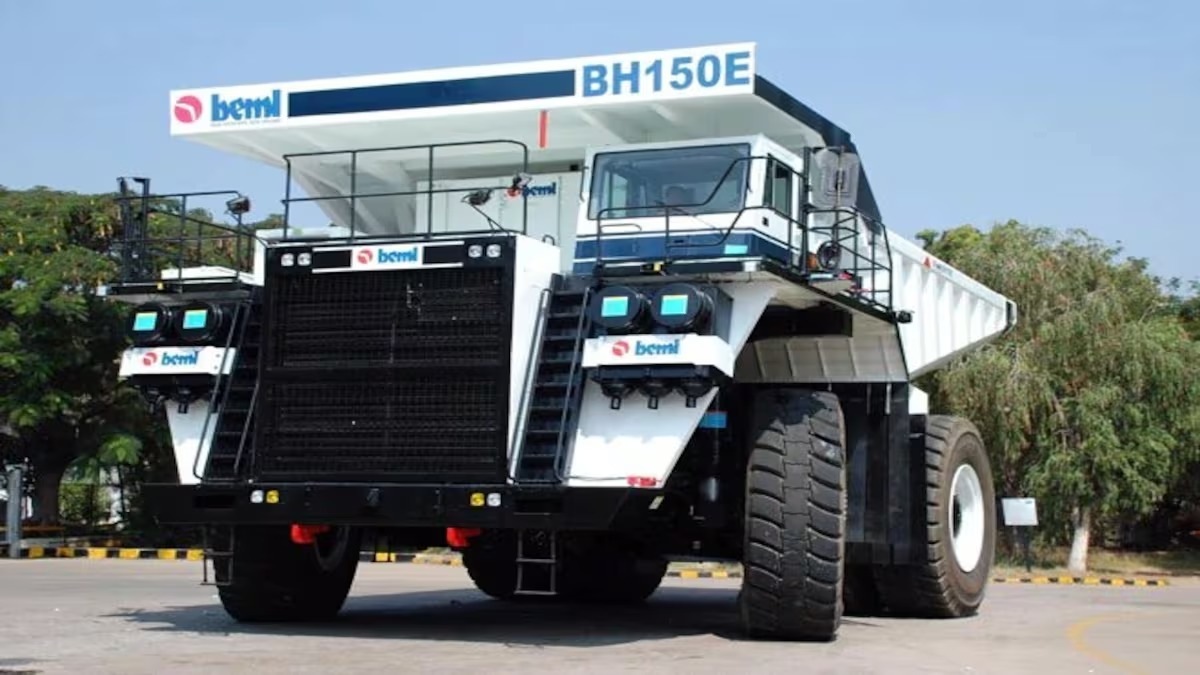
Mining & Construction (7% of Order Book): Hydraulic excavators, wheel loaders, dump trucks, motor graders. They supply Coal India, SAIL, NTPC, and private mining operators. This segment is currently in the doldrums. Management blamed delayed monsoons and a shift in procurement model (from departmental purchase to MDOs — Mine Development Operators). No current mining orders as of Feb 2026 concall. Expected to normalize next FY Q1.
Q3 FY26: When The Math Doesn’t Match The Story
Result type: Quarterly Results | Q3 FY26 EPS: -₹2.69 | Full-Year FY25 EPS: ₹29.90 | Key Driver: ₹80 Cr Metro Project Provision
Source table
| Metric (₹ Cr) | Q3 FY26 Dec 2025 |
Q3 FY25 Dec 2024 |
Q2 FY26 Sep 2025 |
YoY % | QoQ % |
|---|---|---|---|---|---|
| Revenue | 1,083 | 876 | 839 | +23.7% | +29.1% |
| Operating Profit | 4 | 60 | 73 | -93.3% | -94.5% |
| OPM % | 0.4% | 6.8% | 8.7% | -640 bps | -830 bps |
| PAT | -22 | 24 | 48 | -192.4% | -145.8% |
| EPS (₹) | -2.69 | 2.93 | 5.77 | -191.8% | -146.6% |
Pricing In Perfection (And Then Some)
Method 1: P/E Based
TTM EPS (FY25 full year): ₹29.90. Capital goods industry median P/E: 28.8x. BEML’s current P/E: 54.1x. For a stock at 54x to be justified, it needs to deliver 100% profit growth CAGR over the next 3–5 years, which is… let’s just say optimistic for a 60-year-old PSU. Fair P/E band for normalized earnings: 20x–30x.
Range: ₹598 – ₹897
Method 2: EV/EBITDA Based
TTM EBITDA (FY25): ~₹450 Cr (approx). Current EV: ₹13,814 Cr (Mcap + Net Debt). EV/EBITDA: 30.7x. Capital goods peers trade at 15x–20x EBITDA. The premium is unjustified given execution risks on the Bhopal capex and near-term margin pressure from the discrete provision.
EV range (15x–20x): ₹6,750 Cr – ₹9,000 Cr → Per share (assuming net debt ₹100 Cr):
Range: ₹802 – ₹1,070
Method 3: DCF Based
Normalized FCF (post capex, post Bhopal stabilization): ~₹250–350 Cr annually (conservative). Growth: 8–10% for 5 years (assuming order book execution). Terminal growth: 3%. WACC: 10%.
→ Terminal Value (3% growth / 7% cap rate): ~₹4,900 Cr
→ Total EV: ~₹6,200 Cr (post capex financed)
Range: ₹744 – ₹1,250
₹1,500 Crore Factory Bet. ₹80 Crore Provision Hit. What Could Go Wrong?
⚙️ The Bhopal Bet: ₹1,500 Crore Greenfield Rail Factory
In February 2026, BEML’s Board approved a greenfield manufacturing facility (“BRAHMA”) at Umariya (near Bhopal) with total capex of ₹1,500 crore (incl. GST). Phase 1 (~₹900 crore): 18–24 months to completion, adding 300 coaches/year capacity. Phase 2 (~₹600 crore): Post-Phase 1, adding another 500 coach capacity (total 800/year). The facility will be “fully automated, modern, with multi-gauge capability.” Funding: explicitly debt-financed. Financial closure targeted “another couple of months.” Civil works already underway (boundary wall ~50% done). This is the real story. If Bhopal executes, BEML’s rail & metro TAM increases 4x. If delays happen (which is India-default), equity returns compress over the capex cycle.
⚠️ The Q3 Metro Mess
- • ₹80 Cr provision for a metro project restart (in limbo for months)
- • FX-linked impact (Euro/USD rates); expects reversal in 16–18 months
- • Mumbai Metro Mandale depot not ready (storage space bottleneck)
- • Vande Bharat sleeper coach redesign delays (external partner)
- • Net result: Q3 PAT crashed to -₹22 Cr despite 24% revenue growth
✅ Supply Chain Reset & Vertical Integration
- • Critical aggregates being sourced from multiple local players (wheels, bogeys)
- • Developing in-house TCMS (Train Control Management System)
- • Aditya facility (started Sep 2024) now operational for high-speed trains, LHB coaches
- • RC2 facility at KGF shifted load to balance capacity
- • Supplier ecosystem buildout: 3–4 partners for interior panels, 2–3 for seats
📈 Defence Tailwinds: Pipeline Visibility
- • High-mobility vehicles: ₹1,000 Cr+ pipeline
- • Engineered systems: ₹1,000–1,500 Cr pipeline
- • Combat engineering bridging: ₹1,000+ Cr potential
- • Self-propelled mine barrier: Trials cleared, order expected Q1 FY27
- • ARV programs (194 units, 352 unit overhauls): multi-year revenue stream
⚠️ Mining Segment: Stuck In Monsoon Season
- • No current mining orders (as of Feb 2026 concall)
- • Delayed monsoons → delayed ordering by Coal India & MOIL
- • Procurement shift from departmental purchase to MDOs (structural change)
- • Expected normalization in FY27 Q1 (Singareni orders ~₹700–800 Cr cited)
- • BEML actively engaging MDOs directly (roadshows underway)
Is the Foundation Solid? Yes. But Capex Is Going to Test It.
Source table
| Item (₹ Cr) | Mar 2024 | Mar 2025 | Sep 2025 | Latest (Sep 2025) |
|---|---|---|---|---|
| Total Assets | 5,591 | 6,044 | 5,935 | 5,935 |
| Equity + Reserves | 2,698 | 2,887 | 2,800 | 2,800 |
| Borrowings | 71 | 229 | 666 | 666 |
| Other Liabilities | 2,852 | 2,928 | 2,469 | 2,469 |
| Total Liabilities | 5,591 | 6,044 | 5,935 | 5,935 |
From ₹71 Cr (Mar 2024) to ₹666 Cr (Sep 2025). Still low in absolute terms (D/E = 0.24x), but rising fast. Bhopal capex will push this further. CARE Ratings expects “Total Debt to PBILDT going above 2.75x” could trigger downgrades. Currently at 2.5x (comfortable).
Inventory days down, receivable days improved, payable days optimized. Operating cycle is becoming leaner. This is real operational improvement, not accounting magic. Good sign before a big capex.
President of India holding 54% unchanged. GoI intended to divest 26% via “strategic disinvestment” (announced FY17). Still pending. Political risk, but also government backing (implicit).
Sab Number Game Hai (All Is Numbers… Until Cash Runs Out)
Source table
| Cash Flow (₹ Cr) | FY23 | FY24 | FY25 | 9M FY26 (YTD) |
|---|---|---|---|---|
| Operating CF | +560 | +458 | +183 | +TBD |
| Investing CF | -20 | -68 | -205 | -Heavy Capex (Bhopal) |
| Financing CF | -331 | -130 | -139 | +Debt (for Bhopal) |
| Net Cash Flow | +208 | +260 | -162 | -Negative (build phase) |
54x P/E. 15.6% ROCE. Pick Your Poison.
Four-Year Profitability Trend: Inconsistent, Lumpy, Unpredictable
Source table
| Metric (₹ Cr) | FY22 | FY23 | FY24 | FY25 (TTM) |
|---|---|---|---|---|
| Revenue | 4,337 | 3,899 | 4,054 | 4,209 |
| EBITDA | 325 | 369 | 445 | 450 (approx) |
| EBITDA Margin % | 7.5% | 9.5% | 11.0% | 10.7% |
| PAT | 129 | 158 | 282 | 249 |
| EPS (₹) | 15.46 | 18.96 | 33.83 | 29.90 |
This is not a growth story. This is a “execution quality improving, but topline stalled” story. EBITDA margin expanded from 7.5% to 11% in three years (genuine operational leverage). But PAT volatility is high due to one-off charges, project provisions, and FX impacts. Investors chasing 100% profit growth will be disappointed.
BEML vs The Capital Goods Circus
Source table
| Company | CMP | Market Cap (Cr) | FY25 Revenue (Cr) | FY25 PAT (Cr) | P/E | ROCE % |
|---|---|---|---|---|---|---|
| BEML Ltd | ₹1,614 | 13,480 | 4,209 | 249 | 54.1x | 15.6% |
| Action Const. Eq. | ₹866 | 10,320 | 3,212 | 423 | 24.4x | 40.1% |
| Ajax Engineering | ₹471 | 5,385 | 2,101 | 223 | 24.1x | 33.6% |
| Brady & Morris | ₹720 | 162 | 82 | 5 | 33.3x | 25.4% |
BEML trades at the highest P/E (54.1x) but delivers the lowest ROCE (15.6%). Action Const. Eq.: 24.4x P/E, 40.1% ROCE. Ajax: 24.1x P/E, 33.6% ROCE. The valuation disconnect is stark. Either BEML is worth the premium due to future Bhopal upside, or the market is mis-pricing risk.
President of India Owns 54%. That’s Both Comfort and Chaos.
- President of India (GOI)54.03%
- Public & Others22.08%
- DIIs (HDFC, Kotak, ICICI)18.39%
- FIIs5.51%
Shareholders: 1.98 lakh (up from 1.2 lakh in Mar 2024). Retail interest rising. Pledge: None. Stability: Government can’t sell, so expectations are managed.
Promoter: Government of India
Ministry of Defence holds 54% via a nominee director. The ‘in-principle’ decision to divest 26% (announced FY17) is still pending, likely blocked by political bandwidth. Government ownership = implicit rating, explicit dividend policy (28.5% payout historically), and glacial decision-making.
The Divestment That Never Came
GoI decided to divest 26% equity via “strategic disinvestment with transfer of management control” in FY17. A decade later, zero progress. This creates both comfort (government backing won’t vanish) and frustration (capital allocation decisions move at government speed, not market speed).
The Good, The Bad, And The Interim CEO
✅ The Clean Record
- ✓ Clean audit history — CARE Ratings: CARE AA-; Stable (Jul 2025)
- ✓ Interest coverage: 6.61x (safe zone even post Bhopal debt)
- ✓ Dividend payout: 28.5% (consistent, government-mandated)
- ✓ R&D spend: 2.5% of turnover (₹101 Cr in FY25)
- ✓ Manpower optimization: headcount down from 4,798 to 4,622
- ✓ BRSR filing: Compliant with ESG norms
⚠️ Watch List
- ⚠ Elongated working capital cycle: 356 days (high inventory holdings)
- ⚠ Receivable days: 146 days (slow customer payments, mostly government)
- ⚠ Inventory days: 264 days (inherent to diversified product portfolio)
- ⚠ Independent Director departure (Feb 2026): Bipin Kumar Gupta stepped down
- ⚠ Project execution risks: Mumbai Metro, Vande Bharat delays noted
- ⚠ Contingent liability: Bhopal capex is the largest bet in company history
Construction, Railways, Defence. One Growth Story. Two Headwinds.
🚂 Rail & Metro: The Crown Jewel With a Capacity Ceiling
Indian Railways has finally woken up. Passenger capacity is becoming a bottleneck. Metro corps nationwide are expanding. The National Rail Plan targets 15,000+ new metro cars over 5 years. Vande Bharat rollout is accelerating. LHB coaching is standardized across zones. The TAM is real, and BEML has ~50% market share of existing orders. The problem: execution. Mumbai Metro’s Mandale depot delay pushed back ₹800 crore of FY25 revenue to FY26–27. Vande Bharat sleeper coach redesign (external partner’s fault, not BEML’s) is also delayed. When 68% of your order book is in Rail/Metro, a single project slip costs ₹80 crore in provisions. Bhopal is betting that BEML can scale production faster than government can delay projects. That’s… optimistic.
🛡️ Defence: The Glacial Goldmine
India’s defence capex is growing, but procurement cycles are glacial. BEML cited ₹3,000–4,000 crore of defence opportunities in the pipeline (high-mobility vehicles, bridging systems, mine barriers, ARV programs). The good news: these are repeat orders or multi-year programs. The bad news: even when trials clear (“NCNC basis”), orders can take 12–24 months. Management’s language on defence is telling: “we are hoping for”, “we expect in next FY”, “trials cleared, price opening very shortly.” Translation: Defence is a slow-burn, high-conviction play, not a near-term profit driver. If even 40–50% of the pipeline converts, it adds ₹1,500+ crore annual revenue by FY28. But “convert” is the operative word.
⛏️ Mining: Waiting For The Rains, The MDOs, and Luck
Mining equipment demand is cyclical (rainfall-dependent, coal prices-dependent) and now structural (MDO procurement model replaces departmental purchase). BEML has zero mining orders as of Q3 FY26. Management is engaging MDOs directly (“roadshows underway”) and expects orders to normalize in FY27 Q1 (Singareni ₹700–800 crore cited). The opportunity: Coal India expansion, NTPC capex, export orders from GCC/Middle East. The uncertainty: Will MDOs prefer BEML or import cheaper Chinese equipment? Will monsoons cooperate? Will government capex cycle remain on track? Until these resolve, mining is a question mark, not a profit driver.
📊 New Adjacencies: Long-Gestation, Low Near-Term Probability
BEML is exploring Tunnel Boring Machines (TBMs) for metro/high-speed rail projects and maritime cranes for ports/shipbuilding. Both are real opportunities, but timelines are 3–5 years to meaningful revenue. TBM is “clean-sheet development” (2.5 years for design/validation). Maritime cranes DPR is “under preparation” (~2 months out). Neither is a FY27–FY28 profit driver. They’re optionality for FY29+ and strategic hedges against cyclical mining/construction weakness. Nice to have. Not table stakes right now.
Competitive Reality: Action Construction Equipment (ACEI) earns 40% ROCE at 24x P/E. Ajax Engineering earns 33.6% ROCE at 24x P/E. Both are younger, faster, more agile. BEML is a 60-year-old PSU trying to sprint. The market is betting it will succeed. History suggests PSUs rarely sprint successfully.
Macro Tailwinds: Government capex cycle is strong. Infrastructure is a priority. Railways are being modernized. Metro corps are expanding. Defence budgets are rising. All genuine tailwinds. But tailwinds lift all boats — competitors are benefiting too. The question is whether BEML’s market share, brand, and supply chain relationships are durable moats or just incumbency premiums. Given ROCE < WACC, the market seems to be betting on the latter (moat thesis). I'd bet on the former (incumbency erosion).
The Bhopal Bet & The Valuation Disconnect
BEML is a PSU that makes big things, serves government clients, and is now trying to scale. The company has a ₹16,300 crore order book, improving operational leverage (EBITDA margin 10.7%), and a ₹1,500 crore greenfield capex that could 4x rail capacity. But it trades at a 54x P/E, ROCE below WACC, and with a recent -₹22 crore loss (albeit one-time). This is not a “buy on any dip” story. This is a “wait and see if Bhopal executes” story.
Q3 FY26 Execution: Revenue grew 24%, but a single ₹80 crore provision flipped PAT negative. This is indicative of the business — lumpy, project-dependent, vulnerable to one-offs. The metro project that triggered the provision is now being restarted. Management expects FX-linked reversal over 16–18 months. Until then, expect margin volatility. This is not the setup for a 54x P/E multiple.
The Bhopal Factory: This is the crown jewel. If it delivers on time and on budget (18–24 months for Phase 1), BEML’s rail segment TAM increases 4x. Order book visibility extends to FY30+. ROCE could improve to 20%+ if margins normalize and Bhopal reaches 70%+ capacity utilization. But capex is debt-financed. Interest burden rises. Free cash flow becomes negative during the build phase (FY26–FY28). Only post-FY28, when Bhopal stabilizes and contributes to EBITDA, does the company “graduate” to a higher profitability tier. The stock is pricing in a flawless execution over 2–3 years. Historically, PSU capex projects don’t execute flawlessly.
Valuation Mismatch: At ₹1,614 (54x P/E), the stock prices in 100%+ profit growth CAGR over the next 3–5 years. BEML’s historical CAGR (FY22–FY25) is negative on revenue and lumpy on profit. For the stock to justify 54x, something must fundamentally change — either Bhopal must deliver a massive capacity jump, or market share must expand, or margins must expand 200+ bps. None of this is guaranteed. The intrinsic fair value range (₹600–₹1,100) suggests 25–45% downside from current levels. The upside scenario (₹1,400–₹1,600) requires flawless Bhopal execution + sustained 20% order book growth + margin normalization to 13–14%. That’s not impossible, but it’s not baked in by the market yet.
✓ Strengths
- ₹16,300 Cr order book, target ₹20,000 Cr by FY27
- 68% order book in Rail/Metro — highest-margin, longest-gestation segment
- EBITDA margin expanded from 7.5% (FY22) to 10.7% (FY25)
- Supply chain reset: multi-sourcing, local suppliers, vertical integration underway
- Government backing: 54% GOI ownership, implicit rating upgrade floor
- New adjacencies: TBM, maritime cranes (optionality for FY29+)
✗ Weaknesses
- ROCE of 15.6% below WACC; capital destruction happening now
- Working capital cycle: 356 days (inventory 264 days, receivables 146 days)
- Lumpy profitability: Q3 saw -₹22 Cr despite 24% revenue growth
- Debt financing Bhopal: ₹900 Cr capex in FY27–FY28 will compress FCF sharply
- Project execution risk: Metro delays, Vande Bharat redesigns documented
- Revenue growth stalled: CAGR FY22–FY25 is -1.5%
→ Opportunities
- Bhopal Phase 1 adds 300 coaches/year by FY28 (4x capacity jump)
- Defence pipeline: ₹3,000–4,000 Cr opportunity (vehicles, systems, bridging)
- Mining normalization: FY27 Q1 expected to show ₹700–800 Cr Singareni orders
- Metro expansion: 15,000+ cars needed over 5 years; BEML targeting 7,000+ (50% share)
- Margin upside: Bhopal ramp could push EBITDA margin to 13–14%+
- New geographies: Export orders being pursued; GCC mining interest cited
⚡ Threats
- Bhopal execution delays: 18–24 months is tight for greenfield facility
- Debt service pressure: ₹900 Cr capex + interest will strain FCF
- FX volatility: Metro project provision was FX-linked; hedging not foolproof
- Competitor traction: ACEI and Ajax growing faster at better ROCE
- Government slowdown: Metro delays (Mandale depot), defence procurement glacial
- Capex overruns: Civil works at Bhopal are 50% done; cost overruns common in PSU projects
BEML is not a bad business. It’s a business with a bet.
The company manufactures mission-critical equipment for the Indian government, commands 50% market share in metro coaches, has a ₹16,300 crore order book, and is making genuine operational improvements (EBITDA margin +330 bps over three years). The Bhopal greenfield factory is a legitimate, strategically important capex that could unlock a multi-year profit trajectory if executed well. But it’s a bet, not a certainty. And the stock is priced as if the bet is already won. At ₹1,614 (54x P/E), BEML is a “show me the Bhopal profits” stock. Until FY28–FY29, when Bhopal stabilizes and ROCE improves above WACC, the multiple is rich. If you’re willing to wait 2–3 years for the capex cycle to complete and margins to normalize, and if you believe PSU execution is improving (which recent CARE ratings suggest), then BEML at ₹1,000–₹1,200 becomes interesting. At current levels, it’s a “pass and wait for better risk-reward” situation. The market is pricing in too much execution perfection and too little project risk.