DOMS Industries:
₹592 Cr Revenue. 26% ROCE.
The Pencil Empire Scales. Bag JVs & Baby Diapers Happening.
Ninth months of 23% revenue growth. Umbergaon mega-factory under construction. Now partnering with a European luxury bag maker. They sell stationery. Yes, really. And it’s serious business.
The School Supply Outfit That Quietly Became a Growth Monster
- 52-Week High / Low₹3,065 / ₹2,007
- 9M FY26 Revenue₹1,722 Cr
- 9M FY26 PAT₹181 Cr
- Q3 FY26 Revenue₹592 Cr
- Q3 FY26 PAT₹61 Cr
- Book Value₹181
- Price to Book11.8x
- Dividend Yield0.15%
- Debt / Equity0.15x
- Sales Growth (9M)+22.7%
Yes, They Make Pencils. No, It’s Not Boring (Anymore).
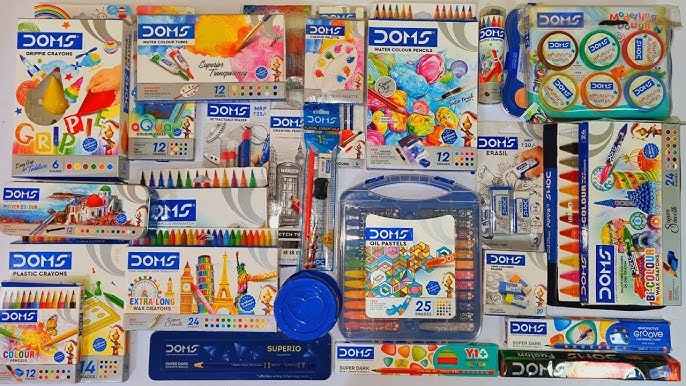
Once upon a time, DOMS Industries was a schoolkid’s trusted pencil brand. You bought it from the local stationery shop, used it for your math homework, and moved on with your life. That company still exists. But so does a entirely different version now — one that manufactures geometry boxes, color pencils, sketch pens, markers, highlighters, adhesives, modeling clay, watercolor paints, baby diapers, and apparently, premium European backpacks.
In FY25, they reported ₹1,913 crore in consolidated revenue (+24% YoY). In 9M FY26, they’re already at ₹1,722 crore. The company holds 29–30% market share in branded pencils and math instrument boxes — which is just a fancy way of saying they own the space. Second-largest player in India’s branded stationery market. Over 13,500 employees. Manufacturing across 18 units in 5 locations. Distribution network spanning 145,000+ retail touchpoints. And fresh announcements of a 50:50 joint venture with Seven SpA (a European bag maker now part of their parent FILA group) for premium backpacks.
The kicker? The stock is down 25% in one year. Because apparently, when a company executes well and grows 23% with improving margins, the market’s instinctive reaction is to smash the price. We love this timeline.
Let’s unpack the stationery empire — with data, humor, and the kind of auditor-level sarcasm only a company this peculiar deserves.
From Pencils to Diapers: A Stationery Company’s Fever Dream
DOMS started in 2006 selling pencils and school stationery. In 2024, they’re still selling pencils and school stationery. But they’ve also added eight product categories, 4,600+ SKUs, and acquired a baby diaper company called Uniclan. This is what happens when you dominate an industry and have nowhere else to grow — you vertically integrate backwards, horizontally expand, and then you buy a hygiene company because why not.
The core business is split across eight categories: scholastic stationery (32% of 9M revenue), scholastic art materials (20%), office supplies (15%), kits & combos (10%), paper stationery (8%), and the rest split between hobby/craft, fine art, and baby hygiene products. Distribution is multi-channel: general trade (44%), e-commerce (34%), and OEM (20%). Exports make up 13% of 9M sales, served via FILA’s global network. The company has backward integration in place — in-house production of sketch pen ink, caps, tin boxes, wooden pencils, and erasers.
Uniclan (the baby diapers division acquired in FY25) contributed about 6% of FY25 sales; by 9M FY26, it’s showing 7.4% of the DOMS-branded mix alongside new brand Wowper. Q3 benefited from winter seasonality, but management’s guiding for 8–9% EBITDA margins on Uniclan going forward — far below core stationery (17%+), but it’s a different margin profile altogether.
Q3 FY26: The Numbers Are Solid. Period.
Result type: Quarterly Results | Q3 FY26 EPS: ₹9.54 | Annualised EPS (Q3×4): ₹38.16 | Full-year FY25 EPS: ₹33.34
Source table
| Metric (₹ Cr) | Q3 FY26 Dec 2025 |
Q3 FY25 Dec 2024 |
Q2 FY26 Sep 2025 |
YoY % | QoQ % |
|---|---|---|---|---|---|
| Revenue | 592 | 501 | 568 | +18.2% | +4.2% |
| EBITDA | 103 | 88 | 100 | +17.7% | +3.0% |
| EBITDA Margin % | 17.5% | 17.6% | 17.6% | -10 bps | -10 bps |
| PAT | 61 | 54 | 61 | +13.1% | -0.2% |
| EPS (₹) | 9.54 | 8.36 | 9.60 | +14.1% | -0.6% |
At What Price Does Growth + Execution = Fair Value?
Method 1: P/E Based
Full-year FY25 EPS = ₹33.34. Q3 annualized EPS = ₹38.16 (suggesting FY26 could be ₹37–39 range if growth normalizes). Industry median P/E for consumer/stationery = ~26.5x. DOMS justified premium for 23% growth, 26% ROCE, and market leadership: 0.9x–1.2x industry. Fair P/E band: 24x–32x.
Range: ₹800 – ₹1,250
Method 2: EV/EBITDA Based
9M FY26 EBITDA annualized = ~₹395 Cr (conservative, assuming H2 normalization). FY26 full-year EBITDA guidance: ~₹460–480 Cr (management signaled upper end of range). Current EV = ₹12,924 Cr. Quality consumer/stationery comps trade at 28x–35x EV/EBITDA. DOMS at growth/execution premium: 32x–40x justified.
EV range (32x–40x): ₹14,720–19,200 Cr → Per share:
Range: ₹844 – ₹1,096
Method 3: DCF Based
Base FCF: ~₹170 Cr (conservative cash generation assumption). Growth: 18–20% for 3 years, normalizing to 10% by year 5. Terminal growth: 4%. WACC: 10.5%.
→ Terminal Value (4% growth / 6.5% cap rate): ~₹7,840 Cr
→ Total EV: ~₹8,960 Cr (net debt: negligible)
Range: ₹620 – ₹950
The Stationery Space Is Suddenly Exciting (And Weird)
🔴 The Big One: 50:50 Premium Backpack JV with Seven SpA (FILA Group)
Announcement Jan 30, 2026: DOMS approved a 50-50 joint venture with Seven SpA, a European bag manufacturer owned by FILA (the Italian parent, which holds 26% of DOMS). Seven has ~EUR 90 million in annual revenues, 6,000+ retail points globally, 60+ international patents. Initial capital: up to ₹15 crore (combined, pro-rata). Manufacturing location: Umbergaon. Go-to-market: exports first (OEM for Seven/FILA globally). Seven bags sell for EUR 60–70 in Italy. This is positioned as a premium play, not conflicting with their existing SKIDO mass-market bag JV. Formation expected by end of Q1 FY27. Management’s own words: “achieving a 3x to 4x gross fixed asset turnover is achievable.” Competitive thesis: DOMS claims it can deliver “much more trustworthy and better quality products than China.” Execution will be the proof.
✅ Capacity Expansion Machinery
- • 44-acre Umbergaon mega-factory: Q2 FY27 commercial production target
- • 9 production buildings planned (~150,000 sq ft each), one every ~3 months cadence
- • FY26 capex: ~₹250+ Cr (9M: ~₹230 Cr); FY27 guidance: ₹225–250 Cr (similar magnitude)
- • Jammu land/building for wood processing: ₹16 Cr invested
- • Wooden pencil capacity to scale from 5.53M to 8M units over coming years
⚠️ Headwinds & Watch Items
- • U.S. tariff shock on wooden pencil exports to FILA’s U.S. business
- • Management flagged commodity volatility (polymers, waxes trending upwards)
- • Pricing actions may be delayed pending sustainability of cost spike — margin pressure near-term
- • GST demand + penalty on Uniclan subsidiary (₹44.8 Cr penalty reduced to ₹17.8 Cr, still pending resolution)
The Vault Is Robust. Debt Is Negligible. Cash Is Flowing.
Source table
| Item (₹ Cr) | Mar 2024 | Mar 2025 | Sep 2025 | Latest |
|---|---|---|---|---|
| Total Assets | 1,190 | 1,511 | 1,605 | |
| Net Worth (Eq + Reserves) | 815 | 1,003 | 1,099 | |
| Borrowings | 172 | 212 | 161 | |
| Other Liabilities | 203 | 297 | 344 | |
| Total Liabilities | 1,190 | 1,511 | 1,605 |
Debt reduced from ₹212 Cr (Mar 2025) to ₹161 Cr (Sep 2025). Debt/Equity ratio at a healthy 0.15x. Interest coverage of 28.2x. They could borrow more for capex but they’re not. They’re self-funding growth. That’s the sign of a conservative, profitable business.
Debtor days at 26 (reasonable for B2B/B2C mix). Inventory days at 99 (seasonal business, so expected). Days payable at 37. Cash conversion cycle: 88 days. No red flags here.
From ₹815 Cr (Mar 2024) to ₹1,099 Cr (Sep 2025). IPO proceeds in FY25 and organic profit retention. The balance sheet is genuinely getting stronger, not just because of one-off accounting.
Money Flows. But Into Capex, Not Dividends.
Source table
| Cash Flow (₹ Cr) | Mar 2023 | Mar 2024 | Mar 2025 |
|---|---|---|---|
| Operating CF | +173 | +183 | +183 |
| Investing CF | -136 | -458 | -140 |
| Financing CF | -12 | +297 | -40 |
| Net Cash Flow | +25 | +22 | +4 |
Growth Is Real. Valuation Is Stretched. Full Stop.
Annual Trends Show One Direction: Up
Source table
| Metric (₹ Cr) | Mar 2023 | Mar 2024 | Mar 2025 | 9M FY26 |
|---|---|---|---|---|
| Revenue | 1,212 | 1,537 | 1,913 | 1,722 |
| EBITDA | 187 | 273 | 348 | 302 |
| EBITDA Margin % | 15% | 18% | 18% | 17.5% |
| PAT | 103 | 160 | 214 | 181 |
| EPS (₹) | 25.23 | 25.23 | 33.34 | ~30 |
The story is clean: revenue grows 25%, profit grows 44%, margins hold steady at 15–18%. That’s exactly what “operating leverage” looks like. The question isn’t whether they can execute. The question is: at what price is that execution worth paying for?
DOMS vs The Stationery Graveyard
Source table
| Company | Revenue (₹ Cr) | PAT (₹ Cr) | P/E | ROCE % | Sales Growth (9M %) |
|---|---|---|---|---|---|
| DOMS | 2,231 | 222 | 58.9x | 26.2% | +22.7% |
| Flair Writing | 1,225 | 135 | 23.3x | 16.1% | +20.1% |
| Kokuyo Camlin | 780 | 26 | 29.4x | 3.7% | +10.8% |
| Linc | 546 | 38 | 16.1x | 22.4% | +6.3% |
DOMS is the largest, growing fastest (22.7% in 9M), with the best ROCE (26.2%), and paying a 58.9x P/E multiple. Flair is smaller but trading at a 2.5x cheaper multiple with similar growth. Linc has lower growth but half the P/E multiple. The sector median P/E is 26.4x. DOMS is trading at 2.2x the sector average. The premium is legitimized by growth and ROCE. But is it that premium? Market says yes. Valuation frameworks say maybe. Your risk tolerance decides.
FILA Owns 26%. Promoters Own 70.4%. Retail Owns Leftovers.
Promoter Structure: Family + FILA
Raveshia-Rajani family: 44.37% (collective). FILA (Italian multinational): 26.01%. Together: 70.4%. This is a family business that invited a strategic parent. FILA brought global expertise, manufacturing standards, brand heritage (LYRA, Daler Rowney), and now, the Seven bag JV. Promoter pledge: 0%. That’s investor-friendly signaling — no collateral risks.
Public + Institutions (29.6%)
DIIs holding 18.28% (SBI MF, Axis MF, Canara Robeco prominent). FIIs holding 8.38% (Invesco, Abu Dhabi Investment Authority). Public holding 2.96%. Total public shareholders: 57,647 as of Dec 2025 (was 34,841 in Mar 2024 — retail interest grew post-IPO). No red flags here.
The Boring (Good) Governance Checklist
✅ The Good Signals
- ✓ CRISIL AA-/Stable rating (upgraded Aug 2025 from A+/Positive)
- ✓ Clean audit history — no material qualifications or fraud history
- ✓ AGM held on schedule (Sept 2025 for FY25)
- ✓ Regular quarterly concalls with analyst transcripts available
- ✓ BRSR (Business Responsibility & Sustainability Reporting) filed
- ✓ Promoter pledge: 0.00% — no collateral risks
- ✓ Interest coverage: 28.2x — debt is irrelevant to their operations
⚠️ The Watch Items
- ⚠ GST demand on Uniclan: ₹5.3 Cr demand + ₹44.8 Cr penalty (Apr 2025). Penalty later reduced to ₹17.8 Cr (Oct 2025), but still pending
- ⚠ Significant capex execution risk: ₹900–1,000 Cr Umbergaon project over 2–2.5 years
- ⚠ New JV with Seven (bags): execution proof still pending. European competitive space is different from Indian stationery
- ⚠ Uniclan/Wowper integration still early; hygiene margins (8–9%) well below core (17%+)
The Stationery Market: Commodified, But Still Growing
India’s branded stationery market is worth ~₹8,000–9,000 crore annually and growing 8–10% YoY. That’s slower than the broad economy, but DOMS is growing 23%+ — which means they’re taking market share from competitors and expanding into adjacencies. The market is split between organized (brand leaders like DOMS, Flair, Linc) at ~30–40%, and unorganized (local brands, imports, counterfeits) at ~60–70%. The unorganized space is structurally difficult to penetrate — it competes on price and distribution proximity, not quality. DOMS chose the right battleground: branded, premium positioning, national distribution.
🎒 The Backpack Play: Seven JV & Premium Positioning
Seven SpA is a EUR 90 million Italian bag maker with global retail presence. The 50:50 JV targets premium backpacks (EUR 60–70 retail). India’s ultra-premium backpack market is tiny — management acknowledged this explicitly: “audience in India for ultra-premium backpacks is very, very limited.” The real opportunity is exports, where Seven handles distribution. For DOMS, it’s a geographic and margin diversification play. Risk: execution in premium European/global markets is vastly different from selling pencils to Indian schoolkids. Upside: if it works, it’s a 10–15% revenue contributor in 5 years. Most likely: it contributes 3–5% by FY30, with decent margins.
💡 Industrial Lubricants & Specialty Adjacencies
Management is exploring industrial lubricants, immersion cooling fluids for data centres (currently in pilot phase with hyperscalers), and adhesives. These are not core to DOMS’ brand but leverage manufacturing scale. Adhesives and hobby/craft products (glitter glue, modeling clay) are already 15% of 9M revenue and growing. The data centre opportunity is 4–5 years away but could be material if adoption accelerates. These adjacencies expand the TAM without cannibalizing core stationery.
📚 Back-to-School Seasonality: Q1 & Q2 Strength
Management flagged Q3 as seasonally strong for baby diapers (Uniclan); Q1 as weak. For core stationery, back-to-school season (April–June in India, per school calendar) drives Q1 FY-end sales. This creates lumpiness in quarterly growth rates — don’t panic if Q1 FY27 shows weaker growth. It’s seasonal, not structural. Full-year growth is what matters.
⚡ U.S. Tariffs & Export Risk
Management disclosed that U.S. tariffs on wooden pencils (50% tariff mentioned) hit their FILA U.S. business exports meaningfully. Exports are 13% of 9M revenue and grew 15%+ (9M), but tariff headwinds are real. Management is watching for tariff normalization talks but can’t rely on it. Mitigation: DOMS is diversifying exports to Nepal, Sri Lanka, Middle East, Africa, Europe, Turkey, Chile, Mexico, Canada — via FILA’s global distribution. Still, tariffs remain a watch item.
Competitive dynamics: DOMS is #2 branded player, but the fragmented market means no single player dominates. Flair Writing is the #1 competitor (smaller, slower growth, cheaper valuation). Unbranded players compete on price in rural distribution. DOMS’ advantage: brand recall, OEM partnerships (Volkswagen, Audi, BMW approved), distribution scale, and manufacturing depth. These are defensible for 3–5 years but not forever.
Macro tailwinds: Urban penetration of branded stationery growing with school enrollment. Rural stationery demand rising as education access improves. E-commerce penetration (34% of sales) still in growth phase. Government spend on education (tied to education budget expansion) creates tailwinds. Inflation in stationery category is low (commodities-driven), so volume growth is primary lever.
The Pencil Maker’s Paradox
DOMS Industries is a genuinely good business. But like many genuinely good Indian consumer/industrial businesses that had IPOs in the last 2 years, it’s priced for near-perfection at 58.9x P/E. The company executes, grows at 23%, maintains 26% ROCE, builds capacity for the future, and diversifies into diapers and backpacks. All admirable. But at ₹2,156/share, the stock is pricing in 5+ years of flawless execution and continued market share gains.
What the bulls say: Second-largest branded stationery player in India, 29–30% market share, 23% revenue growth, 26% ROCE, zero debt, strong management, global partnership with FILA, capacity expansion underway, India’s stationery market still underpenetrated. This could be a 3x–5x compounder over 7–10 years if India’s education enrollment and pen-and-paper usage continue.
What the bears (or pragmatists) say: Valuation is stretched at 58.9x P/E and 32x EV/EBITDA. Even assuming 20% CAGR for the next 5 years, the stock would need to re-rate downward to maintain reasonable return expectations. The fair value methods (P/E, EV/EBITDA, DCF) all suggest ₹800–₹1,100 per share, implying 50–60% downside from current levels. Recent -25% 1-year return was richly deserved.
Management execution: The Feb 2026 concall showed thoughtful management candor. They acknowledged commodity inflation, flagged that growth normalizes after Q3 (due to Uniclan base effects), and explained the Seven JV strategy clearly. Management is not hyping. They’re underplaying. That’s a good sign.
Capex cycle reality: ₹250+ Cr annual capex for 2–3 years will keep FCF generation modest. Once the Umbergaon facility is fully operational (2–3 years), FCF will improve. Until then, expect tight cash positions and negligible dividend growth. Capital allocation is correct but not investor-return favorable in the near term.
✓ Strengths
- 29–30% market share in branded pencils; #2 player in India’s stationery
- 23% revenue CAGR; 44% PAT CAGR over 3 years
- 26.2% ROCE; 22.3% ROE; strong capital efficiency
- ₹183 Cr annual operating cash flow generation
- Zero debt; 28.2x interest coverage; fortress balance sheet
- 145,000+ retail touchpoints; national distribution strength
- FILA partnership unlocks global distribution, expertise, and new ventures
✗ Weaknesses
- Revenue growth at 23% won’t sustain at this pace (confirmed by management)
- EBITDA margins at 17.5% are peaking; commodity inflation near-term headwind
- Valuation at 58.9x P/E is at extreme premium to peers and history
- ₹250+ Cr annual capex for 2–3 years limits dividend growth and FCF
- U.S. tariff exposure on wooden pencil exports (~13% of sales)
- Seven JV (backpacks) execution unproven; different market dynamics
→ Opportunities
- Umbergaon mega-factory: 9 buildings over 2–3 years; significant capacity addition
- Wooden pencil capacity expansion: 5.53M to 8M units; premium segments growth
- Premium backpacks via Seven JV: small but high-margin opportunity in global markets
- E-commerce penetration still only 34% of revenue; online growth acceleration
- Industrial lubricants & specialty chemicals: green-field adjacencies
- Rural stationery penetration: underpenetrated below Tier-2 cities
⚡ Threats
- Commodity cost inflation (polymers, waxes) unpredictable; margin compression risk
- U.S. tariffs on exports could persist; FILA U.S. business headwinds
- Unbranded/Chinese competitors in lower price points stealing volume
- EV adoption in vehicles reduces lubricant demand long-term (immaterial near-term)
- GST disputes on Uniclan: pending resolution risk (though reduced severity)
- Capex execution delays on Umbergaon project; timeline slippage possible
DOMS is a legitimately excellent business trapped in a mediocre valuation framework.
The company deserves respect for execution: 23% growth, improving profitability, wise capital allocation, and strategic JVs that expand TAM. But at ₹2,156/share (58.9x P/E), the stock is pricing in growth that would require DOMS to become a ₹10,000 Cr revenue company in 8–10 years while maintaining 20%+ growth and 17%+ margins. That’s possible. But it’s not assured. And it’s not reflected in fundamentals today.
For long-term wealth creation (10+ year horizon), DOMS has genuine business quality. For medium-term returns (3–5 year horizon) at current prices, the math is brutal. A 50% downside to ₹1,000–₹1,100 would be fully justified on DCF/P/E metrics and would still leave 40–50% compound upside over the next 5 years if the company executes.
The verdict: Business Quality: ★★★★★ | Valuation at CMP: ★★☆☆☆