01 — At a Glance
The Company That’s Torn Between Batteries of Yesterday and Tomorrow
- 52-Week High / Low₹431 / ₹303
- Q3 FY26 Revenue₹4,201 Cr
- Q3 FY26 PAT₹195 Cr
- Q3 FY26 EPS₹2.28
- Annualised EPS (3-Qtr Avg)₹10.00
- Book Value₹173
- Price to Book1.78x
- Dividend Yield0.65%
- Debt / Equity0.11x
- Li-Ion Investment (to date)₹4,352 Cr
The Executive Summary: Exide closed Q3 FY26 with ₹4,201 crore revenue (+4.6% YoY), ₹195 crore PAT, and 11% operating margin. The stock returned -26.8% in 6 months and -17.3% in 3 months because everyone is collectively worried about the Rs. 5,200 crore lithium-ion factory that’s eating capital like a black hole while lead-acid growth barely qualifies as a pulse. ROCE of 8.65%? Yeah. That’s not a typo. When your average debt-ridden Indian FMCG company does 15–20% ROCE, Exide’s numbers make auditors weep quietly in the corner.
02 — Introduction
Welcome to the Most Confusing Battery Shop on Dalal Street
Exide Industries is India’s largest manufacturer of lead-acid batteries. For over 150 years (give or take), they’ve been shoving lead plates into acid containers and calling it a business. And it’s worked. The company earns strong cash, dominates the domestic replacement market, supplies OEMs for 2W/3W/4W vehicles, runs a telecom power backup business (which is dying), and sells inverter batteries to every panicked Indian household that thinks the grid will fail at 4 PM.
But here’s the plot twist: Exide is also spending ₹5,200 crore to build a lithium-ion cell manufacturing facility. Not the battery pack assembly line—the actual cell manufacturing. A 6-GWh capacity plant at Bengaluru, with Phase 1 expected live by Q3 FY26 (which is now, so… fingers crossed). They’ve already spent ₹4,352 crore. The Board has approved another ₹1,400 crore equity infusion for FY26. For a company generating ₹17,596 crore in annual revenue (FY25), this is an existential bet.
The lead-acid business is solid, boring, and under zero pressure to grow. The lithium business doesn’t exist yet. And the stock, trading at 31.5x P/E with a 0.65% dividend yield, is pricing in either salvation or certain doom. There’s no middle ground. Welcome.
From the Feb 2026 Concall: Management noted that “nearly 92% of the business has grown by around 12% on the top line,” but exports and telecom killed the headline number. Translation: if you ignore the parts that are failing, the rest is doing brilliantly. Classic move.
03 — Business Model: Batteries. Literally Just Batteries.
The Simplest & Most Complex Play On Your Mechanic’s Shelf.
Exide is fundamentally three separate businesses awkwardly sharing a balance sheet.
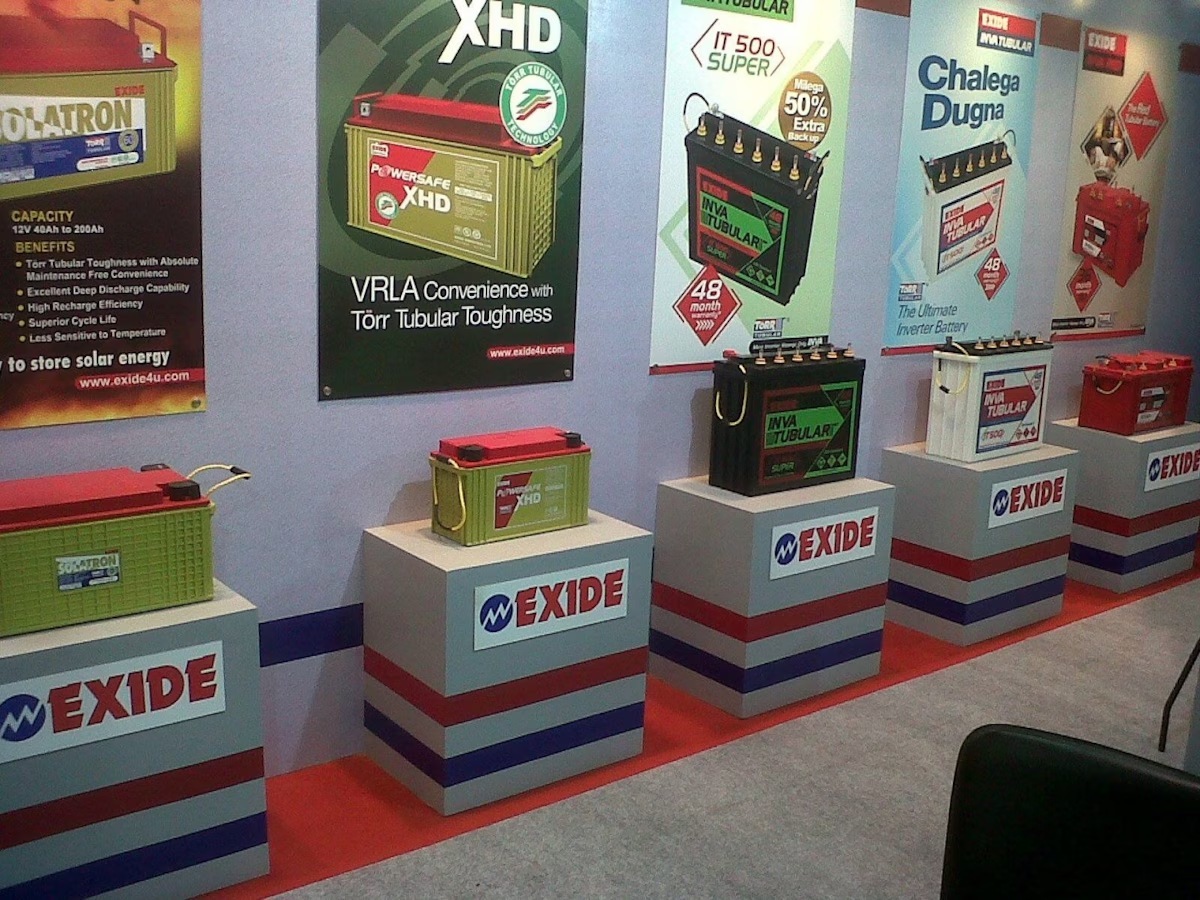
Business 1: Lead-Acid Batteries (Aftermarket). A 1 lakh dealer network. Cars, bikes, 3-wheelers, e-rickshaws, UPS systems, solar inverters. Customers walk into a shop. Mechanic says “Exide.” They buy Exide. Rinse, repeat. Revenue share: ~74% (non-institutional). Margins: 25–30% gross (trade aftermarket). Growth: Single digit. Threat: None in the next 5 years. Opportunity: None either. This is the textbook cash cow.
Business 2: Lead-Acid OEM Supply. Tata, Maruti, Hyundai, Kia, BYD—original equipment for new vehicles. Revenue share: ~26% (institutional). Margins: 10–15% gross. Growth: Tied to vehicle production. Currently decent because Dec 2025 was “+30% YoY.” But EVs are coming, and EVs don’t need lead-acid. Exide acknowledged telecom lead-acid is “largely bottomed out” as lithium replaces it.
Business 3: Lithium-Ion (Coming Soon). Currently exists only in PowerPoint and investor decks. Revenue: ₹0. Capex invested: ₹4,352 crore. Expected commercialization: Q4 FY26 / Q1 FY27 (“plus minus 1 month”). The company is betting that EVs will explode in India, and they’ll supply the battery cells. Hyundai MoU signed. Other OEMs “validating designs.” Realistically, 2–3 years before this becomes material. Until then, it’s a drag on returns.
Domestic92%of Revenue FY25
Aftermarket Share74%Non-Institutional
Lead Recycling346 KMTAnnual Capacity
Dealer Network1 Lakh+Pan-India
Market Position: Exide holds ~45–50% market share in lead-acid batteries. Competitors: Luminous (inverters), Amaron/Sai (imported), and a million unorganized players who sell batteries behind a highway dhaba. Exide doesn’t compete. It dominates. But dominance in a declining product category is like being the CEO of a videocassette factory in 2024.
💬 Real quick: Have you actually bought an Exide battery recently? If yes, which segment—aftermarket or did your mechanic strong-arm you into it? Drop a comment!
04 — Financials Overview
Q3 FY26: The Numbers That Got Spared By A GST Cut
Result type: Quarterly Results | Q3 FY26 EPS: ₹2.28 | Annualised EPS (3-Qtr Avg): ₹10.00 | Full-year FY25 EPS: ₹9.35
| Metric (₹ Cr) |
Q3 FY26
Dec 2025 |
Q3 FY25
Dec 2024 |
Q2 FY26
Sep 2025 |
YoY % |
QoQ % |
| Revenue | 4,201 | 4,017 | 4,365 | +4.6% | -3.8% |
| Operating Profit | 452 | 425 | 391 | +6.4% | +15.6% |
| OPM % | 10.8% | 10.6% | 9.0% | +20 bps | +180 bps |
| PAT | 195 | 158 | 174 | +23.4% | +12.1% |
| EPS (₹) | 2.28 | 1.84 | 2.02 | +23.9% | +12.9% |
What the Numbers Are Hiding: Revenue grew 4.6% YoY, but management explicitly said GST rate cuts in Q2 were the “major demand catalyst” in Q3, and Exide “remained fully aligned” and didn’t hike prices. Translation: they gave away margins to pass GST benefits to customers. Gross margin expanded 175 bps QoQ, but that’s only because antimony prices cooled slightly from the insane “$66,000 per ton” they hit earlier. Non-lead commodity inflation (silver +50%, tin +12%, sulfur +40% sequentially) was a brutal headwind that pricing couldn’t fully offset. The 23.4% PAT growth is real, but it’s a recovery from Q3 FY25’s depressed base, not a sign of underlying business strength.
05 — Valuation: Is This Battery Shop Worth ₹309?
Three Methods. One Ugly Picture.
Join 10,000+ investors who read this every week.