Search for stocks /

Suzlon Energy:₹40 Stock. 32.5% ROCE.617 MW Delivered. Order Book In Overdrive.

Suzlon Energy Q3 FY26 | EduInvesting
Q3 FY26 Results · Quarterly Reporting (Jan–Mar FY)

Suzlon Energy:
₹40 Stock. 32.5% ROCE.
617 MW Delivered. Order Book In Overdrive.

India’s wind turbine king just posted its highest-ever quarterly deliveries while sitting on a 6.4 GW order book at a 1.9x book-to-bill ratio. Execution is the only question. Everything else is momentum.

Market Cap₹54,404 Cr
CMP₹40.0
P/E Ratio16.8x
ROCE32.5%
1-Yr Return-27.2%

The Wind Turbine Roller Coaster: From Bankruptcy Ghost to Growth Darling

Suzlon Energy is screaming back. Q3 FY26: ₹4,228 crore revenue, ₹445 crore PAT, 617 MW delivered (highest ever in India’s wind sector), P/E at 16.8x, and a 6.4 GW order book that would make any power equipment manufacturer weep. The stock tanked 27% over the past year. But 9M FY26 deliveries (1,625 MW) have already surpassed the entire FY25 full-year (1,550 MW). The game is on.

  • 52-Week High / Low₹74.3 / ₹38.9
  • Q3 FY26 Revenue₹4,228 Cr
  • Q3 FY26 PAT₹445 Cr
  • Q3 FY26 EPS₹0.33
  • Annualised EPS (Q3×4)₹1.32
  • Book Value₹5.78
  • Price to Book6.92x
  • Dividend Yield0.00%
  • Debt / Equity0.05x
  • Net Cash Position₹1,556 Cr
Auditor’s Note: Suzlon closed Q3 FY26 with ₹4,228 crore revenue (+42% YoY), ₹445 crore PAT, 32.5% ROCE, and zero dividend payouts. The business is reinvesting cash for growth. Meanwhile, 1,625 MW delivered in 9M FY26 means they’re already on pace for ~2,200 MW annual run-rate. At 617 MW per quarter, management says they could hit 750 MW if downstream projects were ready. The order book is bursting. The execution pipeline is clogged. Classic Indian infrastructure story.

From ₹1 Stock to ₹40: The Resurrection Nobody Asked For

Suzlon Energy is not a household name. But it should be. Fifteen years ago, this company was technically bankrupt. In 2008, during the global financial crisis, Suzlon had global ambitions, took on massive debt to acquire foreign companies, and watched its market cap evaporate by 95%. The stock hit ₹1 levels. Liquidation seemed imminent. Tulsi Tanti, the founder (who passed away in October 2022), rebuilt the company piece by piece — selling assets, deleveraging, focusing on India’s domestic wind boom, and waiting for macro tailwinds.

Fast forward to FY26. Suzlon is now sitting on a 6.4 GW order book, delivering record MW volumes every quarter, earning 32.5% ROCE, and trading at a reasonable 16.8x P/E. The PE ratio is 45% lower than the industry median of 31x. Sounds mispriced, right?

Wrong. The stock is down 27% in one year. Why? Because execution is still a nightmare. Management delivered 617 MW in Q3 but could’ve delivered 750 MW if projects were ready. Land acquisition is a headache. Grid connections are delayed. State tenders are moving slow. Customs penalties keep showing up (₹9.6 crore in Q3, though partially reversed later). The company is building a 6.4 GW order book in slow motion.

This is not a growth story yet. It’s a potential growth story. And the market is pricing the execution risk aggressively — perhaps too aggressively.

India’s No. 1 Wind Turbine Maker. Installed 21 GW Globally. 15.1 GW Domestically.

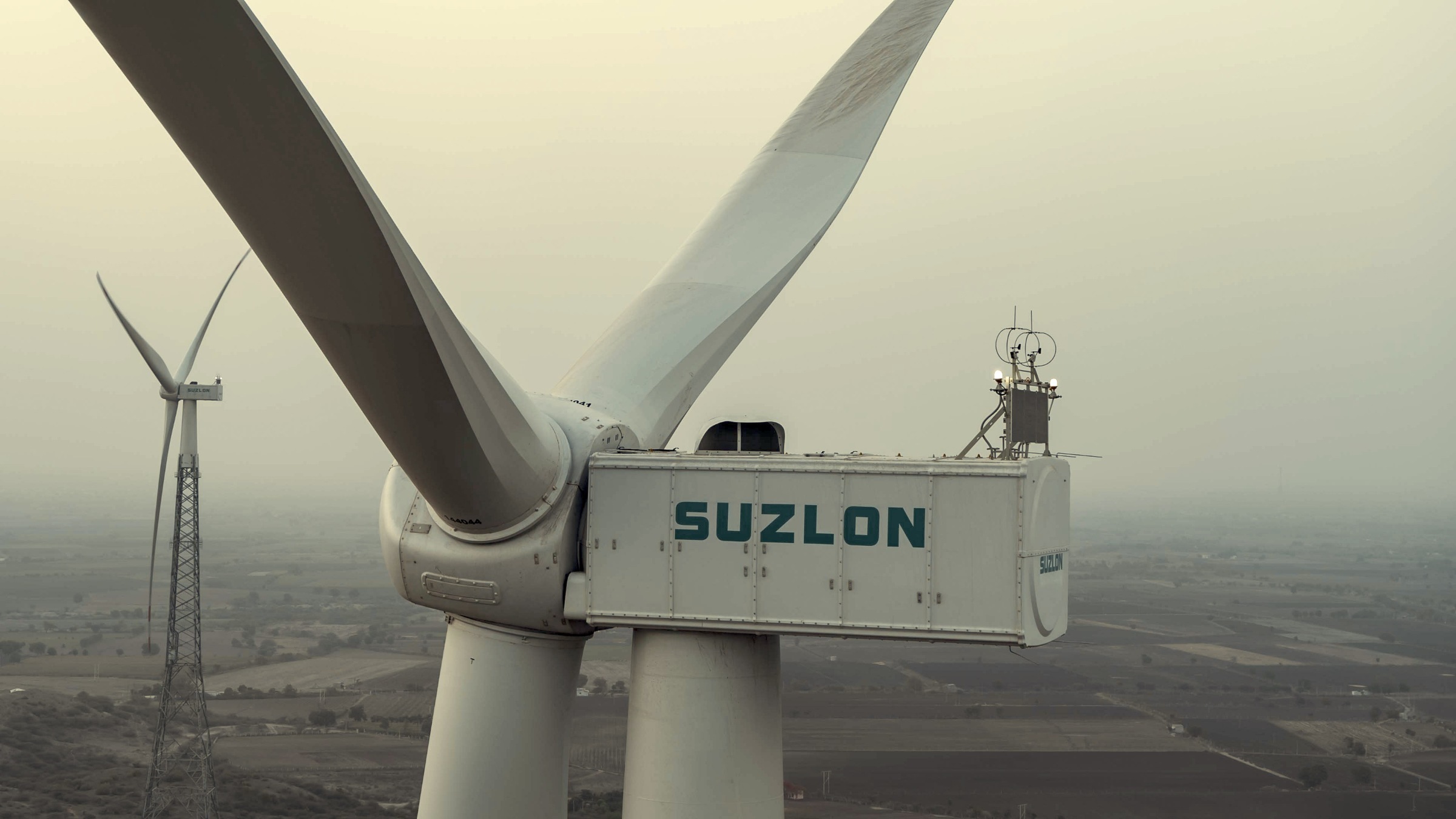
Suzlon manufactures wind turbine generators (WTGs). That’s it. It designs, makes components (blades, towers, generators, gearboxes, nacelles) in-house across 14 facilities in India, and delivers complete turbines to renewable energy developers — power companies, industrialists, and utilities. They also provide installation, operation, and maintenance (O&M) services. It’s a vertically integrated play in one of India’s most fragmented sectors.

The company has ~30% cumulative market share in India — highest in the wind sector. No competitor comes close. But competitors like Vestas, Siemens Gamesa, and GE Renewable Energy operate globally and have deeper pockets. Suzlon competes on delivery speed and local support.

Revenue is driven by turbine delivery volume (MW commissioned per quarter). Management targets 1.5x–2x market growth annually. The S144 platform (2.0–3.0 MW capacity) is the workhorse — it’s 90%+ of the order book and has proven technology. The S133 and S120 are legacy platforms with lower demand. A 5 MW platform is in prototype phase and will launch “at an appropriate time” — corporate-speak for “when land availability improves.”

Market Share (India)~30%Cumulative
Order Book6.4 GWAll-Time High
Book-to-Bill Ratio1.9xNear-Term Visibility
Global Installed Base21 GW17 Countries
Concall Intel: Management said, “Order is not an issue for us. The issue is execution.” They could deliver 750 MW per quarter if projects were ready. The bottleneck is downstream — land acquisition, Right of Way (ROW) clearances, grid connections. Pre-commissioned but waiting: 253 MW of turbines sitting ready to generate but waiting for grid connection. Another 80 MW delayed by temperature-related regulatory confusion. This is not manufacturing constraint — this is Indian bureaucracy constraint.
💬 Have you noticed wind turbines coming up near your town? Are they actually operational, or just sitting there like monuments to permit delays?

Q3 FY26: The Numbers That Keep Growing

Result type: Quarterly Results  |  Q3 FY26 EPS: ₹0.33  |  Annualised EPS (Q3×4): ₹1.32  |  Full-year FY25 EPS: ₹1.53

Metric (₹ Cr) Q3 FY26
Dec 2025
Q3 FY25
Dec 2024
Q2 FY26
Sep 2025
YoY % QoQ %
Revenue4,2362,9753,871+42.4%+9.4%
Operating Profit738500721+47.6%+2.4%
OPM %17%17%19%Flat-200 bps
PAT4453881,279+15.1%-65.2%
EPS (₹)0.330.290.94+13.8%-64.9%
The Story in the Numbers: Revenue growth at 42% YoY is genuinely impressive. But Q2 FY26 (Sep 2025) saw ₹1,279 crore PAT — a one-time tax benefit from Deferred Tax Assets (DTA) recognition. Strip that out, and Q3’s ₹445 crore PAT is solid. OPM at 17% is stable, but down 200 bps QoQ because the product mix shifted: management lost a high-realization customer (no details given), and project revenue (EPC contracts at lower margins) grew from 20% to 27%. Margin pressure will persist until execution stabilizes. The annualised EPS from Q3 × 4 is ₹1.32, but the full-year FY25 EPS was ₹1.53. Why? Because DTA is a one-time accrual. Ignore the PAT noise — focus on operating profit, which grew 48% YoY.

What’s This Wind Machine Actually Worth?

Join 10,000+ investors who read this every week.
Become a member
error: Content is protected !!