Search for stocks /

Tata Consumer:₹5,112 Cr Revenue. 76× P/E. Growth Businesses Now 30% of India. Can It Last?

Tata Consumer Q3 FY26 | EduInvesting
Q3 FY26 Results · Quarter Ended Dec 31, 2025

Tata Consumer:
₹5,112 Cr Revenue. 76× P/E.
Growth Businesses Now 30% of India. Can It Last?

Landmark quarter. Double-digit growth everywhere. GTM redesign rolling out nationally. And the stock keeps trading at the stratosphere like a luxury brand that sells tea and salt. Numbers don’t lie. Valuation models do.

Market Cap₹1,10,504 Cr
CMP₹1,117
P/E Ratio76.2x
Div Yield0.74%
ROCE9.16%

The Tata Group’s Slow Boil That’s Starting to Pop

Tata Consumer Products hit ₹5,112 crore in quarterly revenue for the first time in its history (+15% YoY) — a “landmark quarter” by management’s own words. EBITDA expanded to ₹728 crore with margins at 14.2% (+120 bps YoY). Cash on hand: ₹1,272 crore. Nine-month revenue crossed ₹15,000 crore with all business units delivering double-digit growth. The stock has returned +16.1% over one year, massively outperformed its ROCE of 9.16% (industry peers average 12–15%), and yet trades at 76× P/E — a valuation floor that looks like it was set by someone’s great-grandfather and never revisited. Second-largest tea company globally. Largest salt brand in India. No debt to speak of. And somehow, the math doesn’t feel like a compliment anymore.

Quarterly Reality Check: ₹5,112 cr revenue. ₹728 cr EBITDA. ₹385 cr PAT. The quarterly EPS works out to approximately ₹3.89 (divide PAT by ~99 crore shares), which annualised is ₹15.56 — but P/E 76× values the stock like a 40% compounder in perpetuity. Spoiler: CAGR for last 3 years is 9% on earnings. Valuation and reality have filed for divorce.

When a Boring Blue-Chip Suddenly Looks Exciting—and Still Doesn’t Feel Cheap

Tata Consumer Products is what happens when you inherit 150+ years of brand equity (Tata Tea since 1868), add legendary operational discipline, sprinkle in three high-impact acquisitions in three years (Capital Foods, Organic India), and then sit back and watch management execute like they’re running the Swiss Railways instead of an Indian FMCG company.

The Q3 results paint a picture of transformation in slow motion. Growth businesses (Sampann, RTD, acquired brands, Starbucks) hit ₹1,000+ crore quarterly revenue for the first time and now account for 30% of the India business — up from 18% just two years ago. The company’s go-to-market redesign, which was piloted in select geographies, is now rolling out nationally (82% complete by February 2026). Distribution network sits at 3.8 million total outlets. And the management team is methodically moving the needle on mix, premiumisation, and margin expansion without breaking a sweat in earnings calls.

Yet the stock sits at 76× P/E. Not 20×. Not 30×. 76×. That’s roughly 4x the Nifty 50 multiple and higher than Nvidia. For a company earning ₹14.8 per share (TTM) and growing earnings at mid-single digits. Something doesn’t compute.

Concall Highlight (Jan 2026): “Growth businesses hitting ~30% of India revenue, growing at ~30%. This is a structural mix shift away from being a Salt and Tea company into a multi-category food and beverage company.” — CEO. Translation: they’re trying to be Mondelez, but with better margins and worse stock price economics.

From Legacy Categories to Growth Bets. Execution so Far: A+. Timing: 2005.

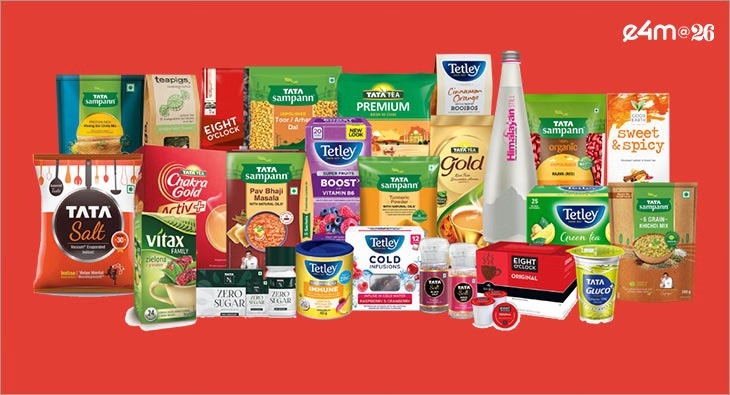
Tata Consumer’s business model is essentially a pyramid. At the base: legacy categories (Tea and Salt) that command 51% of India revenue but grow at mid-single digits. They’re mature, profitable, and as exciting as watching paint set. In the middle: Core adjacencies (Sampann, RTD, water brands) that now represent 20–22% of revenue and are growing at 25–40% annually. At the top: recently acquired “growth portfolio” (Capital Foods—Ching’s Secret, Smith & Jones, Organic India) and international business (coffee, tea across 40+ countries) representing 24% of revenue.

The genius (or madness) is this: management has been deliberately building a portfolio that doesn’t rely on a single leg. Tea may mature. Salt may fragment. But if 30% of the business is growing at 30%, and the core is locked at 14–16% EBITDA margins, then—in theory—the whole thing compounds faster than you’d expect from a “tea company.”

Distribution: 3.8 million total outlets (including e-comm, modern trade, general trade, quick commerce). Direct reach: 2 million+ outlets across rural India. The company claims 38–39% share of e-commerce in certain categories. Nielsen coverage? Only 62% of business (GT is fragmenting due to quick-comm and e-commerce disruption). So publicly reported market share is increasingly outdated — a point management flagged heavily on the concall.

Tea Volume~19%Market Share
Salt Volume~56%Market Share
Growth Biz30%Of India Revenue
Total Reach3.8 MOutlets
GTM Rollout: A Material Execution Lever
The company has shifted from a blended sales model (one salesman covering all categories) to a segmented model: separate distributors for Salt (where it dominates), a “Core + Growth” split for metros. Supervision is now “structured by category.” AI-enabled routing. The goal: reduce “core gravity” and force sales attention onto growth categories. 270 distributors transitioned; 160 added. 82% rollout complete. This is not a press release achievement. This is a real operational reengineering that could compound over 2–3 years if executed well.
💬 If the growth businesses sustain 25–30% CAGR for 3 more years, will that justify the current P/E? Or will margins inevitably compress as they scale? Drop your thesis below.

The Numbers That Make Your CFO Smile (And Your P/E Analyst Scream)

Result Type: Quarterly Results  |  Q3 FY26 EPS: ₹3.89  |  Annualised EPS (Q3×4): ₹15.56  |  Full-year TTM EPS: ₹14.8

Metric (₹ Cr) Q3 FY26
Dec 2025
Q3 FY25
Dec 2024
Q2 FY26
Sep 2025
YoY % QoQ %
Revenue5,1124,4444,966+15.0%+2.9%
EBITDA728646672+12.7%+8.3%
EBITDA Margin %14.2%14.5%13.5%-30 bps+70 bps
PAT385282407+36.5%-5.4%
EPS (₹)3.892.824.09+38.0%-4.9%
P/E Deep Dive: Current P/E = CMP ₹1,117 ÷ TTM EPS ₹14.8 = 75.5x (screener shows 76.2x, slight rounding variance). Industry median FMCG P/E is ~19–20x. Tata Consumer trades at ~4x the median. Q3 annualised EPS (₹15.56) would imply P/E of 71.8x. Even if we assume the company hits ₹20 EPS in FY27 (a stretch given 9% earnings CAGR), that’s still 55.8x. The stock is pricing in either perpetual 30%+ earnings growth (which won’t happen) or a multiple compression eventually (which will). Fair value anchors below.

What Should This Stock Cost? (Hint: A Lot Less Than Today)

Join 10,000+ investors who read this every week.
Become a member
error: Content is protected !!