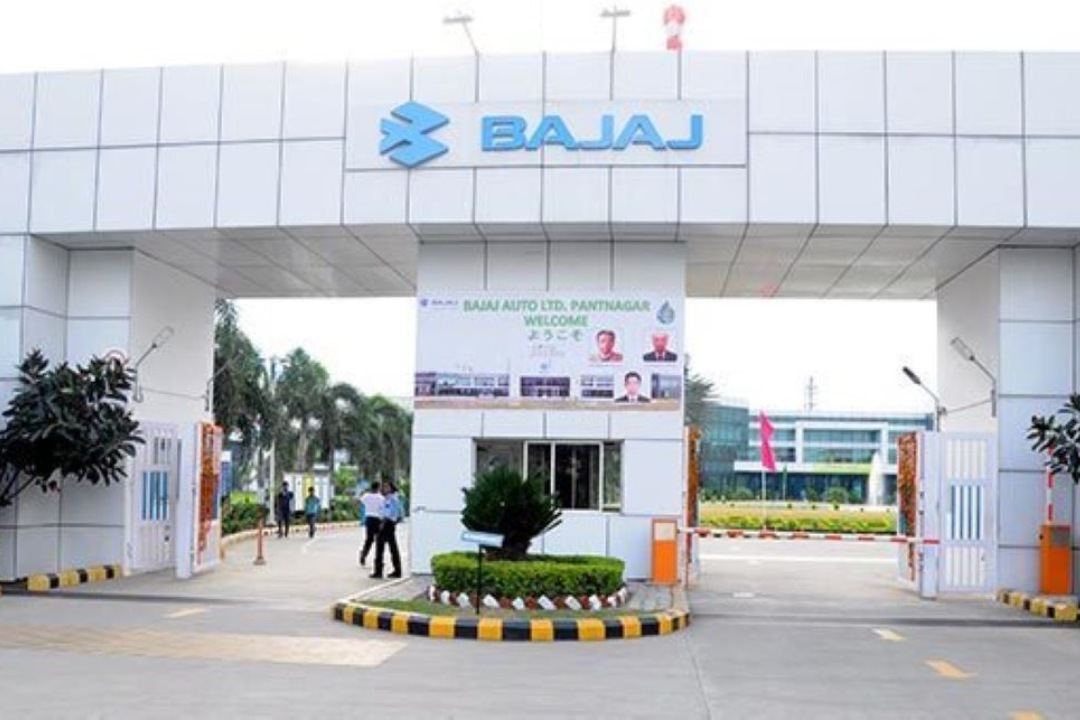
Bajaj Auto:
₹15,220 Cr Revenue. 20.8% EBITDA Margin. All-Time Highs.
Welcome to the Two-Wheeler Revenge Tour.
Record quarterly revenue. Record EBITDA. Record volumes. Record everything. GST cuts worked. Exports boomed. Chetak stopped embarrassing itself. And management is planning to invade your neighborhood with refreshed Pulsars every 15 days. Fear the motorcycle company.
The Two-Wheeler Supercycle Is Real. And Bajaj Is Surfing It.
- 52-Week High / Low₹10,187 / ₹7,088
- Q3 FY26 Revenue₹15,220 Cr
- Q3 FY26 PAT (Pre-Exceptional)₹2,549 Cr
- Q3 FY26 EPS₹98.38
- Annualised EPS (Q3×4 Avg)₹320+
- Book Value Per Share₹1,223
- Price to Book8.03x
- EBITDA Margin (Q3)20.8%
- Debt / Equity0.58x
- 1-Year Return+29.6%
The Motorcycle Company That Accidentally Became a Diversified Powerhouse
Bajaj Auto is not your grandfather’s two-wheeler company anymore. Well, it is. But it’s also something else now — a beast that’s learned to make money in three-wheelers (75% market share), export 600,000+ bikes a quarter, run a ₹16,500 crore financing arm, and develop electric scooters that people actually want to buy. All while maintaining a 28% ROCE and never once running out of cash.
For most of the past decade, Bajaj was the company that “should have” been worth more. Market leader in a growing category, pristine balance sheet, 22.8% ROE, dividends paid like it owed money to a loan shark. But the stock languished because the two-wheeler industry was stuck in a groove — replace old bikes, buy new bikes, repeat. Growth was measured in low single digits. Glamour was somewhere else.
Then two things happened. The GST was cut. Exports woke up. And suddenly, a company that was already printing cash started printing more of it. Q3 FY26 revenue is up 19% YoY. Full year, Bajaj is expecting the highest-ever export topline in USD terms. Chetak, the electric scooter everyone said was a disaster, just became profitable and crossed 25% of domestic revenues when combined with electric 3Ws. And the KTM acquisition — yes, a €800 million commitment to turn around an Austrian motorcycle company in court-supervised restructuring — is now a real, funded reality with Bajaj holding 75% of the entity.
This is not a 6% growth story anymore. This is a 15%+ growth story being priced at 30.7x P/E because investors have trust issues with two-wheeler companies. Let’s dig into what changed.
A Hydra That Actually Knows How to Make Money at Every Head
Bajaj manufactures motorcycles (economy, executive, premium), three-wheelers (passenger, cargo, electric), electric scooters, quadricycles, and is now also the owner-operator of KTM, Husqvarna, and GasGas motorcycles. Revenue mix: ~68% domestic, ~32% exports. Profitability is almost absurd — 20%+ EBITDA margins in a business where the competition is either struggling with costs or running razor-thin margins on volume plays.
Domestic 2W market share: 18.2% (FY25). Domestic 3W market share: 75% in ICE, 85%+ in CNG. Electric 2W (Chetak): top 3 in the industry. Electric 3W: top 2. Pro-Biking (KTM + Triumph): 50% YoY growth. Exports: 45% of total industry 3W exports, 46% of 2W exports.
The captive financing arm (Bajaj Auto Credit Ltd — BACL) has crossed ₹16,500 crore AUM, 45% penetration among buyers, and is printing ₹200 crore quarterly PAT at 21% ROE. This is not a sideline. This is parallel revenue AND customer lock-in.
The model is: manufacture something people need, finance it to people who can’t pay upfront, extract rent on both the hardware and the money. Repeat. Expand. Acquire. Eventually, own the entire customer journey from awareness to repayment.
The Numbers That Make Analysts Raise Their Forecasts Mid-Call
Result type: Quarterly Results | Q3 FY26 EPS: ₹98.38 | YoY EPS Growth: 27.3% | Full-year TTM EPS: ₹318.04
Source table
| Metric (₹ Cr) | Q3 FY26 Dec 2025 |
Q3 FY25 Dec 2024 |
Q2 FY26 Sep 2025 |
YoY % | QoQ % |
|---|---|---|---|---|---|
| Revenue | 15,220 | 12,165 | 13,133 | +25.1% | +15.9% |
| EBITDA | 3,161 | 2,589 | 2,895 | +22.1% | +9.2% |
| EBITDA Margin % | 20.8% | 21.3% | 22.0% | -50 bps | -120 bps |
| PAT (Pre-Exc.) | 2,549 | 2,109 | 2,293 | +20.9% | +11.2% |
| EPS (₹) | 98.38 | 77.18 | 82.65 | +27.3% | +18.9% |
Why 30.7x P/E Might Actually Be Reasonable (And Why Your Grandma Still Thinks It’s Crazy)
Method 1: P/E Based
TTM EPS = ₹318.04. Sector median P/E (2/3W autos) ≈ 19x. Bajaj’s ROCE (28.1%) justifies a 1.4x–1.6x premium. Fair P/E band: 26x–30x.
Range: ₹8,270 – ₹9,540
Method 2: EV/EBITDA Based
TTM EBITDA ≈ ₹11,709 Cr. Current EV = ₹2,92,051 Cr → EV/EBITDA = 24.9x. Quality auto comps trade at 15x–22x. Discount for KTM uncertainty: apply 20x.
EV at 20x EBITDA: ₹2,34,180 Cr → Per share:
Range: ₹8,360 – ₹10,440
Method 3: DCF Based
Operating FCF (9M FY26): ₹5,200 Cr. Full-year normalized: ~₹7,500 Cr. Growth: 12% for 5 years, then 4% terminal. WACC: 10.5%. Net cash: ~₹15,000 Cr.
→ Terminal Value (4% growth / 6.5% cap rate): ~₹1,85,000 Cr
→ Total EV: ~₹2,29,000 Cr + ₹15,000 Cr net cash
Range: ₹8,650 – ₹10,120
The Catalysts That Are Literally Printing Money Right Now
🟢 The GST Rate Cut: Demand Came Back From the Dead
When GST on two-wheelers and three-wheelers fell in Q3, demand responded almost immediately. Apr-Aug FY26 was down -1% industry volume. Post-GST cut, Q3 saw industry ~+15% growth. Management flagged that January is tracking similarly (pending final numbers). Bajaj’s domestic 2W volumes grew faster than industry, implying market share gains. This is not a quarterly blip. This is a structural shift in purchasing power. The rate cut unlocked demand from customers sitting on the sidelines. Bajaj’s margin absorption game is a bet that they’ll own that newly unlocked customer base.
✅ Export Supercycle: 600k+ Units per Quarter
- • Exports reached 200k units/month run-rate in Oct 2025 after ~40 months
- • Q3 exports surpassed 600k units after 15 quarters (last seen Q3 FY22)
- • Q3 export volumes +18% YoY; revenue grew faster (mix/currency tailwind)
- • Nigeria de-risked: weight in portfolio now HALF of last year
- • Brazil subsidiary “close to 10,000 mark” and delivering healthy bottomline
- • Export CV (3W) growth: +56% YoY; broad-based across markets
✅ Pulsar Refresh Offensive: A Bike Launch Every 15 Days
- • Bajaj lost market share in 150cc+ from Q4 FY25 through Q1 FY26
- • Response: 7 Pulsar interventions since November; 8+ more planned
- • Execution cadence: “2, 2, 2, 2 every month” (refreshes across OG, N, NS series)
- • Goal: fully refreshed Pulsar portfolio competing hard in 125cc+ and 150cc+
- • Management expects to outpace industry and continue share acquisition
✅ Chetak Profitability: EV Scooter No Longer a Charity Case
- • Chetak volumes grew ~70% QoQ (Q2 → Q3) as supply normalized
- • Regained ~500 bps market share; returned to “leadership cluster”
- • New launch: Chetak C25 (lighter, cheaper at ₹91,399) for broader coverage
- • EV portfolio: double-digit EBITDA margin overall; Chetak itself at EBITDA breakeven
- • Network: ~450 exclusive Chetak stores, 4,000 POS across 800 cities
✅ Pro-Biking Record: KTM + Triumph + Showroom Rollout
- • Combined domestic volumes >35,000 units; ~50% YoY growth; highest-ever quarterly
- • KTM: Adventure portfolio almost 4x YoY; Duke range +30% YoY
- • Triumph: sustained momentum despite GST hike (Bajaj absorbed the cost)
- • Joint KTM-Triumph showrooms: ~50 operational, targeting >100 by March FY26
⚠️ KTM Turnaround: The Expensive Bet
- • Bajaj ownership in KTM increased to 75% effective Nov 18, 2025
- • Investment committed: €800 million (~₹77.7 Cr) for liquidity + restructuring
- • KTM 2025: revenue ~€1 billion (-46%), restructuring gain €1,193m, net debt €798m
- • Turnaround plan: ensure liquidity (done), build top management (by April), cost reduction
- • Consolidation to start Q4 FY26 onwards; impact on Bajaj’s margin mix TBD
⚠️ Inflation Risk & Input Cost Volatility
- • Q4 expected inflation: 50–60 bps in pristine material costs
- • Noble metals (platinum/palladium/rhodium) seeing strong inflation
- • Bajaj has taken pricing to offset ~half; will remain “nimble” depending on volatility
- • Consumer purchasing power risk if fuel/food/rentals inflation hits demand
A Company That Could Pay Dividends Forever and Still Have Money Left Over
Source table
| Item (₹ Cr) | Sep 2025 | Mar 2025 | Mar 2024 | Mar 2023 |
|---|---|---|---|---|
| Total Assets | 65,456 | 54,110 | 39,344 | 35,136 |
| Net Worth (Eq + Reserves) | 34,170 | 35,188 | 28,962 | 29,362 |
| Borrowings (Gross) | 19,693 | 9,364 | 1,912 | 124 |
| Other Liabilities | 11,593 | 9,557 | 8,470 | 5,651 |
| Total Liabilities | 65,456 | 54,110 | 39,344 | 35,136 |
Gross debt went from ₹124 Cr (FY23) to ₹19,693 Cr (Sep 2025). This is 100% because of KTM financing. Packing credit for working capital + loans to KTM Austria. Interest coverage remains 147.8x. Debt/Equity at 0.58x is still pristine. This is not a solvency issue — it’s a capital allocation decision.
Bajaj Auto standalone has surplus cash of ~₹15,000 Cr. This is before any KTM consolidation. The company could buy back 10% of shares or pay a special dividend tomorrow and still have ₹10,000 Cr left. That’s the kind of fortress balance sheet that lets you absorb GST cuts AND margin hits simultaneously.
Days Payable: 66 days. Debtor Days: 15 days. Inventory: 22 days. Cash conversion cycle: NEGATIVE. They collect cash in 15 days, hold inventory for 22 days, and pay suppliers in 66 days. That’s a ₹5,000+ Cr float every day.
9 Months = ₹5,200 Cr Free Cash Flow. Annualized? Don’t Ask.
Source table
| Cash Flow (₹ Cr) | Mar 2025 | Mar 2024 | Mar 2023 |
|---|---|---|---|
| Operating CF | -1,406 | 6,558 | 5,277 |
| Investing CF | -1,053 | -72 | 1,211 |
| Financing CF | 4,230 | -6,167 | -7,181 |
| Net Cash Flow | 1,771 | 319 | -692 |
A Company That Looks Too Good to Be True. And Yet, It Keeps Delivering.
A Decade of 11% Revenue Growth. A Decade of Double-Digit ROCE. Not Boring. Boring Would Be Negative.
Source table
| Metric (₹ Cr) | FY22 | FY23 | FY24 | FY25 | TTM |
|---|---|---|---|---|---|
| Revenue | 33,145 | 36,455 | 44,870 | 50,995 | 57,719 |
| EBITDA | 5,259 | 6,465 | 8,765 | 9,555 | 11,709 |
| EBITDA Margin % | 16% | 18% | 20% | 19% | 20% |
| PAT | 6,166 | 6,060 | 7,708 | 7,325 | 8,884 |
| EPS (₹) | 213.08 | 214.17 | 276.10 | 262.29 | 318.04 |
This is not a hypergrowth story. This is a “I invested ₹5 lakh ten years ago and it’s now ₹24 lakh” story. CAGR math: 9% revenue + margin expansion + leverage on capex = 21% stock price CAGR over 5 years (actual: 20.9% per Bajaj’s data). That’s the boring route to wealth. Most investors are too impatient for it.
Bajaj vs Everyone Else Trying to Sell Bikes in India
Source table
| Company | Q3 Revenue (₹ Cr) | Q3 PAT (₹ Cr) | P/E | ROCE % | Div Yield % |
|---|---|---|---|---|---|
| Bajaj Auto | 15,220 | 2,549 | 30.7x | 28.1% | 2.14% |
| Eicher Motors | 6,114 | 1,421 | 38.7x | 29.8% | 0.92% |
| Hero MotoCorp | 12,487 | 1,275 | 19.9x | 30.3% | 2.99% |
| TVS Motor | 14,756 | 891 | 61.6x | 15.4% | 0.26% |
| Ather Energy | 954 | -85 | No P/E | -65.7% | 0.00% |
The story in four lines: Bajaj has the highest quarterly revenue of the bunch. The highest quarterly PAT. The second-best ROCE (Hero marginally better). The second-best P/E (Hero cheaper). And it’s the only company paying a dividend yield worth talking about. TVS is expensive at 61x P/E while earning half the PAT on similar revenue. Ather is burning cash. Eicher is smaller with a higher P/E. Bajaj is the Goldilocks — not too cheap, not too expensive, actually makes money.
55% Promoters. Stable as a Rock. So Boring It’s Reassuring.
Shareholding Breakdown (Dec 2025)
Promoter Structure
Bajaj Holdings & Investment Limited (34.2%) is the holding company via which the Bajaj family exercises control. Additional holdings through Jamnalal Sons (9.3%), Maharashtra Scooters (2.5%), Bajaj Sevashram (1.6%), and various family trusts. Total: 55%. No pledges. Family ownership has been intact for 70+ years. This is not a company where promoters are waiting to exit.
Founder Legacy & Expansion
Founded 1945 as Bachhraj Trading, renamed Bajaj Auto in 1960. Went public same year. The company is now among the top 5 two-wheeler manufacturers globally and the largest 3W manufacturer by absolute volume. Founder Jamnalal Bajaj’s philosophy of “make it in India, sell it in the world” has been the playbook since day one. Export volumes now represent 34% of total revenue. That’s not accidental.
55% ownership of BACL by Bajaj Auto. AUM crossed ₹16,500 crore. 45% penetration among bike buyers (that’s ~2 lakh customers acquired in Q3 alone). ₹200 crore quarterly PAT at 21% ROE. CRAR at 19.77% (well above minimum). This is not a sideline business. This is a permanent competitive moat. Every Bajaj buyer you finance is a Bajaj customer you keep for 5 years.
A Company That Actually Listens to Auditors. Shocking, Honestly.
✅ The Fortress Audit Trail
- ✓ India Ratings affirms bank loan facilities at IND AAA/Stable
- ✓ Interest coverage 147.8x — highest in the room
- ✓ No material audit qualifications in concalls or filings
- ✓ Quarterly concalls run like clockwork; management Q&A is substantive
- ✓ Concall transcripts detailed; not corporate word salad
- ✓ Capex communicated in advance; targets hit or beat
- ✓ No related-party transaction red flags
✅ Board Independence & Capital Allocation
- ✓ Board decisions on buybacks, dividends, acquisitions are disclosed early
- ✓ ₹4,000 crore buyback in Mar 2024 — returned capital to minority shareholders
- ✓ Dividend payout consistent at 60–80% of annual profit
- ✓ KTM acquisition decision was transparent; cost & timeline disclosed
- ✓ Management succession planned (Aditya Makharia as Chief Product Officer)
- ✓ ESG reporting (BRSR) completed on schedule
Why A Company That Sells Motorcycles Is The Surprise Winner of This Decade
India’s two-wheeler market was in a funk for 5 years (2019–2024). GST was high. Petrol prices were high. Inflation was eating into rural incomes. OEMs were fighting for share on thin margins. Then, GST came down. Demand woke up overnight. Q3 domestic market grew 15%. Bajaj grew faster. That’s not a blip — that’s a regime change.
🚀 The Rural Purchasing Power Revival
Good monsoons. MSP increases. Government spending on infrastructure. A bike or scooter is the gateway purchase for middle-India mobility. GST cut made the entry price ₹20–30k cheaper. That’s the monthly salary of a farm laborer. Supply responded immediately because everyone had pent-up manufacturing capacity (remember the pandemic?). Bajaj is the only large manufacturer with a distribution network deep enough to capture this surge. Their 1.5 lakh touchpoints include villages Hero doesn’t reach.
🌍 Export Boom Funded by Supply Chain Optimization
Bajaj exports to 80+ countries. India’s cost structure for two-wheelers is now the most competitive globally after Vietnam. Labor is cheaper. Supply chain capital intensity is lower. Regulatory compliance costs are lower. Emerging markets (LatAm, Africa, Southeast Asia) are upgrading from completely manual two-wheelers to motorcycles with engines. Bajaj’s 45% market share in global emerging market 3W exports is not luck. It’s cost leadership. Exports are now 34% of revenue and growing at double-digit rates. That’s a permanent revenue stream few Indian OEMs own.
⚡ Electric Transition: The Hybrid Sweet Spot
EV is 25% of Bajaj’s domestic revenue now (2W EV + 3W EV combined). But here’s the non-obvious bit: ICE is still 75%, and will be for another decade in India. Charging infrastructure is abysmal. Battery swap is the buzzword. Most buyers need a 150km range, not 500km. Bajaj’s Chetak is built for this reality — affordable, practical, profitable. The company is also exploring battery-swap solutions, which could unlock entire categories (last-mile delivery, shared mobility). Meanwhile, ICE volumes are stable. You don’t have to choose between 2W and EV growth — you get both.
⚠️ Competitive Intensity & Price Wars Risk
Hero MotoCorp is the volume leader. TVS is aggressive in rural markets. Honda, Suzuki, and Bajaj fight for premium segment share. EV market is becoming crowded (Ather, Ola, new entrants). Price competition in 100cc+ is brutal. Bajaj’s response is product refresh velocity (8–9 launches per quarter) and brand strength. But if input cost inflation bites harder than GST gains, margins could compress. Management is nimble with pricing but can’t be nimble if competitors undercut aggressively. Watch gross margins in Q4 and Q1 FY27.
The industry narrative: Two-wheelers were thought to be mature. They’re not. GST cut proved that demand was price-elastic, not demand-saturated. Bajaj, with 18% 2W market share, 75% 3W share, export reach, and financial arm, is the only pure-play that benefits from every angle of this cycle — rural revival, export boom, EV premiumization, and financing penetration. Hero has narrower 3W presence. TVS is stretched across EV/ICE and losing margin. Eicher (Royal Enfield) is pure premium, which is a niche.
The Motorcycle Company That Quietly Became the Market’s Best-Kept Secret
Bajaj Auto is not a growth stock masquerading as a value stock. It’s a quality stock that happens to be growing. 28% ROCE. 22.8% ROE. 20%+ EBITDA margins. Zero net debt. Dividends paid like clock work. And over the past 3 quarters, it’s grown 15%+ in revenue while absorbing deliberate margin hits to gain market share and defend competitive positioning.
The Case for the Stock: A GST cut in Q3 FY26 unlocked demand that was price-elastic, not vanished. That demand was broad-based (rural, urban, premium, EV). Bajaj, with distribution depth and cost leadership, was the best-positioned to capture it. Exports are now at all-time highs and diversified away from Nigeria concentration risk. Chetak is profitable and growing. Pro-Biking (KTM + Triumph) is a small contributor now but will be 10%+ of revenue within 3 years if the turnaround works. BACL is a financing moat worth ₹16,500+ crore AUM. The company has ₹15,000 crore of standalone cash to deploy however it wants. Stock is at 30.7x P/E, which is expensive only if you don’t believe the 15%+ growth and 28% ROCE are durable.
The Case Against the Stock: Valuation is not cheap. At 30.7x P/E, all the upside is priced in (including the GST cut, the export boom, and Chetak profitability). Margin compression risks exist if input costs accelerate. KTM is a $800 million bet on European premium bikes at a time when KTM is restructuring — execution risk is real. Rural demand could soften if inflation bites consumption. Competitive intensity in 2W is increasing (Hero, TVS, Chinese imports). A slowdown in domestic M&H (motorcycles & higher segments) would hurt Bajaj’s upgrade-led strategy. And finally, the stock has already run 30% in a year — front-running some of the good news.
Historical Context & Valuation Framework: Over the past 10 years, Bajaj stock has delivered a 16% CAGR. Over 5 years, it’s 21%. Over 3 years, it’s 37%. That’s not accidental — it’s the result of consistent execution and a management team that deploys capital (capex, dividends, buybacks, acquisitions) with discipline. At 30.7x P/E, you’re paying for that track record, not a turnaround. Fair value sits around ₹8,260–₹10,440. CMP ₹9,816 is in the middle of that range — neither a screaming bargain nor a warning sign. For investors comfortable with a 12–15% compounding story (growth + dividends) over the next 3–5 years, the risk-reward is fair.
✓ Strengths
- 18% domestic 2W market share with 75% 3W dominance
- 28.1% ROCE and 22.8% ROE — best-in-class capital efficiency
- ₹16,500 crore BACL AUM at 21% ROE; 45% penetration
- 34% of revenue from exports; 45% of global 3W exports
- Chetak (e-2W) now profitable; 25% of domestic revenue (combined e-products)
- Pro-Biking (KTM + Triumph): 50% YoY growth; expanding into premium
- ₹15,000 Cr standalone cash; fortress balance sheet (0.58x D/E, 147.8x interest coverage)
✗ Weaknesses
- Valuation at 30.7x P/E leaves little room for disappointment
- KTM turnaround is an €800m bet with execution risk
- Margin compression risk if noble metals / input costs accelerate beyond pricing
- Rural demand dependent on sustained purchasing power (inflation risk)
- Competitive intensity in ICE 2W is increasing; price wars a risk
- GST cuts are not permanent; reversal could slow demand
→ Opportunities
- Exports: 200k units/month run-rate sustainable; USD strength helps realization
- Pulsar refresh: 8+ launches planned; can recapture 150cc+ share vs competitors
- E-3W: 50%+ YoY growth; CNG penetration also high (anti-EV tailwind)
- Chetak C25: New entry-level model can broaden price ladder; EV market still nascent
- Riki (L3 e-rick): Seeding phase in ~50 cities; lithium-ion upgrade potential huge
- BACL expansion: Lending penetration can double from 45% to 80%+ over time
- KTM revival: If turnaround succeeds, consolidated EBITDA could step up 20%+ by FY28
⚡ Threats
- Input cost inflation (noble metals, copper, aluminium); Q4 expected 50–60 bps
- Rural demand slowdown if fuel/food inflation erodes purchasing power
- EV adoption at faster pace than expected (ICE margin pressure)
- Emerging market currency volatility (40% of revenue is forex-linked)
- Hero MotoCorp or TVS aggressive pricing in 2W could force margin concessions
- KTM losses persist longer than expected; margin dilution in consolidated numbers
Bajaj Auto is a company that answers a simple question correctly: Can you make money selling motorcycles and three-wheelers in India?
The answer, for 80 years, has been yes. And after a decade of dormancy, that answer is becoming “yes, even more so.” A GST cut proved that demand was sleeping, not dead. Exports proved that Indian manufacturing costs are globally competitive. Chetak proved that electric vehicles don’t have to be loss-making charity cases. And KTM is a reminder that the company’s ambitions are global, not just Indian.
At ₹9,816, with a fair value range of ₹8,260–₹10,440, the stock is fairly priced. It’s not a bargain. It’s not a warning either. It’s a company that’s earned the right to be held by anyone comfortable with a 12–15% annualized return over the next 3–5 years, funded by growth + dividends. For contrarian value investors, it’s a pass — there’s no margin of safety. For quality compounders, it’s worth a serious look.