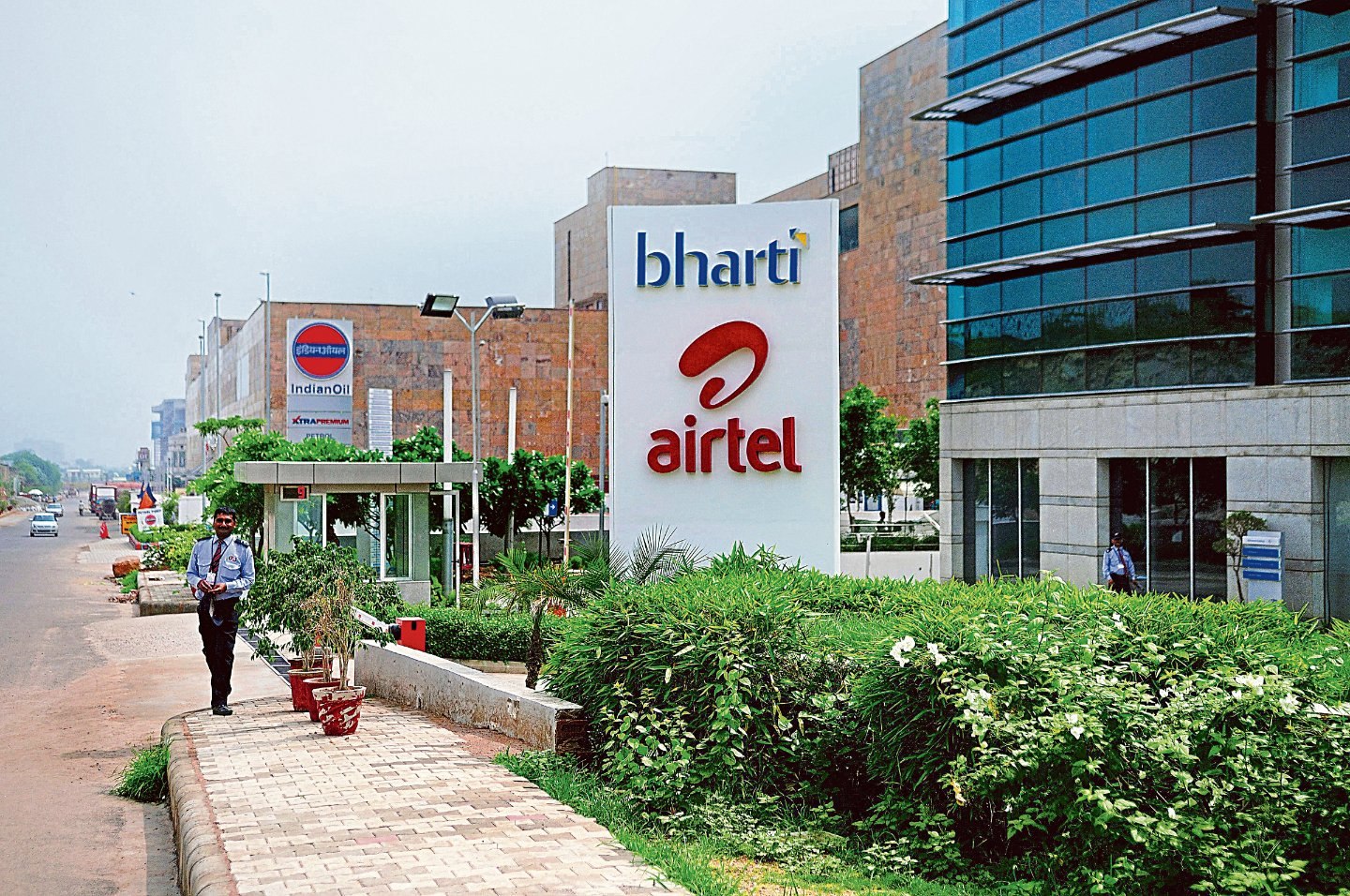
Bharti Airtel:
₹53,982 Cr Revenue. 34.8x P/E.
The Telecom Empire Swallows Data Centres Whole
Consolidated revenue hits ₹54,000 crore. African operations print 5.8% growth in constant currency. 5G SA rolled out pan-India. And now they’re funding a ₹20,000 crore Airtel Money NBFC. A giant building smaller giants inside itself.
The Telco That Refuses to Stay in One Box
- 52-Week High / Low₹2,175 / ₹1,612
- Q3 FY26 Revenue₹53,982 Cr
- Q3 FY26 PAT₹8,503 Cr
- Q3 EPS (₹)₹11.63
- Annualised EPS (Q3×4)₹46.52
- Book Value₹207
- Price to Book9.06x
- Dividend Yield0.86%
- Debt / Equity1.77x
- Net Debt/EBITDA1.69x
The Convergence Thesis That Actually Converged
Remember when telecom was supposed to die? When data would be free. When Netflix would kill TV. When WhatsApp would replace SMS. When 5G would render everything else obsolete. Airtel listened to all of that and then did something radically sensible: ignored it.
Bharti Airtel is India’s largest telecom by revenue, Africa’s second-largest by customer count (174 million), and increasingly—a fintech company masquerading as a network operator. The Feb 2026 concall revealed a company executing simultaneously across three fronts: (1) squeezing India mobile through postpaid upgrades and premium data plans, (2) scaling broadband into every Indian home regardless of fiber availability via 5G Fixed Wireless Access, and (3) exporting the playbook to Africa with digital payments and mobile money generating nine-figure revenue momentum.
Q3 FY26 landed with ₹53,982 crore revenue, a 3.5% QoQ bump and 19.6% YoY growth. Yes, PAT fell 18.8% YoY, but that’s because Q3 FY25 benefited from one-time tax reversals and other gains. Strip that noise, and operating performance is outright healthy—EBITDAaL at ₹27,700+ crore with 51.3% margins. Leverage improving fast: net debt/EBITDA at 1.69x as of Sep 2025, down from 2.19x a year ago.
The stock trades at 34.8x P/E on TTM earnings. The industry median sits at 36.3x. Airtel doesn’t scream “cheap,” but the execution is undeniably there. And the optionality—data centres, fintech, fibre—is being sized for real.
They Own Towers, Pipes, Spectrum, Money, And Increasingly—Everything Else
Airtel’s revenue split in FY25 was India mobile (53%), Africa mobile (27%), and enterprise + broadband + DTH (20%). The Q3 concall painted a more nuanced picture. After the Indus Towers acquisition (making it a subsidiary), the portfolio breakdown is now: Africa 27%, India mobile 53%, India non-mobile 13%, and Indus Towers 7%.
Core business: 355k mobile towers, 750k+ 4G base stations, 440k+ km of optical fibre, 12 data centres, and 174 million customers in 14 African countries. The India mobile subscriber base hit 394 million (October 2025), with market share at ~33.6%. That’s leadership. Not Apple-in-phones leadership, but close enough.
Then came the non-telecom play: Airtel Money just got RBI approval to become a Type II-NBFC (Feb 17, 2026). Management is capitalizing it with ₹20,000 crore in a 70/30 promoter split. This is Africa’s digital payments infrastructure wearing a fintech license. Monthly loan disbursement run-rate: ₹500+ crore. Airtel Payments Bank: 108 million MTU, ₹4,300 crore in deposits, +28% YoY. The fintech within a telco is now becoming a fintech. Cute.
Nxtra data centres: currently ~120-130 MW capacity, ~12% market share. Target: 1 GW in 3-4 years. Management said they’re “not particularly satisfied” with 12% share. Translation: prepare for aggressive capex. Airtel Cloud: 16 signed deals, 300+ ongoing conversations, pitching “sovereign cloud” with MeitY certification. Enterprise services revenue: ₹5,350 crore, +1.5% QoQ, with underlying double-digit growth once you strip out low-margin wholesale data drag.
Q3 FY26: The Deep Dive Into Numbers That Confuse Most Investors
Result type: Quarterly Results | Q3 FY26 EPS: ₹11.63 | Annualised EPS (Q3×4): ₹46.52 | TTM EPS: ₹53.30
Source table
| Metric (₹ Cr) | Q3 FY26 Dec 2025 |
Q3 FY25 Dec 2024 |
Q2 FY26 Sep 2025 |
YoY % | QoQ % |
|---|---|---|---|---|---|
| Revenue | 53,982 | 45,129 | 52,145 | +19.6% | +3.5% |
| EBITDA | 31,144 | 24,597 | 29,561 | +26.6% | +5.3% |
| EBITDA Margin % | 57.6% | 54.5% | 56.7% | +310 bps | +90 bps |
| PAT | 8,503 | 10,445 | 8,651 | -18.6% | -1.7% |
| EPS (₹) | 11.63 | 15.27 | 11.91 | -23.8% | -2.4% |
Is ₹1,871 Cheap, Fair, or Dear?
Method 1: P/E Based
FY26 EPS estimate (consensus-ish): ₹50-52. Historical P/E band for Airtel: 30-40x depending on cycle. At the lower end (maturity discount), 30x; at the higher end (growth re-rate), 38-40x. Current 34.8x sits comfortably in the middle.
Range: ₹1,500 – ₹2,080 (on ₹50 EPS)
Method 2: EV/EBITDA Based
TTM EBITDA: ~₹110,000 crore (annualizing Q3’s performance). Current EV: ₹12,56,111 crore → EV/EBITDA = 11.4x. Telecom peers globally trade 8-12x depending on leverage and growth. Airtel’s 1.69x net debt/EBITDA supports multiple expansion. Normalized multiple for this leverage: 10-12x.
EV range (10x–12x): ₹11,00,000 Cr – ₹13,20,000 Cr → Per share (on 570 cr shares):
Range: ₹1,930 – ₹2,315
Method 3: DCF Based
Operating cash flow: ₹98,332 crore (FY25). Less capex: expected ₹40-45k crore annualized. FCF: ~₹50-55 crore. Growth: 8-10% for 5 years (5G monetization + fintech optionality). Terminal growth: 2.5%. WACC: 8.5% (lower than Castrol due to larger scale + cheaper capital access).
→ Terminal Value (2.5% growth / 6% cap rate): ~₹27,50,000 Cr
→ Total EV: ~₹29,80,000 Cr (less net debt ~₹2,00,000 Cr) = Equity Value ~₹27,80,000 Cr
Range: ₹1,800 – ₹2,100
The Telecom Sector Where Penalties Are A Line Item
🔴 The Regulatory Penalty Deluge (Feb-Mar 2026)
Airtel received multiple DoT penalties in February 2026 for subscriber verification violations: ₹1,44,000 cr (MP), ₹1,09,000 cr (HP), ₹2,09,000 cr (latest), ₹1,11,000 cr (another), and a slew of smaller ones. TRAI also levied ₹17,01,000 cr (complaint redressal delay from March 2024). Airtel will either pay or contest, depending on magnitude. The real trend: subscriber verification is now a compliance nightmare for all players. Management didn’t comment deeply on this in concall—typical play when regulations are in flux.
✅ Airtel Money NBFC License (Feb 13, 2026)
- RBI approved Airtel Money as Type II-NBFC-ND (ICC)
- Registration No. N-14.03676 dated Feb 13, 2026
- ₹20,000 cr capitalization announced; 70% promoter, 30% others
- Monthly loan disbursement run-rate: ₹500+ cr
- This is the fintech play made real. Africa digital payments is the crown jewel.
✅ 5G SA Pan-India Rollout (Q3 FY26)
- 5G Standalone networks now live across India
- Added 11,000 5G sites in Q3; ~74% population coverage
- Mixed NSA + SA strategy to handle handset readiness
- FWA (Fixed Wireless Access) moving to SA; mobile in phased manner
- 5G customer base: 181 million; >90% of new smartphone shipments are 5G
⚠️ No Tariff Hike Signal (Yet)
- Management avoided explicit tariff action threshold
- Strategy: premiumization, postpaid upgrades, international roaming (30%+ YoY growth)
- ARPU ₹259 (India), +22% YoY despite no tariff hikes
- Plan: upgrade ~90 million credit-scored customers to postpaid
- Management flagged: “In absence of tariff repair, we will continue to sweat ARPU growth”
⚠️ AGR Dispute Resurfacing (Feb 2026)
- Airtel AGR payments due March 2026 (~$1 billion)
- Company written to DoT seeking “clarification” and parity
- Claimed “arithmetical errors…errors of commission…errors of omission” in AGR calculation
- Status: “Yet to hear from DoT…will then decide next steps”
- This is leverage-negative if not resolved. Watch closely.
The Debt Fortress That’s Slowly De-Gearing
Source table
| Item (₹ Cr) | Mar 2024 | Mar 2025 | Sep 2025 | Latest (Latest Avail.) |
|---|---|---|---|---|
| Total Assets | 442,019 | 505,006 | 523,863 | ~₹540k+ (est.) |
| Net Worth (Equity) | 81,919 | 113,672 | 117,796 | ~₹120k+ (est.) |
| Borrowings | 215,592 | 213,642 | 208,010 | ↓Declining |
| Other Liabilities | 144,408 | 177,692 | 198,057 | ↑(DTH/Other) |
| Total Liabilities | 442,019 | 505,006 | 523,863 | ✓ Balances |
Absolute debt came down from ₹215,592 cr (Mar 2024) to ₹208,010 cr (Sep 2025). In a growing company, that’s de-prioritization of expansion capex. With ~₹98k cr operating cash flow annually and declining capex, net debt/EBITDA improving to 1.69x signals management confidence. Spectrum dues (₹90k cr) and lease liabilities (₹65k cr) are the bulk; external debt only 27%. Pure balance sheet strength.
Cash + equivalents: ₹13,402 cr (Sep 2025). Interest coverage: 5.57x in H1FY26 (up from 3.46x in FY24). The company has never missed a payment. With Indus Towers now a subsidiary (contributing ₹7% of revenue), passive infrastructure income provides steady cash buffer.
Working capital days: -277 as of Mar 2025 (negative = company collects before it pays). This is beautiful. The business funds itself. New capex ambitions (data centres, fintech) won’t need external equity—cash generation covers it.
₹98,332 Cr Operating Cash Flow. Enough Said.
Source table
| Cash Flow (₹ Cr) | FY22 | FY23 | FY24 | FY25 |
|---|---|---|---|---|
| Operating CF | +55,017 | +65,325 | +78,898 | +98,332 |
| Investing CF | -41,478 | -39,232 | -51,089 | -60,198 |
| Financing CF | -15,203 | -24,470 | -27,778 | -36,533 |
| Net Cash Flow | -1,664 | +1,623 | +31 | +1,601 |
Is the Valuation Stretched, or Just Reflecting Reality?
Annual Trends — FY22 to FY25: Margin Expansion in 3 Acts
Source table
| Metric (₹ Cr) | FY22 | FY23 | FY24 | FY25 |
|---|---|---|---|---|
| Revenue | 116,547 | 139,145 | 149,982 | 172,985 |
| EBITDA | 57,534 | 71,274 | 77,893 | 85,060 |
| EBITDA Margin % | 49% | 51% | 52% | 49% |
| PAT | 8,305 | 12,287 | 8,558 | 37,481 |
| EPS (₹) | 7.23 | 14.97 | 13.20 | 58.85 |
FY25 PAT benefited from one-time tax reversals & exceptional gains (₹28,500+ cr). Strip that, normalized PAT would be ~₹9,000-10,000 cr. Still, the underlying trajectory is clear: revenue growing 14% CAGR, margins expanding from 51% to 52-57% depending on quarter. This is margin power in a competitive market—only happens with leadership and execution.
Airtel vs The Telecom Wasteland: How Bad It Could Have Been
Source table
| Company | CMP / BV | Qtr Revenue (₹ Cr) | Qtr PAT (₹ Cr) | P/E | ROE % |
|---|---|---|---|---|---|
| Bharti Airtel | 9.06x | 53,982 | 8,503 | 34.8x | 23.2% |
| Vodafone Idea | – | 11,323 | -6,363 | – | – |
| Bharti Hexacom | 12.85x | 2,360 | 481 | 45.6x | 25.2% |
| Tata Comm | 14.58x | 6,189 | 413 | 36.3x | 55.2% |
| M T N L | – | 198 | -897 | – | – |
Peer meditation: Vodafone Idea and MTNL are funeral homes. Tata Comm earns ₹413 cr quarterly at 6x Airtel’s scale. Bharti Hexacom trades at 45.6x P/E on 25% ROE (strong, but niche circle operations). Airtel at 34.8x on 23% ROE is the sweet spot. No wonder LIC, SBI funds, and global investors hold it.
Who Owns The Telecom Kingdom Now?
- Promoters (Bharti Group + Singtel)48.87%
- FIIs28.75%
- DIIs (incl. LIC)19.54%
- Public & Others2.65%
Pledge: 0.00%. Shareholder count: 8,52,831 (rising annually). Promoter holding has dropped from 55% (Mar 2023) to 48.87% (Dec 2025) — a 620 bps decline. FIIs buying. Smart.
Promoters: Bharti Group + Singtel
Sunil Bharti Mittal (Group chairman) and Singtel (Singapore Telecom, ~35% stake post-Google investment absorption). The pairing of Indian entrepreneurship + Singapore’s financial discipline has defined Airtel’s trajectory. No drama, no pledges, disciplined capital deployment. The Google investment of ₹700 crore for 1.28% stake (announced Oct 2024) is the harbinger of institutional capital seeking exposure to Airtel’s fintech dreams.
FIIs Now Hold 28.75% (Largest Chunk)
FII buying has been relentless. Key anchor investors: Europacific Growth Fund (earlier 2%+, diluted now), Government Pension Fund Global (Norway), Google International LLC (1.17%). The narrative shift from pure telecom to telecom-fintech-infrastructure hybrid is resonating with global capital. That’s a positive signal.
CARE Reaffirms AAA for Airtel (Jan 2026)
✅ Credit Rating: CARE AAA (Stable)
- ✓ Reaffirmed Jan 8, 2026; Stable Outlook
- ✓ Strong market position: 33.6% mobile subscriber share
- ✓ Leverage improvement: net debt/PBILDT at 1.69x (Sep 2025)
- ✓ PBILDT growth +19% in FY25; ARPU at ₹256 (highest among Indian telcos)
- ✓ Enterprise services scaling; broadband growing at 25%+ ARPU base
- ✓ Strong parentage: Singtel backing + Mittal family capital access
✅ Governance Scorecard
- ✓ Clean audit history; no material qualifications
- ✓ Board of 12 directors (6 independent, 3 women) — balanced composition
- ✓ MD/CEO Shashwat Sharma + EVP Gopal Vittal reappointed through 2030
- ✓ Pledge status: 0.00% (always clean)
- ✓ Interest coverage: 5.57x (FY26 H1); super comfortable
- ✓ Regular concalls & investor engagement; transparent communication
The Sector That Everyone Said Was Dead Now Printing Cash
The Indian telecom story was supposed to be a tragedy. Jio disrupted pricing. Vodafone Idea entered into a death spiral. MTNL became a zombie. The sector consolidated to 3 players (Airtel, Jio, Vodafone). Valuations compressed. Regulatory penalties haunted the sector. Data was supposed to be free. Voice calls were supposed to be extinct. The consensus was: telecom is a commodity, margins compress to zero, returns are mediocre.
🚀 ARPU Inflection: The Plot Twist Nobody Saw Coming
Airtel ARPU: ₹209 (Mar 2024) → ₹256 (Sep 2025). That’s a 22% bump in 18 months. How? Mix shift to 4G/5G, postpaid growth, international roaming monetization (30%+ YoY), premium plans, and people upgrading from 2G. Management flagged ongoing “experiments…A/B testing across geographies” to find new monetization levers. Translation: they’re literally A/B testing how much they can charge different customer cohorts. In a commoditized market, that’s pricing power re-emerging.
💼 Enterprise Services: The Profit Engine Hiding in Plain Sight
Airtel Business: ₹5,350 crore quarterly (₹21,400 cr annualized). Growth: +1.5% QoQ (seems meh). But composition: 45% core connectivity (5-6% industry growth), 30% digital/adjacencies (20% industry growth), 25% wholesale data (declining). Strip the wholesale drag, underlying is double-digit. Cloud, cybersecurity, IoT, SD-WAN, CPaaS—these are 20% CAGR segments. Airtel is winning here because they have the network + brand + talent.
🏠 Broadband: Fixed Wireless Access Changed Everything
Airtel added 1.2 million broadband customers in Q3 (all-time record). Installed base crossed 13 million. The magic ingredient: FWA (Fixed Wireless Access). No fiber trenches needed. 5G antennas double as broadband transmitters. Management explicitly flagged FWA as expanding the addressable market—circles with low fiber density now become economical. This is the unsung profitability lever in Indian telecom. Vodafone Idea has no 5G to build FWA on. Jio is likely keeping FWA data to mobile customers. Airtel is going all-in. Winner, winner.
⚠️ Tariff Action: The Sword of Damocles
The sector needs tariff hikes to recover 5G capex economics. Airtel, Jio, and Vi all need it. The probability: high in next 6-12 months. The trigger: either competitor action or joint signaling. Management is being coy (“experiments…A/B testing”), but the intent is clear. A 10-15% tariff hike would flow 80%+ to EBITDA (variable cost base is low). For Airtel, that’s ₹1,500-2,000 cr incremental EBITDA in a single quarter. The stock would re-rate. But it’s not baked in yet because the market sees ARPU expansion happening anyway without tariff action.
The Africa wildcard: 174 million customers across 14 countries. Local currency depreciation (especially Nigerian Naira) has been a headwind, but underlying data + mobile money growth is real. Airtel Money NBFC capitalization with ₹20,000 crore signals Africa’s payment infrastructure is now tier-one priority. If even 5% of African subs take digital payment services, that’s ₹200+ cr annual revenue just from take-rates. That’s a ₹500 crore+ business opportunity. Not priced in.
The Telecom Giant That Grew Teeth
Bharti Airtel is perhaps the only “legacy” telecom business that’s successfully avoided the commodity trap. ₹53,982 crore quarterly revenue. 57.6% EBITDA margin. 5G SA pan-India. FWA scaling to every Indian home. Africa generating 27% revenue at 5.8% constant-currency growth. Fintech + data centres now explicitly sized for significance. And it’s trading at 34.8x P/E—exactly sector median.
Q3 FY26 Execution: Revenue growth +19.6% YoY, +3.5% QoQ. EBITDA margin expanded 310 bps. Leverage improving across all metrics. PAT decline is noise (one-time gains in prior year). The business is firing on cylinders: mobility (ARPU ₹259, highest in industry), broadband (1.2 mn adds, record), enterprise (double-digit underlying growth), and emerging ventures (fintech RBI-licensed, data centres ramping).
The Valuation Question: Is ₹1,871 cheap? Fair? Dear? The P/E at 34.8x is not cheap. But it’s not expensive either for a business growing revenue 14-15% CAGR, expanding margins, de-leveraging, and sitting at the convergence of mobility + fintech + infrastructure. The fair value range of ₹1,500-₹2,315 brackets the current price comfortably. Upside appears modest unless the fintech or data centre narratives traction faster than expected.
Key Risks: (1) Tariff delay or industry-wide pricing weakness could stall ARPU momentum. (2) Regulatory penalties and AGR disputes are ongoing drains. (3) 5G capex moderation takes time—two more years of ₹40-45k cr annual spending. (4) Fintech is unproven in profitability—the ₹20,000 cr NBFC capitalization is a bet, not a done deal. (5) Data centre 1 GW ambition is capital-heavy and competitive.
Key Tailwinds: (1) ARPU expansion continues even without tariff hikes. (2) Africa mobile money is a multi-billion rupee opportunity. (3) Data centre hyperscaling attracts institutional partnerships. (4) India broadband TAM expanding via FWA. (5) 5G standalone monetization opportunity in B2B (slicing, URLLC, verticals). (6) Operating leverage from capex moderation post-FY26.
✓ Strengths
- 33.6% mobile market share; leadership franchise
- 57.6% EBITDA margin; among the highest in global telecom
- ₹98,332 cr annual operating cash flow
- 5G SA pan-India; 74% population coverage; 181 mn 5G customers
- FWA scaling; addressable market expanding
- Enterprise services double-digit growth (ex-wholesale drag)
- Africa business: diversified across 14 countries, 174 mn subs
- Fintech RBI-licensed; ₹20,000 cr NBFC capitalization underway
✗ Weaknesses
- High debt: ₹208k cr borrowings (though declining)
- Spectrum obligations: ₹90k cr DoT dues; annual capex burden
- High capex: ₹40-45k cr annually (will take 2-3 years to normalize)
- Regulatory penalties: ongoing DoT/TRAI fines for compliance lapses
- P/E at 34.8x: not cheap; limited margin of safety
- Dividend yield 0.86%: below inflation; not an income play
- Africa currency headwinds: FX translation risk on 27% revenue
→ Opportunities
- Tariff hike: 10-15% price increase would add ₹1,500-2,000 cr EBITDA
- ARPU premiumization: postpaid upgrades (90 mn credit-scored customers)
- Africa mobile money: fintech take-rates on 174 mn customer base
- Data centres: Nxtra eyeing 1 GW by FY29; partnership opportunities
- Enterprise growth: cloud, cybersecurity, IoT at 20%+ CAGR
- 5G slicing monetization: B2B/B2C enterprise use cases
- Fiber: FTTH expansion to 13 mn+ homes; dense fiber = pricing power
⚡ Threats
- Tariff action delayed: ARPU growth stalls if competitors don’t move
- Vodafone Idea survival: if Vi stabilizes, pricing pressure rebounds
- Regulatory uncertainty: AGR disputes, penalty escalation, spectrum disputes
- Fintech execution risk: ₹20,000 cr NBFC needs to achieve 10%+ ROCE in 3-4 years
- Data centre competition: entrenched players (STT GDC, Yotta) + hyperscaler expansion
- FX headwinds: Africa currency volatility continues; Naira depreciation ongoing
- Market saturation: India mobile base growing mid-single digits; competition for adds
In the graveyard of Indian telecom, Bharti Airtel is the only ghost that learned to dance.
It started as a disruptive force (affordable calling), survived commoditization (everyone offers data now), and is now morphing into something bigger (fintech + infrastructure). The Q3 FY26 results confirm the metamorphosis is real, not just investor relations theatre. Revenue growth is honest. Margins are expanding. Leverage is coming down. And management is explicitly betting on three big ideas: Africa fintech, Indian broadband (FWA + fiber), and data centre hyperscaling.
At ₹1,871, Airtel doesn’t scream cheap. But it doesn’t feel expensive either for a business that’s simultaneously growing, expanding margins, de-leveraging, and building optionality in fintech and infrastructure. The risk/reward feels balanced. The execution is real. The tailwinds are multiple. The downside scenarios (tariff delay, fintech stumble, regulatory escalation) are priced in at the median. Upside scenarios (tariff hike + Africa fintech traction + data centre partnerships) could drive 15-20% re-rating.