01 — At a Glance
The 100-Year-Old Bank That’s Just Waking Up
- 52-Week High / Low₹721 / ₹401
- Q3 FY26 Revenue₹1,469 Cr
- Q3 FY26 PAT₹341.5 Cr
- Q3 FY26 EPS₹21.57
- TTM EPS (annualized)₹79.30
- Book Value₹617
- Price to Book1.03x
- Dividend Yield1.71%
- Debt / Equity5.91x
- 1-Year Return+53.4%
Auditor’s Opening Note: TMB closed Q3 FY26 with ₹1,469 crore revenue (+10.4% YoY), ₹341.5 crore PAT (+13.74% YoY), and a record quarterly profit. That’s the highest profit in the bank’s 100-year history. Asset quality is pristine at 0.91% GNPA—lowest in a decade. Yet the stock trades at P/E 8.0x, a 55% discount to HDFC Bank. And management just invested ₹250 crore in technology overhaul. This is either genius undervaluation or the stock market is trying to tell us something.
02 — Introduction
From Nadar Community Savings Club to Private Equity Darling (Maybe)
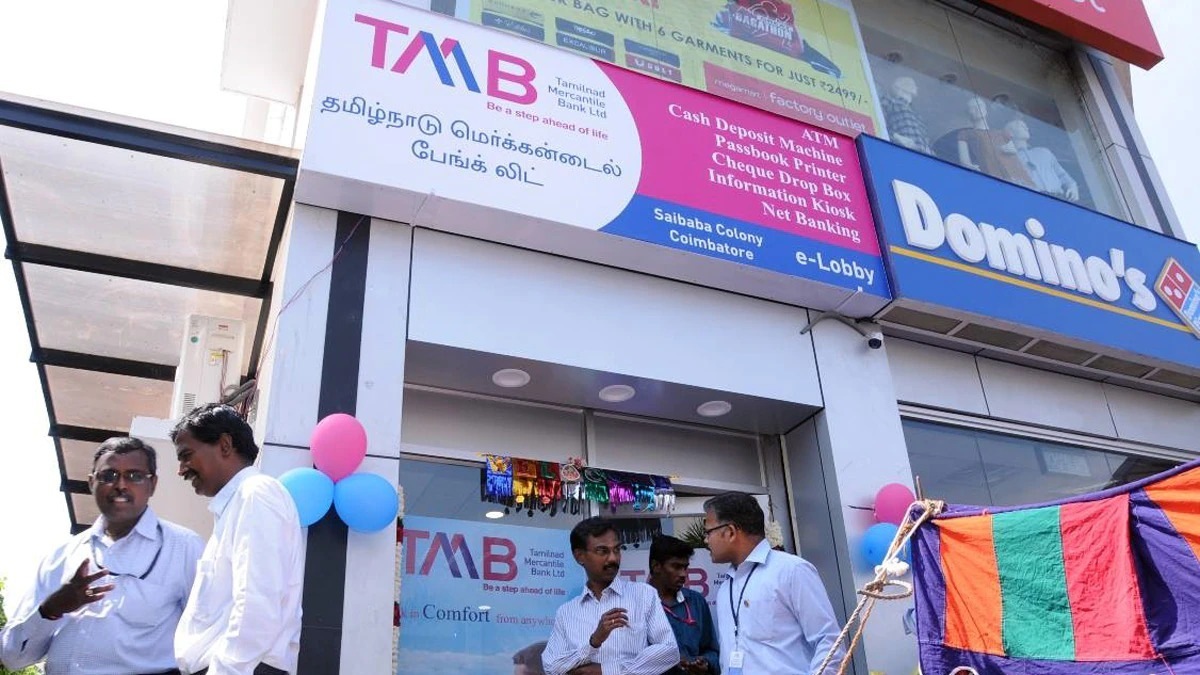
Tamilnad Mercantile Bank. Say the name three times fast and it still sounds like a cooperative society for textile traders from the 1920s. Which, technically, it is. Founded in 1921 by 10 visionaries of the Nadar community in Thoothukudi, Tamil Nadu, TMB has spent 103 years doing exactly what it does best: lending to farmers, small traders, and microfinance borrowers at rates that make sense to both parties. No philosophy. No moonshot. Just banking.
Until now. Management in early 2026 is on a tear. ₹250 crore IT capex deployed. 36 new branches opened. Digital engagement hub live. Oracle Fusion migration in full swing. Cost-to-income hitting 44.4%, which is actually rather sharp for a ₹9,900 crore market-cap bank. And they’re targeting geographic diversification—from 74% Tamil Nadu concentration to 65% by FY27, and 35% outside TN by FY32. This isn’t incremental change. This is structural transformation.
The story is compelling because execution is visible. Record quarterly profits. Deposit growth at 12.53% YoY. Credit growth of 16.30% YoY. CASA (Current & Savings) accounts grew 14.94% YoY, hitting 27.95% ratio—back to pre-2023 levels. But here’s the catch: equity investors have been paid nothing. Dividend payout over 3 years stands at 7.52% of profits. The stock has delivered zero price returns in 10 years but collected dividends in the process. So the question isn’t whether TMB is well-run. The question is whether it’s meant to be owned by equity investors, or whether it’s just a glorified deposit ATM for the Tamil Nadu middle class.
Concall Insight (Feb 2026): Management stated Q3 net profit of ₹341.5 cr was the bank’s “highest ever quarterly profit.” They weren’t gloating. They said it matter-of-factly, then moved straight into Q&A about deposit costs. This is a culture that doesn’t believe in hype. Sometimes that’s a feature. Sometimes it’s a bug for equity valuations.
03 — Business Model: What The Heck Are They Even Doing?
They Lend Money To Poor People. And Make Money. Revolutionary.
Let’s say you’re a farmer in Tamil Nadu with 5 acres, a motorcycle, and a dream of buying a tractor but no collateral to offer a nationalised bank because the system is designed by people who’ve never owned land. You walk into TMB with 10 grams of grandmother’s gold. TMB lends you 75% of that gold’s LTV. You get the loan. No credit score. No 36-month income statements. Just gold, LTV, and trust that you’ve survived 5 crop cycles and will probably survive this one too. TMB makes 10-11% yield on that loan. The farmer pays 8-9% interest. Everyone’s happy. Grandmother’s gold sits in the TMB vault and the bank’s balance sheet shows ₹16,599 crore in agri-gold exposure as of Q3 FY26.
This is the entire business model. 42% agriculture loans (including ₹16,599 cr agri-gold). 30% MSME loans (finally recovering from de-growth). 21% retail (ex-gold), and 7% corporate (selective, collateralized, tiny). ₹44,366 crore in advances. ₹53,689 crore in deposits. 578 branches, with 73.5% in Tamil Nadu. 87% of branches in South India. No flash. No fintech cosplay. Just structured lending to people the banking system forgot.
Gold loans are 45% of the advances portfolio (management corrected it from 50% in concall). It’s the “stability anchor,” as they call it. Average LTV: 54%. Sourced at 73%. Daily HO monitoring on commodity risk. Board-approved ceiling: 50%. This isn’t a casino bet on gold prices. It’s vanilla lending with tangible collateral. The problem: if gold prices crater, the portfolio needs re-underwriting. The upside: if gold prices stay flat, this business is a perpetual cash machine.
Gold Loans45%Portfolio Mix
MSME30%Portfolio Mix
Agri42%of Advances
Branches578as of Q3 FY26
💬 Gold loans scare you, or they sound like boring genius? How many TMB branches have you actually walked into?
04 — Financials Overview
Q3 FY26: The Data Dump You Actually Need
Continue reading with a premium membership.