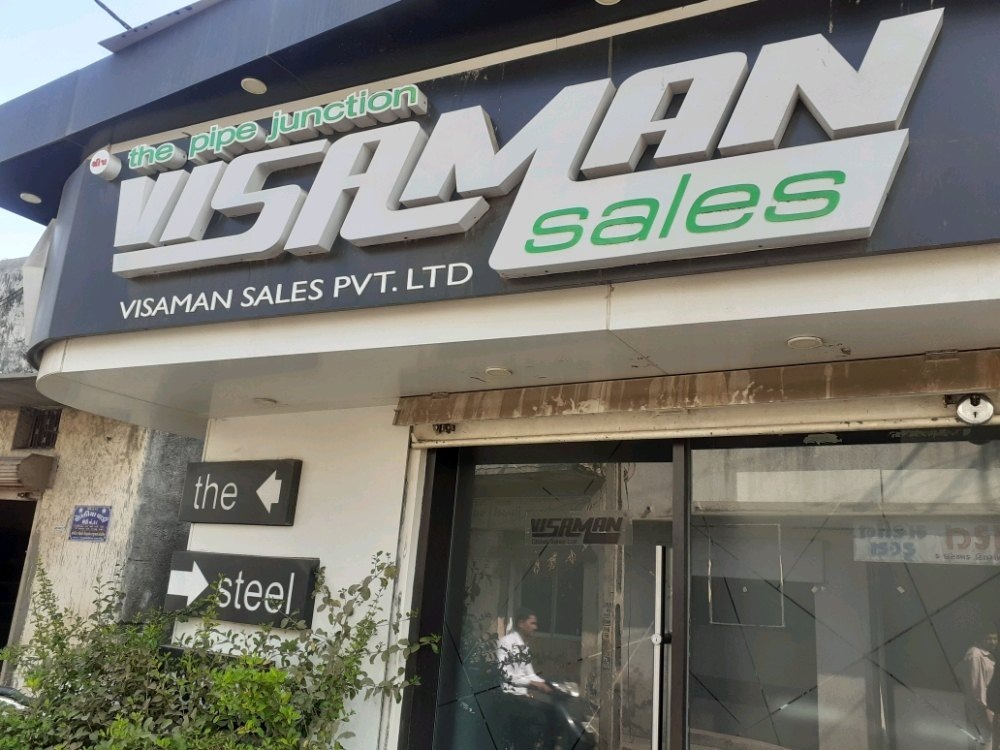
1. At a Glance – Blink and You’ll Miss the Drama
₹236 crore market cap. Stock price around ₹122. Six-month return of 154% and one-year return of 191%, which is basically the stock market equivalent of “Gym join kiya, protein shuru, reel daal di.” Meanwhile, the core business is selling steel products with operating margins that were chilling at 2–3% and suddenly jumped to 7% in the latest half year.
Sales for the latest half year came in at ₹109 crore (down YoY), but PAT jumped to ₹3 crore. Debt stands at ₹70 crore, debt-to-equity is almost 1, and interest coverage is a modest 1.76. Translation: this company lifts heavy steel and also lifts heavy EMIs.
ROE is around 10–11%, ROCE around 9–10%. Not scandalous, not sexy either. The valuation, however, is fully in party mode: P/E north of 60 while the industry median is ~22.
So why is the market excited? Because Visaman Global Sales Ltd has moved from pure steel trading to whispering sweet nothings about manufacturing, processing, subsidiaries, preferential allotments, and “next phase of growth.” Or as auditors call it: transition phase.
Question to you already: is this a steel story… or a capital market story wearing a steel helmet?
2. Introduction – Steel Hai, But Tempered With Equity Dilution
Visaman Global Sales Ltd was incorporated in 2019, which means it is young enough to still experiment, but old enough to have learnt that margins in steel trading are thinner than Mumbai real estate walls. The company operates in one of the most brutally competitive spaces: steel pipes, coils, sheets, plates, structural steel – basically everything heavy, shiny, and price-sensitive.
In its early avatar, VGSL was largely a trader. Buy from giants like SAIL, JSW, NMDC, AM/NS. Sell to infrastructure, industrial, and project clients. Earn wafer-thin margins. Pray that steel prices behave.
But then reality hits. Trading doesn’t compound easily. So FY24 onwards, the company tweaked its main objects to include mild steel manufacturing and processing. That’s management-speak for: “Bhai, sirf dalali se kaam nahi chalega.”
IPO happened in July 2024 on NSE Emerge, raising about ₹16 crore. Post-listing, the company has been busy with preferential allotments, warrants, subsidiaries, and board meetings that sound more like startup pitch decks than steel trader minutes.
The market loved the narrative. The stock ran. Fundamentals? They’re jogging, not sprinting.
Let’s break this steel dabba layer by layer.
3. Business Model – WTF Do They Even Do?
Visaman Global Sales Ltd does three things, in descending order of excitement:
First, steel trading. This is the bread and butter. HR coils, CR coils, GP/GI coils, colour-coated coils, MS sheets, plates, pipes – round, square, rectangular, hollow tubes, boiler tubes, spiral pipes, TMT bars. If it’s steel and heavy, VGSL probably sells it.
Second, customisation via outsourcing. Clients want specific sizes, thickness, coatings? VGSL sends the requirement to manufacturers or third-party processors. The company itself doesn’t do much processing yet – it coordinates. Think of it as Zomato for steel, minus the app and minus the discounts.
Third, logistics and credit facilitation. VGSL provides third-party logistics solutions and credit to customers. Helpful for sales, risky for cash flows. Debtor days creeping up to 57 tell you how generous the company is feeling these days.
Sales channels include B2B, B2C, and B2CH (hybrid). User industries range from bridges and wind farms to bus stands and fire protection systems. Basically, wherever India is building something, steel is required, and VGSL wants to be invited to the party.
The big pivot is intent to move towards manufacturing and processing. But as of now, most of the heavy lifting is still trading. Manufacturing is a plan, not yet a profit line.
Reader check: do you like businesses that promise future margin expansion, or do you prefer already-fat margins?
4. Financials Overview – Half-Yearly Results, Half-Boiled Confidence
Result Type Lock: The latest official heading clearly states Half Yearly Results. EPS will be annualised by multiplying by 2