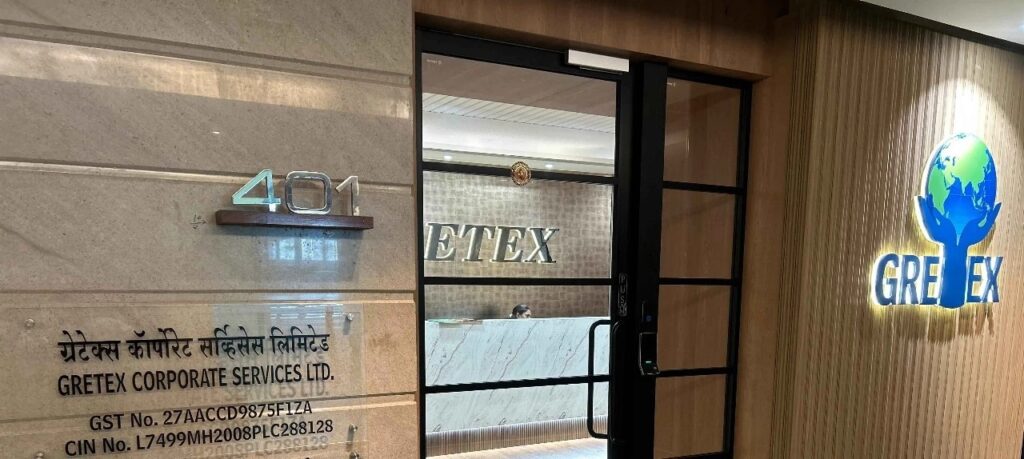
Gretex Corporate Services Ltd is that rare species in Dalal Street zoo: a merchant banker that actually lists companies while its own stock behaves like a hyperactive SME IPO on Red Bull. With a market cap of roughly ₹809 crore and a current price hovering around ₹353, Gretex has delivered eye-popping 35% returns in just three months and about 41% over one year — all while reporting a negative PAT on a trailing twelve-month basis. Yes, welcome to Indian capital markets, where vibes sometimes matter more than earnings.
Latest quarterly numbers show revenue of about ₹80 crore with PAT around ₹13 crore, even as full-year FY25 PAT stands at a loss of roughly ₹1.4 crore. ROE is a sleepy 0.86%, ROCE a barely-awake 2.7%, and yet Price-to-Book is a spicy 5.78x. Promoters hold ~63.3%, debt is almost cosmetic at under ₹8 crore, and dividend yield exists mostly for emotional support at 0.13%. The stock screams confidence, the ratios whisper caution, and the business sits right in the middle of India’s IPO-industrial complex. Curious already? Good. You should be.
2. Introduction
Gretex Corporate Services Ltd was incorporated in 2008, which means it has survived multiple market cycles, several SEBI regulations, and at least three different definitions of “easy money.” It operates as a SEBI-registered Category I Merchant Banker — basically, the licensed middleman who helps ambitious promoters convert dreams, pitch decks, and PowerPoint optimism into listed equities.
In FY23 alone, Gretex listed nine companies on the SME platform of BSE. That’s not a typo. Nine. This is not a company that waits for perfect macro conditions; it thrives on pipeline. IPO pipeline, preferential allotment pipeline, rights issue pipeline — if it involves forms, fees, and filings, Gretex wants a cut.
But here’s the twist: while the topline over the last few years has exploded (sales growth of ~195% over five years), profits have developed commitment issues. FY24 was strong, FY25 cooled off dramatically, and TTM numbers look ugly. Meanwhile, the stock price has politely ignored this mess and continued climbing. Is this confidence in future deal flow, blind faith in capital markets, or just momentum traders having fun? Keep reading — the numbers will roast themselves.
3. Business Model – WTF Do They Even Do?
Imagine a marriage broker, but instead of weddings, they arrange IPOs. That’s Gretex.
The company offers a bouquet of merchant banking and advisory services:
IPOs, rights issues, preferential allotments
Angel funding, VC, PE, QIPs
Debt syndication via loans and debentures
M&A, demergers, delisting, open offers
AIF incorporation, due diligence certificates, valuations, ESOP advisory
Revenue in FY23 came largely from service charges (~83%), followed by profit on sale of shares (~16%), with scraps from “others.” Translation: Gretex earns when deals happen, not when markets feel sentimental. This makes revenue inherently lumpy — feast during bull markets, fasting during dull phases.
The SME IPO boom has been Gretex’s playground. Smaller companies, smaller ticket sizes, but lots of volume. If India sneezes another SME IPO cycle, Gretex will already be standing there with a tissue and an invoice. The downside? When markets pause, revenue visibility can disappear faster than retail liquidity in a falling SME stock.
4. Financials Overview
Result Type Detected: Quarterly Results (locked) Annualised EPS = Latest Quarterly EPS × 4
Latest reported quarter: Sep 2025 EPS for the quarter: ₹5.06 Annualised EPS: ₹20.24
Quarterly Comparison Table (₹ crore, EPS in ₹)
Metric
Latest Qtr (Sep 2025)
YoY Qtr (Sep 2024)
Prev Qtr (Jun 2025)
YoY %
QoQ %
Revenue
80
94
22
-14.9%
+263%
EBITDA
32
-17
2
NA
Massive
PAT
13
15
1
-13.3%
+1200%
EPS (₹)
5.06
4.39
0.34
+15.3%
🚀
Commentary: QoQ growth looks like a meme stock chart because the previous quarter was weak. YoY revenue dipped, but margins exploded thanks to operating leverage and other income volatility. This is not FMCG — this is deal-driven finance where one good mandate can flip the quarter from “meh” to “wah bhai wah.”
5. Valuation Discussion – Fair Value Range Only
Let’s do this calmly, without screaming “multibagger.”
1. P/E Method
Annualised EPS: ₹20.24
Reasonable P/E range for capital market intermediaries: 12x–18x
Fair Value Range (P/E): ₹240 – ₹365
2. EV/EBITDA Method
EV ≈ ₹805 crore
Annualised EBITDA (rough estimate using latest quarter ×4): ~₹128 crore
EV/EBITDA ≈ 6.3x
Sector range: 6x–10x Implied Value Range: ₹760 – ₹1,270