1. At a Glance – Blink and You’ll Miss the Madness
Pramara Promotions Ltd is what happens when corporate gifting, toys, plastic moulding, and brand marketing decide to elope together and start a listed company. As of today, this NSE SME stock is chilling at around ₹346 with a market cap of roughly ₹482 crore, having casually delivered a 127% return in one year and a 96% return in just six months, because why not. The company clocked ₹53.2 crore in sales and ₹6.13 crore in PAT in the latest half-yearly results, translating into a jaw-dropping 177% YoY profit growth. Valuations? Spicy. A P/E of ~49, P/B of 4.1, and EV/EBITDA north of 28—basically priced like a growth startup but operating out of a 40,000 sq. ft. Mumbai factory churning out toys faster than a Chinese New Year assembly line. ROCE stands at 15.2%, ROE at 12.1%, debt at ₹29.5 crore, and promoter holding has slid to 39.4% with 30.4% pledged, which is… let’s say “emotionally complex.” If numbers were gossip, Pramara would be that aunty who knows everyone’s secrets and still shows up overdressed.
2. Introduction – Corporate Gifting, but Make It Capital Markets
Once upon a time, corporate gifting meant a calendar, a diary, and maybe a pen that never worked. Pramara Promotions looked at that boring universe and said, “Let’s add toys, plastic, branding, licensing, OEM manufacturing, and a dash of adrenaline.” Incorporated in 2006, the company spent years quietly supplying promotional merchandise to FMCG giants, media brands, and global corporates before deciding to tap the public markets via an SME IPO in September 2023, raising ₹15.27 crore.
Fast forward to FY25–FY26, and Pramara is no longer quiet. Revenues are growing, profits are exploding (comparatively), order books are stacked, and the stock price is behaving like it just discovered Red Bull. The company now claims to be India’s largest supplier and manufacturer of promotional toys, merchandise, and corporate gifts, with over 5,000 products designed since inception. From Happy Meal-style toys to induction kits for government bodies, Pramara’s stuff ends up everywhere—often in your house, sometimes in your kid’s mouth, and occasionally in landfill (environmentalists, please breathe).
But beneath the shiny toys and booming numbers lies a balance sheet with working capital stress, promoter dilution, pledging, and cash flow gymnastics that deserve a closer look. So let’s peel the plastic wrap.
3. Business Model – WTF Do They Even Do?
Imagine a brand wants to run a promotion: “Buy two biscuits, get a toy.” That toy doesn’t magically appear. Pramara designs it, manufactures it, packs it, sometimes licenses the character on it, and delivers it in industrial-scale volumes. That’s the core business.
Pramara operates as a promotional marketing agency with in-house manufacturing, which is key. Unlike pure-play ad agencies that just ideate, Pramara actually makes stuff—plastic toys, POSM material, corporate gifts, and branded merchandise. Their services span consumer promotions, trade promotions, corporate gifting, loyalty programs, OEM manufacturing, POSM, cross-promotions, sweepstakes, and even toy retail.
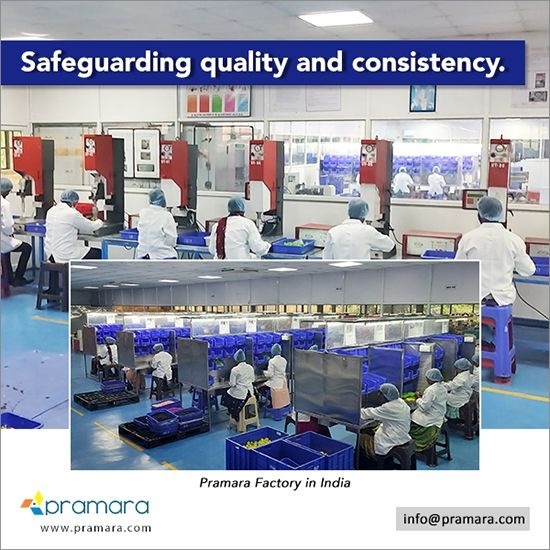
The Mumbai manufacturing facility can produce over 150 million products annually, with daily capacity of 2.5–4 lakh units. Plasticizing capacity runs at 2,000–2,500 tons per month, and packaging lines look like something out of a logistics fever dream—flow wrap machines, shrink wrap machines, band sealers, all pumping out hundreds of thousands of units daily.
They’ve also launched private labels like Toyworks and Tribeyoung, targeting e-commerce with toys and accessories. Add clients like Unilever, P&G, Mondelez, PepsiCo, Domino’s, Kellogg’s, and Cartoon Network, and you realize this is less “gift supplier” and more “behind-the-scenes FMCG accomplice.”
Question for you: how sticky do you think such client relationships are once you’re embedded in their promotional cycles?
4. Financials Overview – Numbers That Squeak
Result Type Lock: The latest official heading is Half Yearly Results, so EPS is annualised by multiplying by 2, not 4.
Half-Yearly Performance Comparison (₹ crore)
Metric
Latest H1 FY26
H1 FY25
Prev H2 FY25
YoY %
QoQ %
Revenue
53.18
30.75
55.66
72.9%
-4.5%
EBITDA
7.98
4.85
8.01
64.5%
-0.4%
PAT
6.13
2.21
4.05
177.4%
51.4%
EPS (₹)
4.40
2.01
3.36
118.9%
31.0%
Annualised EPS (Half-Yearly): ₹4.40 × 2 = ₹8.80
Commentary: Revenue growth is loud, profit growth is louder, and EPS growth is basically screaming. Margins are stable-ish, but the QoQ revenue dip shows seasonality and order timing. Still, PAT acceleration suggests operating leverage is kicking in. Or accounting timing. Or both.