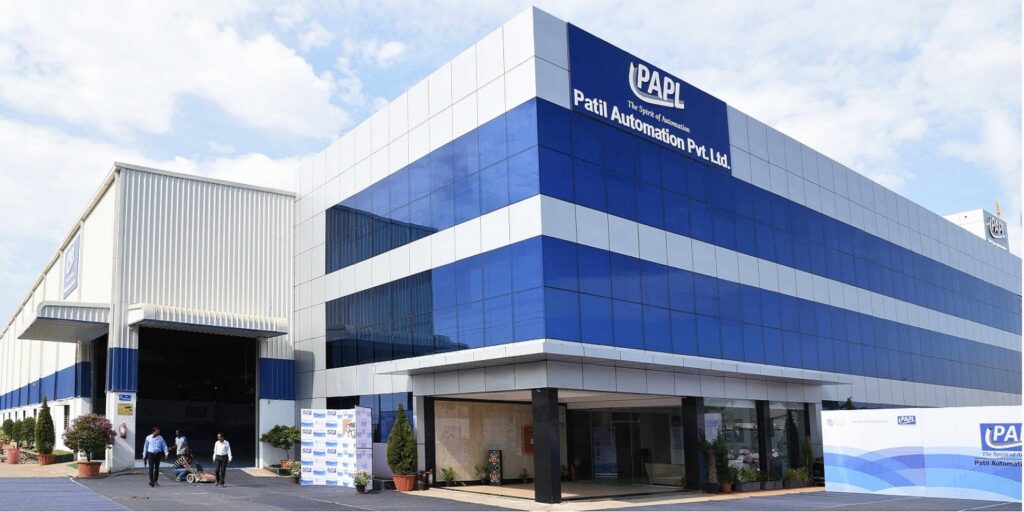
Patil Automation Ltd is what happens when a Pune-based welding nerd decides to industrialise his obsession and the stock market politely says, “Fine, take my money, but show me numbers.” With a market capitalisation of about ₹415 crore and a current price hovering near ₹190, this SME-listed automation player has quietly welded together a respectable financial story. H1 FY26 revenue came in at ₹73.55 crore, net profit at ₹7.53 crore, and ROCE is flexing at 24.5% like it just discovered protein shakes. The company is trading at a P/E of around 31.6, roughly in line with industry valuations, but the real gossip is not the multiple—it’s the order book of ₹140 crore, the EV battery pack assembly line orders, and a balance sheet that looks suspiciously healthier post-IPO. Three-month returns are mildly negative, six-month enthusiasm has cooled, but fundamentals are still doing push-ups in the background. Is this a cyclical auto-ancillary automation story, or an early EV infra whisperer? Keep reading, because the welding sparks are flying.
2. Introduction
Patil Automation was incorporated in 2015, which in stock market years is basically a teenager with ambition issues and a LinkedIn premium account. Yet here it is—listed, scaled, and supplying automation solutions to automotive OEMs who don’t want humans near welding torches anymore. The company operates in a niche that sounds boring at first glance but is actually critical: welding lines, robotic assembly lines, and special-purpose machines that quietly decide whether your car’s chassis survives a pothole.
What makes Patil Automation interesting is not that it does automation—everyone and their cousin does that now—but that over 70% of its revenue still comes from welding lines. This is old-school, hardcore manufacturing automation, not PowerPoint automation. Add to that a near-total dependence on the automotive sector (99.1% revenue), and you have a company that rises and falls with auto capex cycles. Dangerous? Maybe. Focused? Definitely.
IPO money has been deployed where promoters promised it would be: new facilities, capacity expansion, and debt reduction. No Maldives trips, no “strategic investments” in unrelated businesses—just more square feet and more robots. But with EV orders coming in and acquisitions like Pentaco Automation and MII Robotics entering the scene, the question becomes: is Patil Automation still a single-trick welding pony, or is it trying to become a broader automation circus? And if so, will margins survive the act?
3. Business Model – WTF Do They Even Do?
Imagine an automotive OEM walking into a factory and saying, “I don’t want humans welding anymore. Too slow, too risky, too many chai breaks.” That’s where Patil Automation walks in, adjusts its helmet, and says, “Say no more.”
The company designs, manufactures, tests, installs, and commissions automation systems—primarily welding lines. These include spot welding, MIG, TIG, robotic welding cells, and fixtures that hold parts steady while robots do their thing. Welding lines alone contribute more than 70% of revenue, which tells you where management’s heart (and billing software) lies.
Assembly lines are the second-largest contributor at over 22% of revenue. These are robotic systems with programmable workstations and conveyor-based material movement. Think of them as factory choreography—every part moving exactly when and where it should.
Then come the smaller siblings: special purpose machines (SPMs), material handling systems, maintenance services, and miscellaneous items like spares and scrap. Individually tiny, collectively useful, but not yet stars of the show.
The company operates from MIDC Chakan, Pune—basically the Thanos-level hotspot of Indian automotive manufacturing. Two units with a combined area of over 1 lakh sq. ft. were already running at 83.5% capacity utilisation in H1 FY25, which is corporate code for “Boss, we’re full.” Hence the new facility: another 59,046 sq. ft., capacity jumping from 2,304 units to 3,454 units annually, funded largely through IPO proceeds.
The business model is project-based, order-driven, and milestone-linked. Cash flows can wobble quarter to quarter, but when order execution is smooth, profitability follows. Simple in theory, execution-heavy in reality.
4. Financials Overview
Result Type Lock
The latest official heading clearly states “Half Yearly Results”. Result type is therefore locked as HALF-YEARLY RESULTS. Annualised EPS = Latest EPS × 2.
Annualised EPS (Half-Yearly × 2) ≈ ₹6.9, which matches trailing twelve-month EPS of ₹6.93 shown in the data.
Witty commentary: Revenue is growing steadily, EBITDA margins are quietly improving, and PAT is behaving like a disciplined middle child—no tantrums, just progress. EPS looks messy because equity capital jumped post-IPO, not because profits vanished. Context matters, Twitter doesn’t.