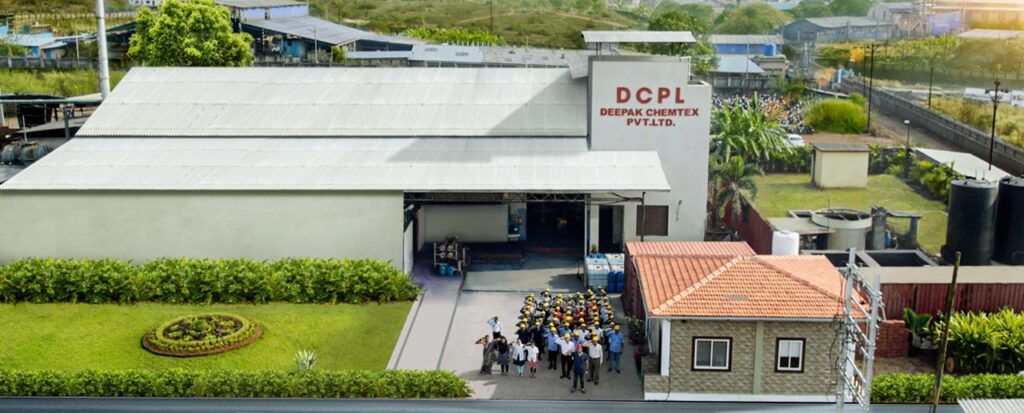
Deepak Chemtex Ltd is that classic SME chemical stock which looks boring at first glance, then punches you with numbers, and then confuses you by destroying shareholder returns anyway. Incorporated in 1997, listed on BSE SME, current price hovering around ₹109, market cap roughly ₹118 crore, and yet this tiny colourant-and-chemicals manufacturer is casually throwing around ROCE of ~34% and ROE of ~25%. Not bad for a company whose products include food colours, pharma dyes, cosmetics additives, and inkjet inks – basically things you consume, apply, or accidentally spill on your shirt.
Latest half-year numbers (H1 FY26, Sep 2025) show revenue of ₹31 crore and PAT of ₹4 crore. Sequentially lower than the March half, yes, but still profitable, still cash-generating, still debt-light. Over the last 3 months, the stock is down ~14%, over 6 months ~25%, and over 1 year ~31%. Meanwhile profits are growing at a 32% TTM pace. Market clearly said: “Nice results beta, but mood kharab hai.”
Promoters hold a chunky 73%, debt is barely ₹1 crore, current ratio is an absurd 6.99, and interest coverage is so high (186x) that even banks feel ignored. This is not a loss-making science project. This is a profitable chemical SME trading at a P/E of ~10.6 when industry averages are north of 25. Curious already? Good. Keep reading.
2. Introduction – A Stock That Didn’t Read Its Own Financials
Deepak Chemtex is one of those companies that quietly compounds profits while the stock price goes through its own existential crisis. Founded in 1997, long before “specialty chemicals” became a buzzword investors chant like a mantra, the company has been manufacturing colourants and chemical intermediates used across food, pharmaceuticals, cosmetics, confectionery, animal feed, and inkjet inks.
Now, if this sounds boring, remember: boring chemicals are usually the most profitable ones. Nobody makes Instagram reels about Acid Blue 9, but everyone uses it. And that’s exactly where Deepak Chemtex operates – deep inside supply chains, far away from consumer glamour, but close to repeat demand.
What makes things interesting is timing. The company recently expanded capacity by acquiring a new manufacturing facility at Lote MIDC, adding 1,500 metric tonnes per annum of dye stuff capacity. It also pushed aggressively into solar power to reduce electricity costs by up to 80%. This is not random jugaad. This is margin protection behaviour.
Yet, the stock has corrected sharply. Why? SME liquidity, cyclical chemicals, quarterly volatility, and general smallcap PTSD. So the question becomes: is the market overreacting, or are the numbers hiding something ugly under the lab coat?
Let’s put on our funny detective hat and start checking the evidence.
3. Business Model – WTF Do They Even Do?
Imagine a company that sells colours, but not the fun Crayola type. Deepak Chemtex manufactures industrial colourants and chemical compounds that end up in food items, medicines, cosmetics, inks, fertilizers, detergents, and plastics. Basically, if it needs colour, stability, or chemical consistency, there’s a decent chance Deepak Chemtex is somewhere in the background.
The business spans:
Inorganic acids like sulphuric acid, oleum, hydrochloric acid
Sulphates like zinc, copper, and magnesium sulphate
Specialty dyes such as Acid Blue 9, Acid Violet 43, Acid Red 52, etc.
These are not one-off novelty products. These are repeat-order, compliance-heavy, boring-but-sticky products. Customers don’t like changing suppliers here because consistency matters. One wrong batch and suddenly your pharma tablet looks like Holi celebration gone wrong.
Revenue is straightforward: ~98% from sale of products, ~2% other income. No complex fintech experiments, no crypto treasury, no “AI-powered colour blockchain”. Just manufacturing, selling, exporting.
Exports go to China, Europe, USA, Japan, Australia, UK, Kenya, Mexico. Yes, China is both a competitor and customer. Welcome to chemicals.
Subsidiaries include DCPL Speciality Chemicals and Southwest Corporation, plus a newly incorporated US subsidiary Atlas Tints Inc. to expand overseas reach. That’s ambition, not stupidity.
Simple model. Capital discipline. Chemical smell. All checks out so far.
4. Financials Overview – Numbers That Don’t Panic
Result Type Lock: The latest results are clearly labelled Half Yearly Results (H1 ended September 30, 2025). So EPS annualisation = latest EPS × 2. Lock applied. No further debate.