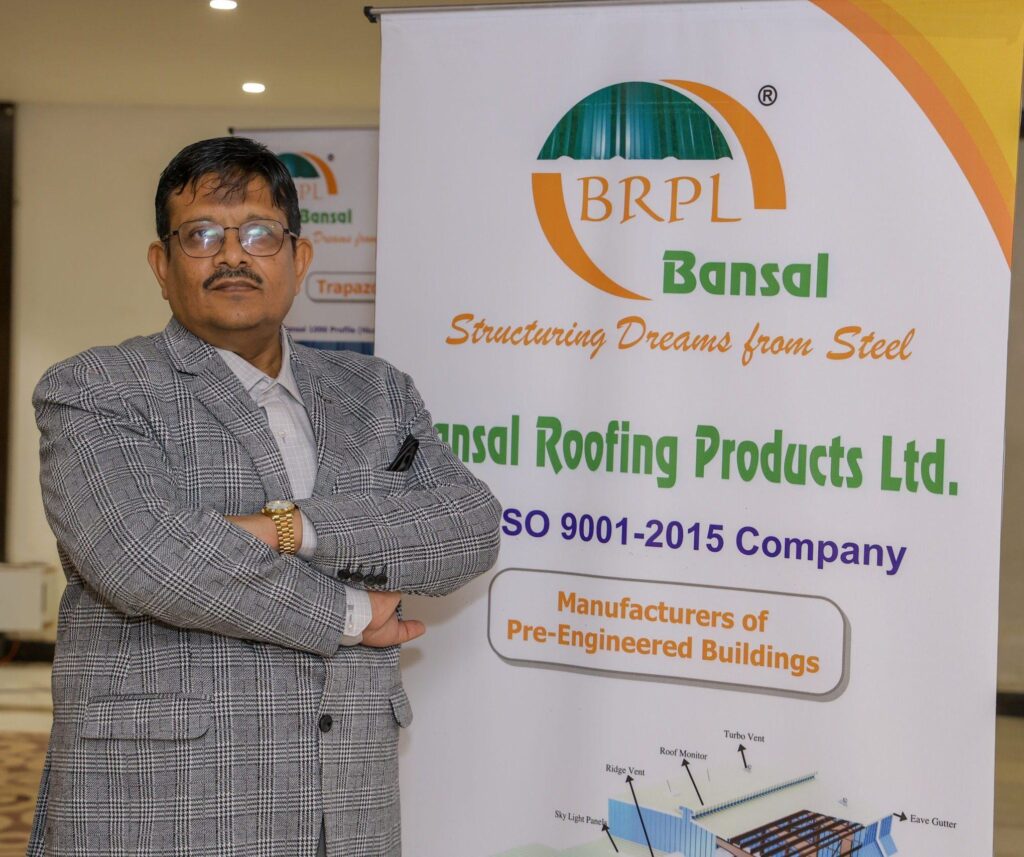
In an industry where “raising the roof” is more than just a figure of speech, Bansal Roofing Products Ltd has turned it into a business model. With a market cap of ₹143 crore and a current price of ₹109, this Vadodara-based underdog is showing the swagger of a midcap. The company clocked H1 FY26 revenue of ₹70.28 crore and a net profit of ₹3.38 crore — up by a firecracker-worthy 175% YoY in the latest quarter. The Return on Capital Employed (ROCE) stands tall at 22.4%, ROE at 18.2%, and the company continues to be virtually debt-free (Debt-to-Equity ratio: 0.05).
While most construction material players are sweating under debt, Bansal Roofing is busy turning sheet metal into cash flow. It’s almost poetic — or just good management. With 95% of PEB components made in-house, a 1 million+ sq. meter installation base, and 125+ projects wrapped up across India and abroad, they’re now stepping into their “Phase-IV expansion” at lightning speed.
Investors have reasons to stay glued. The Q2 FY26 revenue jumped 104%, profits soared 175%, and the EPS now sits at ₹5.76. Someone’s clearly roofing profits, not just buildings.
2. Introduction
If “head above the rest” was a business mantra, Bansal Roofing would be the poster child. Born in 2008 as a marketer of metal sheets, it slowly flexed into full-scale pre-engineered building (PEB) manufacturing — one project at a time. From humble steel sheds to sleek industrial structures, the company’s transformation reads like a Bollywood script: small-town beginnings, mid-tier success, and now — a near debt-free empire of corrugated dreams.
The Indian infrastructure boom has been a blessing. Warehouses, factories, logistics hubs — everyone wants a roof that doesn’t leak or collapse under inflation. And in this metal symphony, Bansal Roofing is the unsung guitarist strumming profits quietly.
It’s not your typical cement-and-steel play either. The company offers color-coated sheets, polycarbonate sheets, PEB structures, purlins, FRP products, and even touchless sanitizer stands (because why not diversify?). Add names like Adani Wilmar, GMM Pfaudler, BHEL, and Larsen & Toubro to its client list — and you’ll start wondering why this ₹143 crore minnow swims so confidently among industrial sharks.
The cherry on top? Their factory at Vadodara churns 1,400 tons per month, soon doubling as Unit 2 expands to 2,000 tons/month. Basically, they’re building roofs faster than your builder can delay a flat possession.
3. Business Model – WTF Do They Even Do?
Imagine a metal Lego factory for grown-ups. That’s Bansal Roofing. The company doesn’t just sell roofing sheets; it builds entire ecosystems — from structural frames to shiny panels and accessories.
Its bread and butter come from Pre-Engineered Buildings (PEBs) — custom-made structures assembled faster and cheaper than conventional construction. Think warehouses, plants, malls, or even railway sheds. 95% of these components are made in-house, ensuring control over quality and margins.
Their Product Buffet includes:
Color-coated roofing sheets (for your fancy industrial selfies)
Z, C & Sigma purlins (the skeleton of PEBs)
Polycarbonate & FRP sheets (because sunlight is cheaper than LEDs)
PUF panels and ventilators (eco vibes, anyone?)
Deck sheets and perforated sheets for advanced construction needs
And if that wasn’t enough, the company even makes uPVC sheets and foot-operated sanitizing stands — a pandemic-era innovation that aged surprisingly well.
In short: if it’s a metal structure, Bansal Roofing probably makes it. If it’s not, give them six months — they’ll find a way.
4. Financials Overview
Table: Quarterly Performance (₹ in Crores)
Metric
Q2 FY26
Q2 FY25
Q1 FY26
YoY %
QoQ %
Revenue
34.09
16.68
36.20
104%
-5.8%
EBITDA
2.47
1.23
3.04
100.8%
-18.8%
PAT
1.46
0.53
2.02
175%
-27.7%
EPS (₹)
1.11
0.40
1.53
175%
-27.4%
Commentary: The numbers scream one thing — scalability with discipline. Revenue more than doubled YoY, but the best part? Margins didn’t evaporate. Operating margins stood around 7.25%, and PAT margin improved sharply on a higher base.
QoQ softness is visible due to monsoon impact (typical for construction-linked businesses), but YoY growth is a fireworks show. PAT of ₹1.46 crore in Q2 against ₹0.53 crore last year is no small feat for a ₹143 crore market-cap company.
Annualized EPS now comes close to ₹4.44, putting the P/E at around 24x, fair for a company growing profits at 150%+.
5. Valuation Discussion – Fair Value Range Only
Let’s break it down, the Edu way:
Method 1: P/E Multiple Method
Annualized EPS = ₹4.44
Industry Average P/E = 21
Conservative range (18–22x) ⇒ ₹80–₹98
Method 2: EV/EBITDA Approach
EV = ₹142 Cr
TTM EBITDA = ₹12 Cr
EV/EBITDA = 11.8x
Peer median ~13–15x ⇒ Upside fair value range ₹130–₹160
Method 3: DCF Snapshot (Simplified) Assuming Free Cash Flow CAGR 10–12% for next 5 years, and terminal growth 4% ⇒ DCF range ₹120–₹150
🧮 Fair Value Range (Educational): ₹100 – ₹150
Disclaimer: This fair value range is for educational purposes only and not investment advice.
6. What’s Cooking – News, Triggers, Drama
If corporate updates were a recipe, Bansal’s kitchen is sizzling:
Phase III of Unit-II started commercial production in Aug 2024.
Phase IV construction is already underway.
The company has been bagging orders like a Diwali sale — including a ₹9 crore project from Kutch Copper, and a 900 MT PEB contract in FY24.
Board meetings are as punctual as their steel deliveries —