Ambar Protein Industries Ltd Q2 FY25 – Edible Oil Refiner Flexes Its Muscles with ₹469 Cr Sales, 31% Growth, and ROE of 32%. But Is This a Lean Machine or Just a Greasy Story?
Welcome to the land of oil, margins, and mild cholesterol anxiety — Ambar Protein Industries Ltd, the Gujarati edible oil manufacturer behind the brand “Ankur.” The company trades at ₹265 per share, giving it a market cap of ₹152 crore, and currently carries a P/E ratio of 18.9, which is cheaper than the sunflower oil it sells in 1-litre pouches. With sales of ₹469 crore, PAT of ₹8.05 crore, and a return on equity (ROE) of 32.3%, Ambar Protein looks like a company that squeezes decent profit out of every drop.
But hold your kadhai — despite its performance, it pays zero dividend, leaving investors as dry as an oil-free diet. The company’s ROCE stands tall at 27.5%, with a debt-to-equity ratio of 0.61, and it recently increased its borrowing limit to ₹100 crore, presumably to fry bigger fish (or pakoras). However, the Q2 FY25 results show a QoQ sales dip of 4.8% and PAT decline of 25.6%, meaning even the oil bulls are feeling the heat.
Still, with sales growth of 31% and profit growth of 45.8% over the trailing twelve months, Ambar Protein remains one of those fascinating mid-cap stories where traditional manufacturing meets disciplined capital management. Let’s dive into the oily details.
2. Introduction
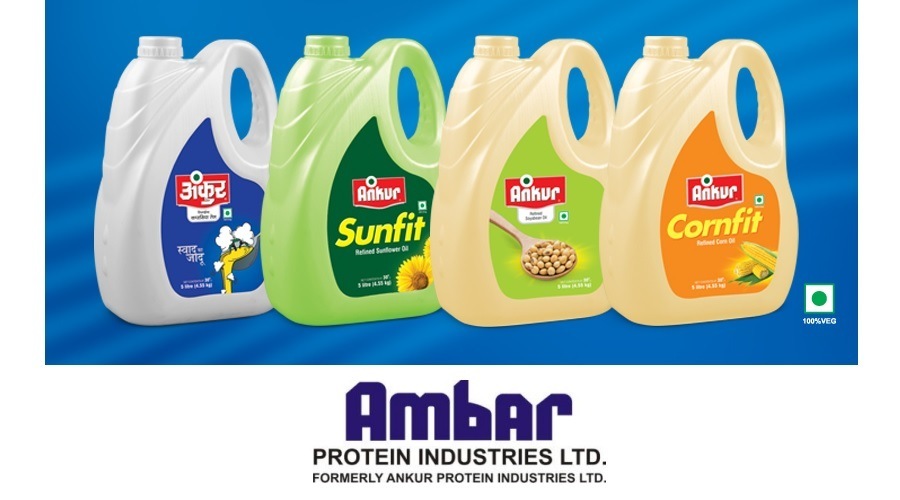
Once upon a time in Chandgodar, Ahmedabad, a refinery decided that cottonseed oil deserved more love than motor oil. Thus was born Ambar Protein Industries Ltd in 1992, a company now running a 110-ton-per-day refining plant and selling edible oils across Gujarat under the Ankur brand. The company’s catalog is a buffet — refined cottonseed, sunflower, soybean, and corn oil — packed in everything from 1-liter pouches to 15-kg tins.
What’s most amusing is that while FMCG giants like Marico and Patanjali Foods fight over ad campaigns, Ambar quietly focuses on operational efficiency and regional dominance. The company’s motto seems to be: “No celebrities, no drama, just consistent profit margins.”
The only real complaint? It’s almost too boring for Dalal Street’s taste. No sudden bonus issues, no stock splits, no dividend — just relentless refining and sales growth. And that’s what makes this smallcap Gujarati player so intriguing: it’s the quiet kid in the classroom who tops the test while everyone’s busy gossiping about Adani Wilmar’s market share.
So, does Ambar Protein have the potential to become the next regional FMCG breakout, or is it destined to remain the anonymous workhorse of Gujarat’s oil market? Let’s find out.
3. Business Model – WTF Do They Even Do?
Ambar Protein’s business model is the edible oil equivalent of an efficient dhokla recipe — minimal ingredients, solid output. The company operates in refining, manufacturing, and packaging of edible and non-edible oils, plus by-products like oil cakes and D-oil cakes used in cattle feed.
Its flagship brand, “Ankur,” dominates Gujarat’s cottonseed oil segment and caters primarily to household and retail consumers. The company refines and packages not only cottonseed oil but also groundnut, sunflower, maize, mustard, and soybean oils — either sourced directly from producers or purchased in bulk for resale.
In FY22, it processed 21,239.96 metric tons of cottonseed oil and repackaged an additional 2,134.92 metric tons of other edible oils for sale. Its 110 TPD refinery runs like a well-lubricated machine, blending scale and efficiency.
Ambar’s real advantage? Low working capital days (12) and inventory turnover discipline. This gives it a faster cash cycle than most of its edible oil peers, many of whom are stuck waiting for receivables longer than your sabzi queue.
The company’s recent expansion approvals — a 200 TPD sunflower refinery facility and new machinery installations in FY24 — suggest it’s shifting gears from regional player to mid-tier national supplier.
But will Gujarat’s oil kingpin move beyond its home turf, or is it just adding capacity to match upcoming demand? Let’s check the numbers.
4. Financials Overview
Quarterly Comparison (Figures in ₹ crore)
Metric
Sep 2025
Sep 2024
Jun 2025
YoY %
QoQ %
Revenue
111.66
88.95
117.27
25.5%
-4.8%
EBITDA
2.51
4.23
2.14
-40.7%
17.3%
PAT
2.00
2.69
0.75
-25.6%
166.7%
EPS (₹)
3.48
4.68
1.30
-25.6%
167.7%
Commentary: Sales jumped 25% YoY, proving demand for edible oil remains strong despite volatile commodity prices. However, operating margins slid from 4.76% to 2.25%, as input cost pressures (cottonseed and sunflower oil imports) likely squeezed profits. PAT of ₹2 crore looks modest but steady — a clear sign of disciplined management rather than reckless expansion.
If you annualize the latest EPS of ₹3.48, that’s ₹13.92 per share, matching the reported TTM EPS of ₹13.99, confirming data consistency. With a P/E of 18.9, Ambar trades slightly below its FMCG peers — possibly undervalued, depending on your cholesterol tolerance.
5. Valuation Discussion – Fair Value Range
Method 1: P/E Approach Industry P/E: 26 Company P/E: 18.9 EPS (TTM): ₹13.99
Lower Range = 15 × 13.99 = ₹210
Upper Range = 25 × 13.99 = ₹350
Method 2: EV/EBITDA Approach EV = ₹175 crore EBITDA (TTM) ≈ ₹14 crore EV/EBITDA = 12.4 Industry average ~15x So, fair EV range ≈ ₹210–₹260 crore Equivalent per share = ₹255–₹315
Method 3: Simplified DCF (Educational) Assume FCF per share = ₹7.5 (CMP/FCF ratio = 35.4 → implies ₹7.5) Growth 8% for 5 years, discount rate 11% Fair value ≈ ₹230–₹300
→ Fair Value Range: ₹230–₹350 per share
This fair value range is for educational purposes only and is not investment advice.
6. What’s Cooking – News, Triggers, Drama
The last few quarters have been a busy season at Ambar Protein’s factory floor:
Feb 2025: Successful installation of new machinery for product launches.
Sep 2024: Approval to set up new 200 TPD sunflower refinery facility.
Jan 2024: Resignation of auditor Mrs. Monali D. Shah — cue dramatic music, but the company swiftly replaced her and kept the books cleaner than filtered oil.
Aug 2023: Board approval for capacity expansion — the company seems to be preparing for bigger orders and