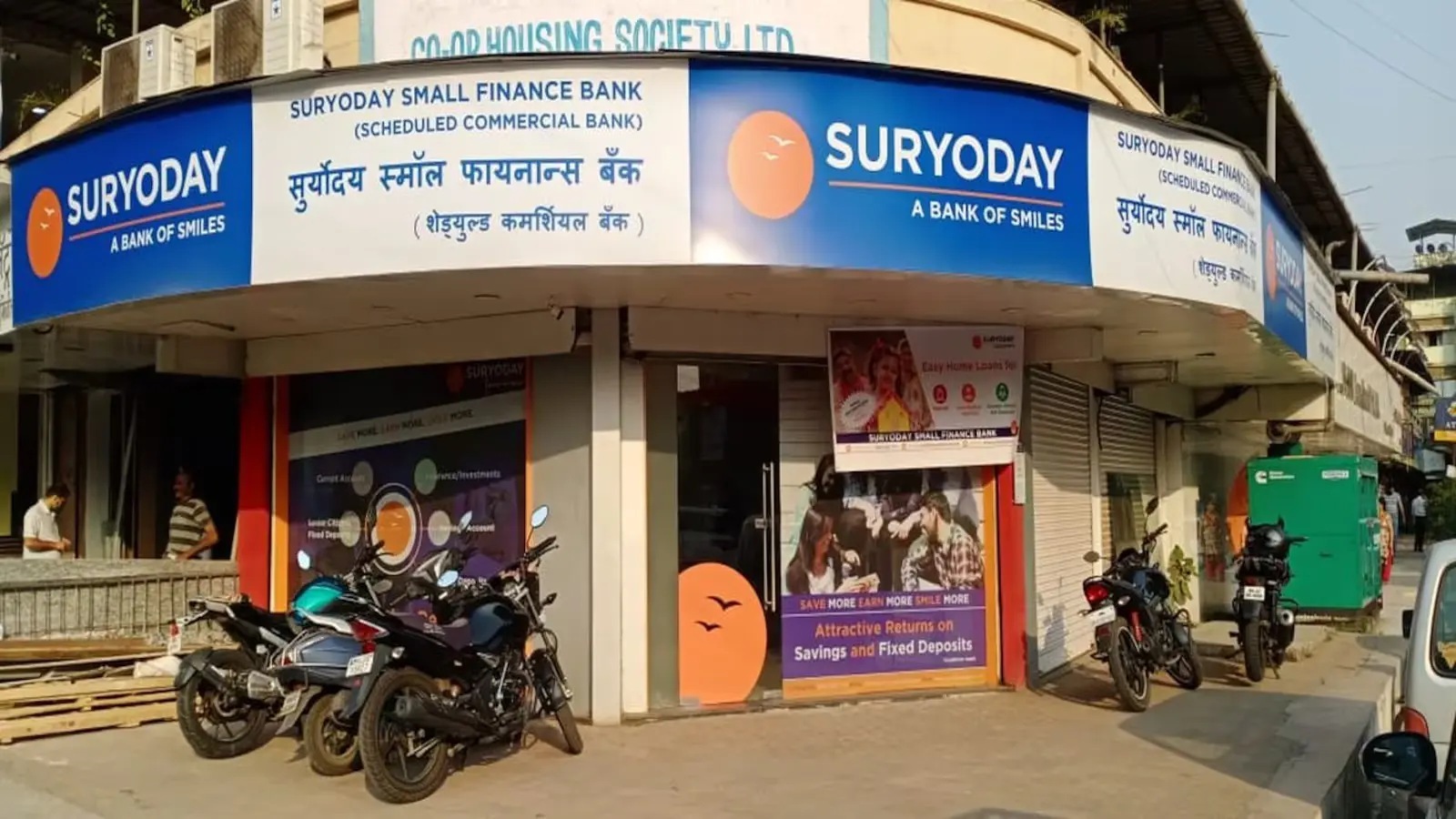
1. At a Glance
Welcome to Suryoday Small Finance Bank Ltd — the bank that started its journey lending to chaiwallahs, sabziwallahs, and small entrepreneurs but is now trying to play in the big banking league. Incorporated in 2008 and transformed into a Small Finance Bank (SFB) in 2017, Suryoday has seen more plot twists than a Bollywood thriller.
As of Q2FY26, the bank clocked Revenue of ₹520 Cr, PAT of ₹30.4 Cr, and a GNPA of 5.9% — numbers that could either make investors nervous or proud depending on their caffeine level. The stock trades around ₹143, with a P/E of 23.3x and Book Value of ₹187, meaning it’s priced at 0.76x BV — a rare discount in a market that loves expensive dreams.
Market cap? A humble ₹1,521 Cr, while Debt stands tall at ₹14,156 Cr. With ROE of 6.16% and ROA of just 0.82%, you can sense this is no AU Small Finance Bank yet — but it’s definitely trying to become one.
In short: a story of ambition, stress tests, and survival. Let’s decode the script.
2. Introduction – From Micro Loans to Macro Hopes
Suryoday Small Finance Bank is like that overachieving cousin who started life small but now wants to hang with the big corporate banks. It began as an NBFC, hustling in the microfinance segment, before the Reserve Bank decided, “Beta, ab tu bank ban sakta hai.”
Since 2017, the company has expanded across 15 states and union territories, catering to nearly 3.4 million customers through 710 banking outlets — roughly one branch for every 5,000 hopeful borrowers.
But the journey hasn’t been all rosy. With GNPA jumping to 7.2% in FY25 from 2.8%, the bank has had its fair share of “arrears drama.” Still, it remains optimistic — targeting 30–35% growth in advances and dreaming of keeping NPAs below 5% next year. Because why not dream big?
Deposits grew 36% YoY to ₹10,580 Cr, signaling growing customer trust (or at least a good interest rate). Advances rose to ₹10,251 Cr, with microfinance still ruling the throne at 50% of the portfolio.
This is a bank in transformation — trying to replace “micro” with “diversified,” “risky” with “secured,” and “loss” with “respectable profits.” Whether it works, we’ll see.
3. Business Model – WTF Do They Even Do?
So, what does Suryoday actually do apart from giving analysts anxiety?
The bank’s bread and butter are microfinance loans, which still form about half of its book. Picture this: small group loans to women entrepreneurs, street vendors, and rural traders — the kind of lending that powers local economies but keeps bankers awake at night during monsoon season.
Beyond that, they’ve built new verticals:
- Commercial Vehicle Loans (13%) – lending to truck owners who pray diesel prices stay low.
- Loan Against Property (10%) – classic “ghar girvi, paisa hazir” model.
- Housing Loans (7%) – small-ticket housing for lower-income households.
- Financial Intermediary Group Loans (11%) – basically lending to those who lend further.
- Partnerships & Supply Chain Finance (4%) – experimental but growing.
On the liability side, they’ve built a strong deposit base — ₹10,580 Cr — led by Retail Term Deposits (60%), CASA (20.9%), and Bulk Deposits (19%). Translation: most customers prefer parking money here for high FD rates, not the current account convenience.
A digital facelift is underway — ₹200 Cr invested in backend tech,