1. At a Glance
Let’s raise a glass — or maybe a calculator — to Allied Blenders & Distillers Ltd (ABDL), India’s undisputed whisky monarch, which just poured out another strong quarter. For Q2FY26, the company clocked ₹995 crore in revenue, with an EBITDA of ₹130 crore and a PAT of ₹63 crore — a refreshing 35% YoY profit surge. Not bad for a company that sells liquid confidence for a living.
At ₹672 a share, ABDL sits on a market cap of ₹18,798 crore, trading at a sky-high P/E of 73.2. But with whisky in one hand and a ₹115 crore PET plant just commissioned in the other, this is no hungover balance sheet. The company’s operating margin improved to 13%, up from just 6% in FY23, proving that even in the liquor business, efficiency matters more than intoxication.
Still, the spirit is slightly diluted by a ₹845 crore tax demand hanging like an empty bottle over its head. Debt sits at ₹1,056 crore, and receivables are an industry-style headache at 181 days. Yet, the company has delivered a 104% CAGR in profit over five years — that’s not just high-proof, that’s premium proof.
So, what happens when India’s largest whisky maker starts brewing efficiency? Let’s dive — or maybe stagger — through the details.
2. Introduction: The Spirit of Scale, the Drama of Taxes
Allied Blenders & Distillers (ABDL) is the kind of company that makes you question if India runs on fuel or whisky. Founded in 1988 and officially incorporated in 2008, ABDL is behind the legendary Officer’s Choice — the drink that built half of India’s nostalgia and most of its Monday headaches.
As of FY25, the company sold 33.1 million cases, making it India’s No.1 spirits company by volume, and among the top global whisky sellers. Its empire spans whisky, rum, brandy, vodka, and gin — basically every liquid that turns Indian weddings into concerts.
But behind the glamour of amber bottles lies a corporate soap opera. On one side, they’re commissioning a PET bottling plant to produce 615 million bottles annually; on the other, they’re fighting a ₹618 crore income tax demand covering a decade’s worth of audits. It’s like a hangover that refuses to go away even after you’ve downed an entire bottle of Officer’s Choice Blue.
The company’s expansion spree — from Telangana to Aurangabad — signals ambition, but its financials reveal a mix of strong sips and bitter aftertastes. A 20% ROE, 21% ROCE, and 13% OPM are stellar, but high working capital and litigation risk make investors gulp nervously.
Still, one thing is clear — in India’s liquor landscape, ABDL isn’t just serving drinks; it’s serving dominance.
3. Business Model – WTF Do They Even Do?
Let’s simplify. ABDL makes the stuff your boss drinks after rejecting your leave request. The company’s business runs across three key streams:
- Distillation & Blending:
ABDL produces alcohol (Extra Neutral Alcohol, ENA) — 66% of which is now captive — and blends it into its signature spirits. They’re on track for 100% ENA self-sufficiency by FY27, which means less dependence on third-party distillers and fatter margins. - Bottling & Packaging:
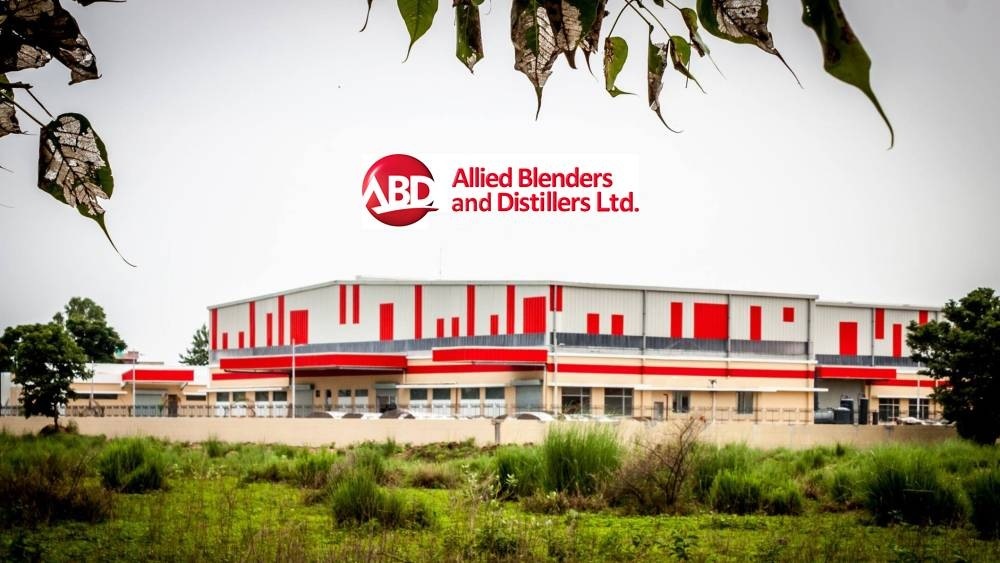
With 34 bottling units (9 owned, 6 exclusive, 19 non-exclusive), ABDL churns out millions of cases each quarter. Their new PET plant in Rangapur, commissioned in Q2FY26, can produce 615 million bottles/year, enough to make every Indian adult own a bottle of Officer’s Choice… or two. - Sales & Distribution:
Their army of distributors covers 79,000 retail outlets, spanning over 90% of India’s geography. The company is also expanding its global footprint, exporting to 23 countries, including the U.S. and EU markets — turning “Make in