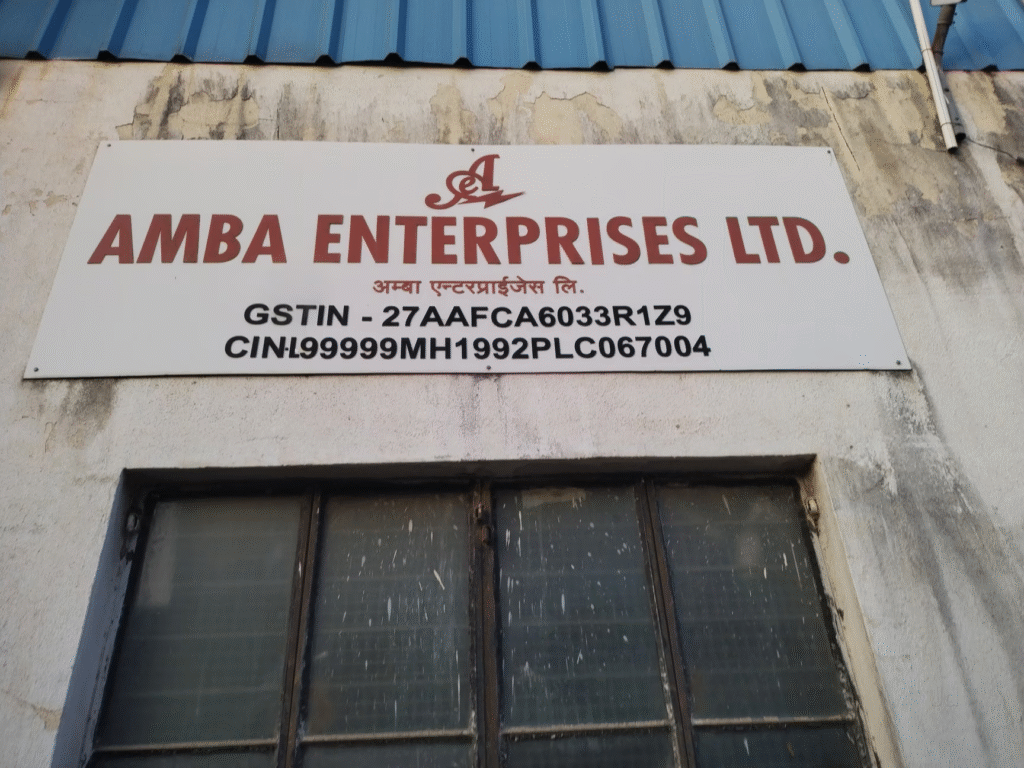
Amba Enterprises Ltd (AEL) is a smallcap transformer-lamination specialist with a market cap of just ₹194 Cr. It makes the nuts, bolts, and metal guts that sit inside transformers, motors, and alternators—basically the unsung heroes of India’s power and industrial backbone. Current price is ₹154, down 26% in a year, because investors discovered the company’s operating margins (3%) are thinner than a college canteen chai.
2. Introduction
Founded in 1995 and headquartered in Pune, Amba is not your flashy renewable energy unicorn, nor does it sell glossy PowerPoint decks like IT firms. Instead, it manufactures silicon steel slit coils, motor stampings, die-cast rotors, and transformer laminations. Translation for the average investor: they slice and dice metal into shapes that big boys like Siemens, Skoda, Cummins, and Bharat Bijlee use in their machines.
Revenues have grown decently—sales of ₹340 Cr in FY25 compared to ₹218 Cr in FY22. But profits? A meagre ₹7.3 Cr in FY25. That’s less than the catering budget of a mid-sized wedding in Delhi. The stock trades at a P/E of 26.5—investors are already pricing in “greatness,” while margins are still struggling for an upgrade.
Here’s the paradox: Amba sells to tier-1 clients but itself is tier-3 in profitability. Growth is visible, but cash flows are like India’s electricity—available, but with frequent fluctuations.
Would you pay a premium for a company that grows sales like a rocket but keeps profits at bicycle speed?
3. Business Model – WTF Do They Even Do?
AEL manufactures transformer core laminations and related products. Think of it as the “backstage worker” of India’s energy and industrial show. The hero actors are transformers, motors, and alternators—but without Amba’s laminated steel, they’d just be expensive paperweights.
Product range:
CRNO/CRNGO lamination strips
Die-cast rotors and shaft-inserted assemblies
Stampings for motors, alternators, pumps, and UPS
Slit coils (20 mm to 1200 mm wide, up to 2000 mm length)
Capacity: Pune plant with ~3,500 MT per year. In industrial terms, this is “small but significant”—enough to keep orders flowing but not enough to threaten giants like Apar or Waaree.
Clientele: Siemens, Cummins, KSB, Skoda, Emerson, and even IRCTC (probably for their coaches and generators). Basically, the who’s who of engineering, but Amba remains the “cog in the wheel.”
In short, they sell shavings of steel that power the grid, but margins are so thin you’d wonder if they’re cutting laminations or cutting investor patience.
4. Financials Overview
Metric
Latest Qtr (Jun’25)
YoY Qtr (Jun’24)
Prev Qtr (Mar’25)
YoY %
QoQ %
Revenue
89.45 Cr
85.83 Cr
83.73 Cr
4.2%
6.8%
EBITDA
2.54 Cr
2.71 Cr
2.23 Cr
-6.3%
13.9%
PAT
1.68 Cr
1.76 Cr
1.89 Cr
-4.6%
-11.1%
EPS (₹)
1.33
1.39
1.49
-4.6%
-10.7%
Commentary: Sales are growing like a teenager, but profits behave like an overworked CA—constantly tired. Operating margins hover at ~3%, so one extra GST penalty (like the recent ₹7.34 lakh demand) can wipe out a chunk of quarterly profit.
5. Valuation – Fair Value Range Only
Let’s use three lenses:
a) P/E Method
EPS (TTM): ₹5.79
Industry P/E: ~40
Conservative P/E: 20–30
Fair value range = ₹116 to ₹174
b) EV/EBITDA Method
EV: ₹201 Cr
EBITDA (TTM): ~11 Cr
EV/EBITDA: ~18x
Industry average ~14–20x
Fair range = ₹150–200
c) DCF (Quick & Dirty)
Assume FCF grows 10% annually (optimistic given negative FCF trends).
Discount at 12%.
Range: ₹120–160
Fair Value Range (educational only): ₹120–175
Disclaimer: This is purely educational and not investment advice. SEBI won’t accept “ChatGPT ne bola tha” as an excuse.
6. What’s Cooking – News, Triggers, Drama
Order wins: May 2024 saw purchase orders from Havells and KSB. That’s like getting booked for back-to-back weddings in shaadi season.
Exclusive outsourcing deal: In Dec 2023, Kapsons Industries tied up with Amba for motor stamping. Outsourcing sounds fancy, but margins? Same thin chai.
Auditors switched: M/s Bhavesh & Associates resigned; M/s MASD & Co took charge in Aug 2023. Auditor changes usually mean either “fresh start” or “old auditor got tired of excuses.”
Regulatory pinch: GST demand order of ₹7.3 lakh in Feb 2025. Pocket change for Siemens, but material for a company earning just ₹7 Cr annually.
Question: Do you think small companies with marquee clients can ever graduate to fat margins, or will they remain contract coolies forever?