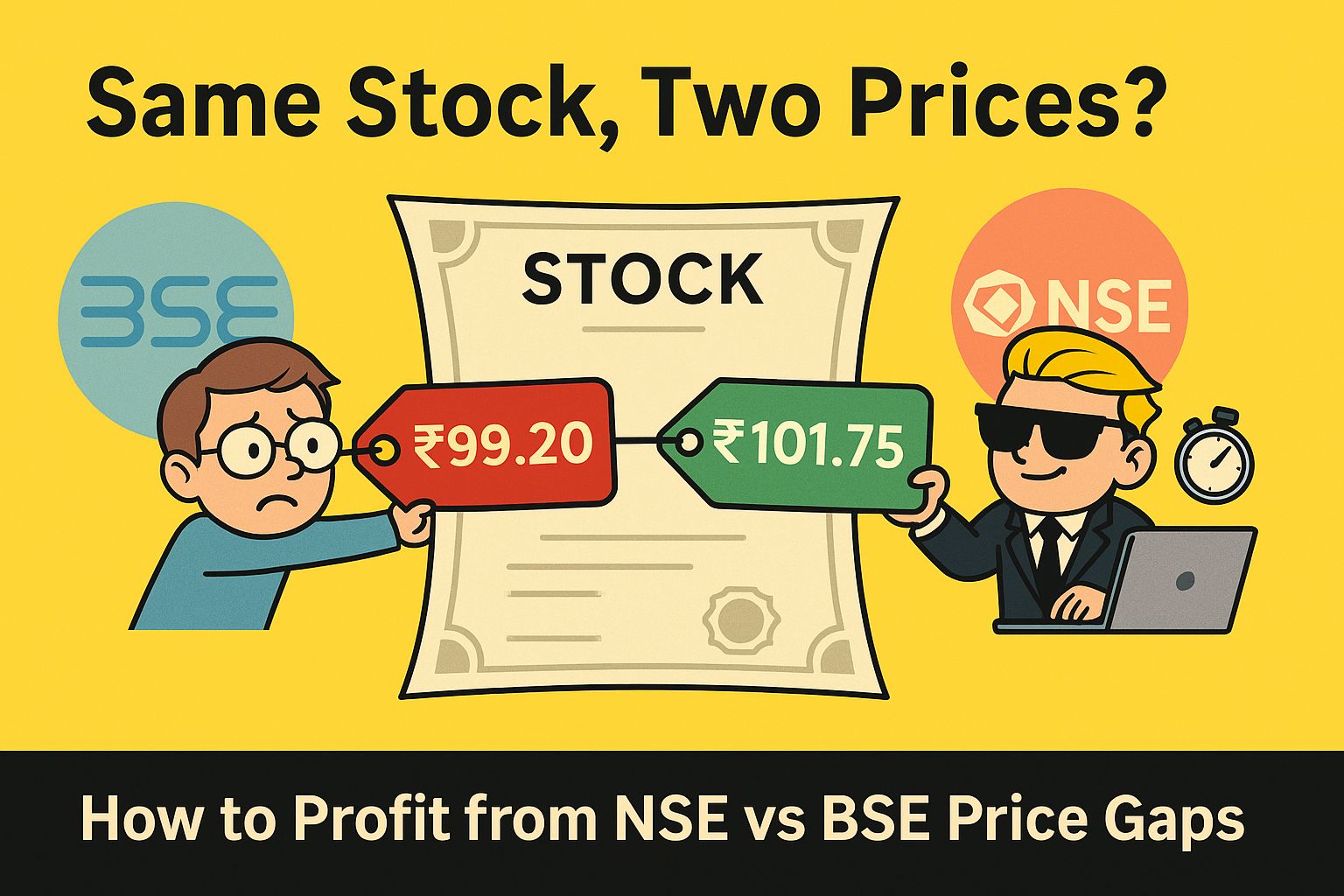
💸 One Stock, Two Prices? – How to Profit from This Exchange Drama 🎭
Date of Publishing -
Spotted a factual error — a wrong number, date, or fact? Tell us and we will check the source.
At a Glance
Yes, the same stock can have different prices on NSE and BSE – welcome to the Indian stock market, where even the same share suffers from an identity crisis depending on which exchange you ask. Here’s how it works, why it happens, and how clever traders (and bots) milk this difference like it’s a free buffet.
🧨 Introduction: Same Stock, Two Personalities?
Imagine this: Tata Motors is trading at ₹980 on NSE. Flip over to BSE – boom – it’s ₹978.
Wait. Aren’t both literally the same stock? Same company. Same ISIN. Same fundamentals.
Yes. But different demand-supply dynamics on different exchanges can lead to what’s called…
⚖️ Price Disparity Between Exchanges.
🧠 Why This Madness Happens
Here’s why a single stock trades at two different prices:
Liquidity Mismatch: NSE has ~90% of the volume. BSE? That introvert cousin who comes to weddings but doesn’t dance.
Order Book Gap: Market makers, algos, and retailers all place buy/sell orders. If one side is thicker on NSE vs BSE, prices diverge.
Latency Arbitrage: High-frequency traders capitalize on millisecond delays. They see the price on NSE tick up, rush to buy cheaper on BSE.
Round Lot Sizes: Some institutional orders execute only on NSE due to size constraints. This causes price shifts even for retail shares.
📉 Live Example Time: Tata Power (Hypothetical)
Exchange
Price
Volume
NSE
₹430.50
19,23,000
BSE
₹428.90
1,42,000
That’s a ₹1.60 difference. Small? Sure. But if you buy 1,000 shares and sell instantly on NSE? 💰 ₹1,600 in seconds. Minus charges = still biryani for the week.