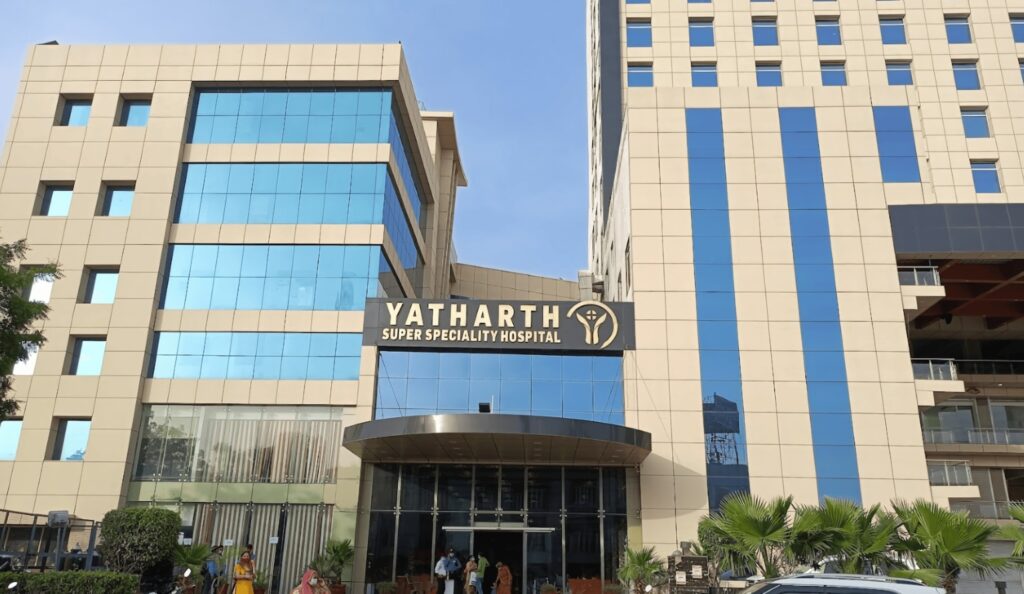
1. At a Glance – Blink and You’ll Miss the Growth
If hospitals were Bollywood movies, Yatharth would be that sleeper hit that suddenly starts minting money while critics are still arguing about the genre. Q3 FY26 numbers landed like a well-timed defibrillator shock: ₹320 Cr quarterly revenue (+46% YoY) and ₹43 Cr PAT (+49% YoY). Market cap is hovering around ₹6,240 Cr, stock price at ₹647, and the valuation multiple sits at a P/E of ~37x, which sounds expensive until you remember that most hospital stocks in India are priced like luxury real estate in South Delhi.
This is a debt-light hospital operator with 2,300+ beds, expanding aggressively via acquisitions and brownfield projects, while maintaining ~65% occupancy and an ARPOB of ~₹32,395. That’s not small-town nursing home money—that’s serious tertiary-care billing.
But here’s the twist: promoters have been trimming stake, QIPs have diluted equity, and expansion is happening at a pace that can either turn Yatharth into a regional healthcare king… or a very busy project manager with too many sites to supervise.
So the real question: Is this a disciplined growth story or just hospitals popping up faster than doctors can be hired? Let’s open the patient file.
2. Introduction – From NCR Specialist to North India Aspirant
Yatharth Hospital and Trauma Care Services started life in 2008 as a Delhi-NCR focused multi-specialty hospital operator. For years, it played a simple game: build hospitals where land is cheaper, competition is manageable, and patient volumes are steady. No fancy pan-India ambitions, no Instagram-friendly hospital lobbies—just beds, doctors, and billing.
Fast-forward to FY26, and the company now operates 7 hospitals across NCR, Uttar Pradesh, Haryana, Madhya Pradesh, and Delhi, with more on the way. It has shifted gears from organic growth to aggressive acquisitions—Model Town in Delhi, Faridabad, and most recently Shantived Hospital in Agra for ₹260 Cr in cash.
This is not the Apollo playbook. This is more like a regional consolidation strategy, buying stressed or under-managed assets, fixing operations, and plugging them into a centralised medical and procurement system.
The pitch is clear:
- Focus on IPD-heavy revenue (almost 89% of revenue)
- Stick to high-acuity specialties
- Keep capital efficiency reasonable (₹60–70 lakh per bed for brownfield expansions)
But hospital businesses are not spreadsheets—they are living organisms. Doctors churn, regulation bites, and ramp-ups take time. Which makes Yatharth’s current execution pace both impressive and slightly terrifying.
3. Business Model – WTF Do They Even Do?
Imagine explaining Yatharth to a lazy investor cousin at a wedding.
“They run hospitals. Proper ones. Not those 20-bed clinics with one orthopaedic surgeon and an ECG machine.”
Yatharth focuses on multi-specialty and super-specialty hospitals, with strengths in:
- Cardiology
- Oncology
- Neurosciences
- Nephrology & Urology
- Orthopaedics & Trauma
The business model is brutally simple:
- Acquire or build hospitals in under-served but dense catchments
- Drive IPD volumes (that’s where the money is)
- Push complex procedures rather than routine OPD consults
- Sweat the asset via higher occupancy and ARPOB
In Q1 FY26, IPD contributed ~88.8% of revenue, which tells you this is not a “blood test and go home” business. Average Length of Stay is ~4.1 days, and
